
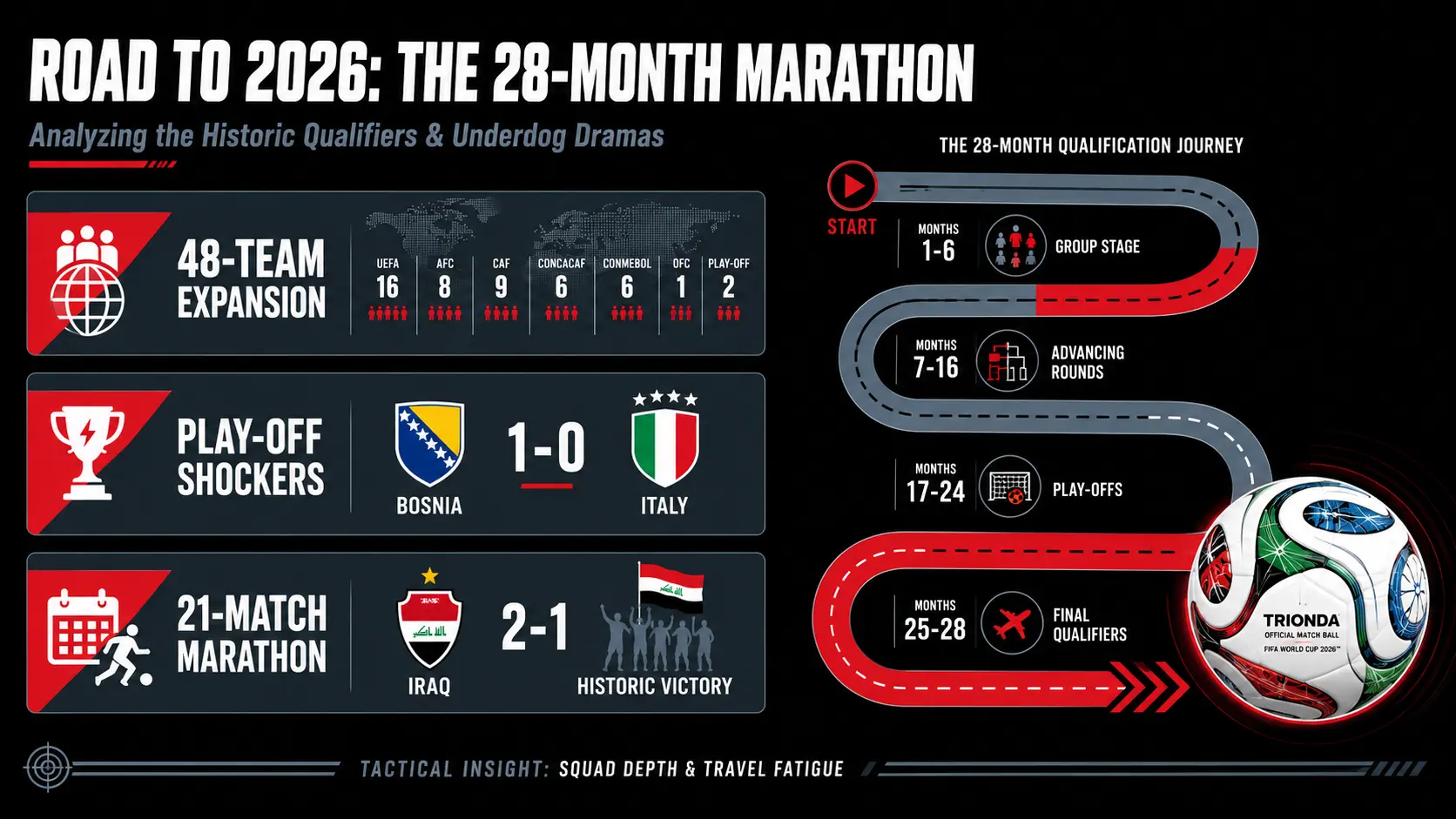
The 2026 FIFA World Cup is finally here, bringing the biggest tournament expansion in history. Expanding the grand stage to forty-eight nations broke the decade-long bottleneck that kept ambitious developing teams locked out of the finals. Under the reshaped format sanctioned by the FIFA Council, regional federations fought through a grueling 28-month world cup qualification marathon that wrapped up just as the summer kickoff approached. This retrospective untangles the historic slot allocation changes, recaps the most jaw-dropping stats, and celebrates the underdog debutants that redefined global football along the way.
The 2026 FIFA World Cup is about to kick off!
The grueling and intense qualification stages have officially drawn to a close, and the 48-nation line-up alongside the group stage brackets is fully finalized!
If you want to jump straight to “Every National Team’s Official 26-Man Roster & Squad Analysis”:
👉 Click here to explore: 2026 World Cup 48 Qualified Teams
If you want to dive deep into how these nations triumphed over 28 months of qualifying drama, keep reading our comprehensive recap below!
How the 2026 FIFA World Cup Redefined Global Representation with its New 48-Team Format?
The 2026 FIFA World Cup completely changes the calculus of international sports by widening the finals to forty-eight teams. This sweeping expansion directly expands global representation by ensuring regions that were previously underrepresented now have a genuine pathway to the ultimate stage. By lowering the draw barrier, this global tournament has transformed from an exclusive powerhouse club into a truly democratic festival of global football.
The FIFA Council Greenlights a Groundbreaking Slot Allocation Scheme
The FIFA Council officially approved the Slot Allocation Scheme to reshape the qualification baseline for each major continental body. This decision guaranteed that soccer growth in rising regions translates directly to guaranteed representation. This administrative framework acted as the absolute backbone of the modern world cup qualification system, shifting the competitive balance forever.
Analyzing the New Direct Slots Handed to the Six Continental Confederations
Six football confederations saw their guaranteed slots surge, shifting the competitive balance ahead of the upcoming finals. This complex redistribution process balanced historical power with geographical diversity. The final direct slot changes for CAF, UEFA, AFC, CONMEBOL, OFC, and CONCACAF settled into a brand new landscape:
| Confederation | Old Direct Slots | New Direct Slots (2026) | Direct Entry Increase |
|---|---|---|---|
| UEFA (Europe) | 13 | 16 | +3 |
| CAF (Africa) | 5 | 9 | +4 |
| AFC (Asia) | 4.5 | 8 | +3.5 |
| CONMEBOL (South America) | 4.5 | 6 | +1.5 |
| CONCACAF (North & Central America) | 3.5 | 6 (including 3 hosts) | +2.5 |
| OFC (Oceania) | 0.5 | 1 | +0.5 |
What Mind-Blowing Team and Player Statistics Defined the 28-Month Qualification Journey?
The wild 28-month world cup qualification grind is finally over, leaving behind a treasure trove of record-shattering statistics from 899 matches across the globe. Teams racked up an incredible 2,527 goals over the cycle, fueled by the aggressive attacking play demanded by the new format. From historic clean-sheet runs to individual scoring masterclasses, these numbers highlight the shifting balance of power in international football.
How Group Runners-up Advance to the Play-off Stage via Nations League Links
Group Runners-up faced a cutthroat battle to salvage their tournament dreams through the secondary Play-off Stage. Integrating these matches with the UEFA Nations League created a vital safety net for top-performing teams that slipped up during the regular group matches. This structural shift ensured that teams showing elite consistency across different competitions still had a shot at redemption.
Breaking Down the Most Iconic Individual Records and Top Scorers
Individual player statistics went off the charts as world-class forwards dominated regional qualifiers over the multi-year cycle. Norwegian phenom Erling Haaland put on a clinic, bagging 16 goals in just 8 matches to finish as the global qualifying king. Beyond Haaland’s dominance, a few other stellar individual campaigns stole the spotlight:
- Mohamed Amoura (Algeria): Led CAF scoring with 10 goals in 10 matches.
- Mohamed Salah (Egypt): Remained lethal, chipping in 9 crucial goals during the group stage.
- Viktor Gyökeres (Sweden): Kept his composure to score a brilliant 89th-minute winner against Poland in the playoffs.
How Ivory Coast Engineered an Unprecedented Defensive Masterclass Across Ten Games
The Ivory Coast national team pulled off a defensive miracle, completing their 10-match group stage with 25 goals scored and absolutely zero conceded. This historic defensive shutout represents the gold standard for the 2026 FIFA World Cup qualifying cycle. It proved that ironclad tactical discipline and backline resilience are just as vital as raw attacking firepower over a grueling multi-year campaign.
Which Historic Debutants Shook Up the Global Hierarchy as the Ultimate Underdog Stories?
Several historical debutants successfully tore up the traditional script to secure their first-ever places in the newly expanded 48-team bracket of the 2026 FIFA World Cup. These shock qualifications are the direct result of the expanded tournament format, proving that the gap between global powerhouses and rising nations has shrunk. Their arrival brings a thrilling wave of unpredictability to the upcoming main event.
Cabo Verde and Curaçao Defy Population and Size Limitations to Qualify
Cabo Verde and Curaçao shattered the myth that tiny population bases and limited land area block success in the modern world cup qualification cycle. Cabo Verde, a volcanic archipelago of just 520,000 people, topped Group D ahead of powerhouse Cameroon, unlocking a 10.5 million USD FIFA payout that will now go directly toward state-of-the-art youth academies. Not to be outdone, Curaçao—home to just 156,000 residents and covering only 444 square kilometers—officially qualified as the smallest country by both population and land area to ever reach the global finals.
How Jordan and Uzbekistan Lit a Central and Western Asian Football Fire
Jordan and Uzbekistan triggered a massive soccer wave across West and Central Asia by marching through incredibly demanding qualifying groups. Jordan played fearlessly to dominate their third-round matchups, while Uzbekistan became the first Central Asian country to secure a spot in the finals. Their breakthroughs reflect years of smart domestic league reforms and targeted infrastructure spending rather than simple luck.
Bosnia and Herzegovina stuns Italy to Deliver the Ultimate Play-off Shocker
Bosnia and Herzegovina pulled off the biggest shocker of the European cycle by sending four-time world champions Italy packing in a dramatic play-off final. After a grueling 120-minute battle ended in a tense 1-1 deadlock, Bosnia kept their nerves to win the penalty shootout 4-1. This historic defeat condemned Italy to missing an unprecedented third consecutive world tournament, showing just how cruel the single-elimination play-off format can be.
How the Intercontinental Play-offs Served Up Epic Drama to Settle the Last Spots?
The dramatic world cup qualification cycle reached its peak during the high-stakes Intercontinental Play-offs, where nations fought to the death for the final remaining berths. This unique mini-tournament threw completely different continental styles into single-elimination battles. It acted as the ultimate test of psychological grit and on-the-pitch execution, deciding which teams would join the 2026 FIFA World Cup party.
Iraq Concludes a Twenty-One Match Odyssey with an Extra-Time Thriller
Iraq survived an exhausting 21-match journey, securing their ticket to the main stage with a wild 2-1 extra-time win over South American representatives Bolivia. This long-haul campaign tested the endurance of the Iraqi team, forcing them to travel across continents and quickly adapt to brutal altitude changes. Their historic victory booked a long-awaited return to the world stage, validating their defensive tactical blueprint.
DR Congo Edges Jamaica to End a Fifty-Two Year Absence from the Finals
The Democratic Republic of Congo made history by beating Jamaica 1-0 in a high-pressure play-off final to reclaim their place among football’s elite. This clinical victory ended a painful 52-year absence for the Leopards, whose last appearance came in 1974. The historic triumph capped a wild campaign that included a nerve-shredding penalty shootout win over Nigeria in the CAF playoffs just to earn this intercontinental shot.
How Did the 28-Month Qualification Paths Settle Across the Six Confederations?
The massive world cup qualification cycle across six continents has officially wrapped up, locking in the final forty-eight teams for the highly anticipated 2026 FIFA World Cup. With the final whistle blown, fan attention has naturally shifted from weekly scoreboards to a static review of the completed qualification paths. To give you a clear look at this historic rearrangement, this section reviews the structural systems of the six confederations without drowning you in complex point standings.
Recapping the Diverse and Multi-Layered Paths of UEFA and CAF
The European and African paths relied on multi-layered tournament structures to test the consistency of the world’s most competitive teams. Under UEFA’s setup, 54 nations were split into 12 groups, sending the winners straight to the finals while runners-up joined forces with UEFA Nations League standouts for a wild 16-team playoff. Meanwhile, CAF went with a direct 9-group double round-robin, where group winners advanced directly, and the top runners-up entered a regional bracket to fight for an intercontinental ticket. Both systems successfully separated true quality from short-term form.
Summarizing the Breakthroughs Across the AFC CONMEBOL and OFC Paths
The Asian, South American, and Oceanian qualification systems produced major surprises under the brand-new 48-team allocation model. The AFC’s expanded 8.5 slots led to an intense multi-round format that allowed rising Middle Eastern and Central Asian powers to shine during the third and fourth rounds. CONMEBOL maintained its legendary 10-team double round-robin league, sending the top six straight to the tournament and the seventh-place team to the intercontinental playoffs. Finally, the OFC celebrated a historic milestone as New Zealand secured the region’s first-ever direct ticket, ending Oceania’s long history of playing high-pressure play-offs.
Standing on the Eve of a Brand New Global Football Era
This grueling 28-month qualifying cycle proves that international soccer is moving toward a highly diverse, multi-polar era under the new format. The dramatic collapse of giants like Italy and the rise of underdogs like Cabo Verde and Uzbekistan show that reputation alone no longer guarantees a spot on the grandest stage. With forty-eight hard-tested squads officially locked in, the largest and most balanced world tournament in history is ready to kick off, turning this qualifiers retrospective into the first chapter of a legendary saga.
FAQ
How to qualify for the 2026 World Cup in Africa?
To qualify for the 2026 World Cup in Africa, national teams had to navigate a competitive group stage organized by CAF. The continent was divided into nine qualifying groups of six teams each, with matches played in a round-robin format. The nine group winners earned direct qualification to the finals, while the four best group runners-up advanced to a CAF play-off tournament, with the eventual winner booking a spot in the Intercontinental Play-offs.
Which African countries have already qualified for the World Cup?
The African nations that successfully secured direct qualification to the tournament include established powerhouses alongside historic debutants. Giants such as Egypt and Morocco demonstrated immense consistency to top their respective groups early in the campaign. They are joined by the sensational debutants Cabo Verde, who shocked the continent by winning Group D, and the Democratic Republic of Congo, who qualified via the Intercontinental Play-offs.
What African Teams Are Currently Competing in the World Cup Playoffs?
The African teams that competed in the high-stakes CAF play-off tournament included several highly competitive runners-up looking for a final chance. This mini-tournament featured DR Congo, Nigeria, and other top-tier group runners-up. Ultimately, DR Congo defeated Nigeria in a thrilling penalty shootout during the CAF play-off final to represent Africa in the Intercontinental Play-offs, where they eventually defeated Jamaica to qualify.
How Many Outstanding African Teams Can Qualify for the FIFA Club World Cup?
Four outstanding African club teams are eligible to qualify for the expanded FIFA Club World Cup under the current allocation system. This club-level tournament is distinct from the national team tournament, but it draws heavily on the continental success of teams competing in the CAF Champions League. It represents another major avenue for African football to showcase its talent on the global club stage.
How Far Has a Successful African Country Ever Gone in the World Cup?
The furthest a successful African nation has ever gone in the tournament is the semi-final stage. Morocco achieved this historic milestone during the 2022 tournament in Qatar, defeating powerhouse teams like Spain and Portugal before being eliminated. This breakthrough shattered the previous quarter-final ceiling that had been reached by Cameroon (1990), Senegal (2002), and Ghana (2010).
References
- UEFA Scores & Fixtures | FIFA World Cup 26™ Qualifiers (FIFA)
- 2026 FIFA World Cup qualification – Wikipedia (Wikipedia)