
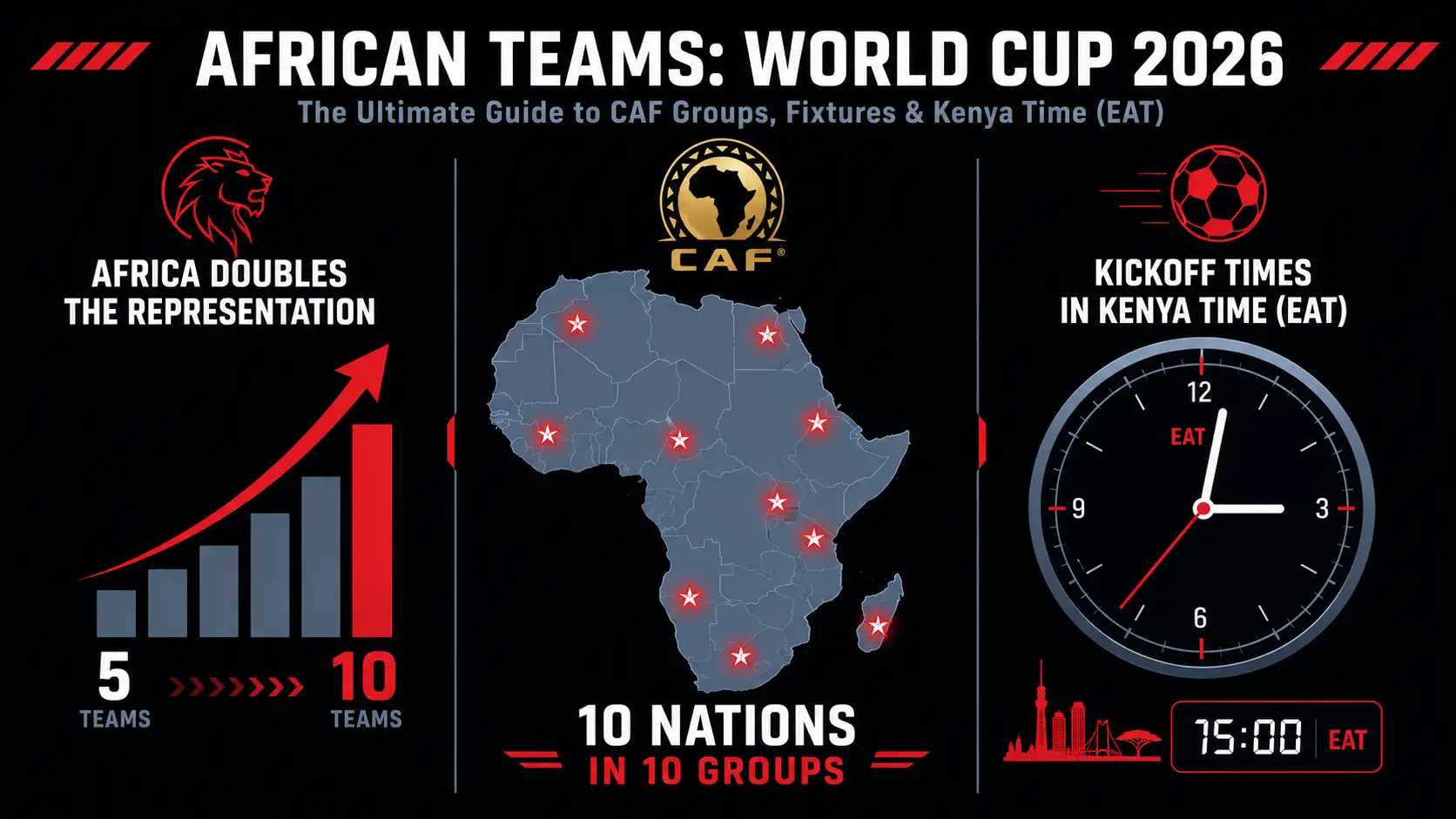
African teams in World Cup 2026 are entering the tournament with a record 10 CAF representatives, giving Kenya and the wider African audience more teams, fixtures and storylines to follow than any previous FIFA World Cup. The qualified African countries are Algeria, Cabo Verde, Congo DR, Côte d’Ivoire, Egypt, Ghana, Morocco, Senegal, South Africa and Tunisia. This guide explains which African countries qualified for World Cup 2026, how CAF’s allocation expanded from five teams in 2022 to 10 teams in 2026, and why Congo DR’s play-off route made Africa’s final place especially important. Instead of turning this page into a full qualifiers breakdown, the article focuses on the confirmed CAF teams, direct qualifiers, play-off qualifier, group opponents and first fixtures in Kenya time. For readers in Kenya, the key value is practical: you can quickly see which African teams are playing, which groups they are in, when their opening matches start in East Africa Time, and how the 48-team format gives African teams a better chance to reach the knockout stage.
To continue planning your tournament experience, visit our FIFA 2026 navigation hub for schedules, groups, standings, team lists, news, and other essential World Cup resources.
African teams in World Cup 2026 confirmed
African teams in World Cup 2026 are confirmed as 10 CAF representatives, making African teams in World Cup 2026 a major tournament topic for fans across Kenya and the wider continent. The confirmed African teams are Algeria, Cabo Verde, Congo DR, Côte d’Ivoire, Egypt, Ghana, Morocco, Senegal, South Africa and Tunisia, and the official group structure places those teams across Groups A, C, E, F, G, H, I, J, K and L.
Which African countries qualified
African countries qualified for World Cup 2026 through CAF’s expanded route and final play-off pathway. The full list is Algeria, Cabo Verde, Congo DR, Côte d’Ivoire, Egypt, Ghana, Morocco, Senegal, South Africa and Tunisia.
For readers in Kenya, the most important point is simple: Kenya did not qualify, but Africa has more representation than ever. This makes the tournament more relevant across the continent, especially because the group stage contains CAF teams in 10 different groups.
World Cup qualifiers Africa groups 2026 and the final CAF teams
World Cup qualifiers Africa groups 2026 is a common search because many fans want to know which African teams came through qualifying and then entered the World Cup group stage. The final CAF teams at World Cup 2026 are Algeria, Cabo Verde, Congo DR, Côte d’Ivoire, Egypt, Ghana, Morocco, Senegal, South Africa and Tunisia.
In this guide, the focus is not the full qualifying table. The focus is the final result of those CAF qualifiers: which African countries reached the 2026 FIFA World Cup, which groups they joined, and when their first matches start in Kenya time.
Full CAF teams list
CAF teams World Cup 2026 list includes teams from North Africa, West Africa, Southern Africa and Central Africa. This spread gives the tournament a stronger pan-African feel than 2022, when only five African teams reached the finals.
| CAF Team | Region | 2026 World Cup Status | Key Note |
|---|---|---|---|
| Algeria | North Africa | Qualified | Group J with Argentina, Austria and Jordan |
| Cabo Verde | West Africa | Qualified | First World Cup appearance |
| Congo DR | Central Africa | Qualified | Returned through the play-off route |
| Côte d’Ivoire | West Africa | Qualified | Group E with Germany, Curaçao and Ecuador |
| Egypt | North Africa | Qualified | Group G with Belgium, IR Iran and New Zealand |
| Ghana | West Africa | Qualified | Group L with England, Croatia and Panama |
| Morocco | North Africa | Qualified | Group C with Brazil, Haiti and Scotland |
| Senegal | West Africa | Qualified | Group I with France, Iraq and Norway |
| South Africa | Southern Africa | Qualified | Opening match against Mexico |
| Tunisia | North Africa | Qualified | Group F with Netherlands, Japan and Sweden |
Why 2026 is historic for Africa
World Cup 2026 is historic for Africa because CAF has 10 representatives at the finals for the first time. This jump changes the tone of the tournament from “which African team can survive the group” to “how many African teams can reach the knockout stage.”
For a Kenya-facing article, this is the strongest emotional hook: African football is not just participating in 2026; African football is occupying more space in the tournament structure. That is the clearest difference from the 2022 edition.
CAF teams gain record World Cup places
African teams in World Cup 2026 gained record World Cup places because FIFA expanded the tournament from 32 teams to 48 teams, creating the main official reason behind the growth of African teams in World Cup 2026. CAF’s route gave Africa nine direct places, while Congo DR added the 10th African place through the FIFA Play-Off Tournament route.
Africa rises from five to ten teams
Africa rises from five to ten teams between World Cup 2022 and World Cup 2026. This is the cleanest comparison for readers who want to understand what changed without reading a full qualification guide.
The practical difference is huge. In 2022, Africa sent Morocco, Senegal, Ghana, Tunisia and Cameroon. In 2026, Africa sends 10 teams, meaning the continent doubled its presence and now covers almost every major football region on the continent.
Nine direct spots and one playoff path
CAF received nine direct World Cup 2026 places and one additional play-off route. This structure means most African teams qualified by winning their qualifying group, while one extra team had to survive a longer path.
The clean way to explain it is:
- Nine African teams qualified directly as CAF group winners.
- Four best runners-up entered the African play-offs.
- The African play-off winner moved into the FIFA Play-Off Tournament.
- Congo DR won the final route and became Africa’s 10th team.
How expansion changed CAF allocation
World Cup expansion changed CAF allocation by turning Africa from a five-team confederation at the finals into a 10-team confederation at the 2026 tournament. This matters because Africa now has more group-stage matches, more knockout-stage possibilities and more national fan bases with a direct reason to follow the tournament.
For a Kenya audience, this also makes schedule coverage more useful. Even without Kenya in the finals, East African readers can follow continental storylines across South Africa, Ghana, Senegal, Morocco, Egypt and Congo DR.
CAF explains Africa’s qualification route
African teams in World Cup 2026 reached the tournament through a CAF qualification route that selected nine direct winners and one final play-off qualifier, so African teams in World Cup 2026 should not be explained as one single type of qualification. This route belongs in this article as a short context section, while the detailed match-by-match qualifying story should sit in a separate CAF qualifiers guide.
What CAF means in football
CAF means Confederation of African Football in football. This organisation governs African international competitions and manages Africa’s qualification route for the FIFA World Cup.
In simple terms, CAF is the African football authority that connects national teams such as Morocco, Senegal, Egypt, Ghana, South Africa and Tunisia to FIFA’s global tournament structure. That definition should appear early because many searchers use “CAF teams” without fully knowing the organisation’s formal name.
How African places were decided
African World Cup 2026 places were decided through group winners and a final play-off pathway. The direct route produced nine qualified teams, while the longer route produced Congo DR as the final African representative.
This section stays short because the main purpose of this page is the confirmed African teams, groups and fixtures. The purpose here is only to explain why the list has nine direct qualifiers plus Congo DR, not to rebuild the full qualification timeline.
Where to read the full qualifiers guide
The full CAF World Cup qualifiers guide should explain the complete African qualification format, group tables, best runners-up and play-off sequence. Readers who want the deeper route should continue to a dedicated World Cup 2026 CAF Qualifiers Guide covering group winners, the play-off path and the final qualification table.
African teams qualified through two routes
African teams in World Cup 2026 qualified through two routes, which is why the African teams in World Cup 2026 list should be divided into direct qualifiers and the play-off qualifier. This classification helps readers understand why Congo DR’s path is different from Morocco, Senegal, Egypt or Ghana.
Nine teams qualified directly
Nine African teams qualified directly by winning their CAF qualifying groups. The direct qualifiers are Algeria, Cabo Verde, Côte d’Ivoire, Egypt, Ghana, Morocco, Senegal, South Africa and Tunisia.
This group is the backbone of Africa’s 2026 presence. Morocco brings the strongest recent World Cup storyline after reaching the 2022 semi-finals, Senegal carries major continental expectations, and Ghana, Egypt and Côte d’Ivoire give the tournament familiar African names with large fan bases.
Congo DR earned the final place
Congo DR, also known as DR Congo, earned the final African World Cup 2026 place through the play-off route. The Leopards defeated Jamaica 1-0 after extra time in the FIFA Play-Off Tournament, completing Africa’s record 10-team line-up and ending a 52-year wait to return to the World Cup.
This is one of the strongest story angles in the article. Congo DR is not just another name in the list; it represents Africa’s extra place, the value of the new format and a major return to the World Cup stage.
Nigeria Cameroon and Gabon missed out
Nigeria, Cameroon and Gabon entered the African play-off conversation but missed out on World Cup 2026 qualification. This detail matters because many African fans will search for Nigeria and Cameroon when checking the final CAF list.
The best way to handle this is to answer the confusion directly: Nigeria and Cameroon were involved in the play-off route, but Congo DR became the African team that advanced to the final tournament. That prevents readers from assuming those bigger-name teams qualified.
African teams groups and fixtures in Kenya time
African teams in World Cup 2026 are spread across Groups A, C, E, F, G, H, I, J, K and L, so African teams in World Cup 2026 fixtures matter almost every day of the early group stage. Kenya-based readers should read every time below as East Africa Time, and they should recheck the official fixtures page before matchday because international schedules can still be updated.
Group opponents for every CAF team
African teams World Cup 2026 groups place each CAF representative in a different tactical and travel context. The group list below is the functional core of this article because it answers the user’s practical question immediately.
| African Team | Group | Group Opponents |
|---|---|---|
| South Africa | Group A | Mexico, Korea Republic, Czechia |
| Morocco | Group C | Brazil, Haiti, Scotland |
| Côte d’Ivoire | Group E | Germany, Curaçao, Ecuador |
| Tunisia | Group F | Netherlands, Japan, Sweden |
| Egypt | Group G | Belgium, IR Iran, New Zealand |
| Cabo Verde | Group H | Spain, Saudi Arabia, Uruguay |
| Senegal | Group I | France, Iraq, Norway |
| Algeria | Group J | Argentina, Austria, Jordan |
| Congo DR | Group K | Portugal, Uzbekistan, Colombia |
| Ghana | Group L | England, Croatia, Panama |
First matches and stadiums
African teams World Cup 2026 first matches create the opening watchlist for Kenya-based fans. The Kenya times below convert the listed match windows into East Africa Time, making the table easier to use for readers in Nairobi, Mombasa, Kisumu and across Kenya.
| African Team | First Match | Venue | Kenya Time |
|---|---|---|---|
| South Africa | Mexico vs South Africa | Mexico City Stadium | 11 June, 22:00 EAT |
| Morocco | Brazil vs Morocco | New York New Jersey Stadium | 14 June, 01:00 EAT |
| Côte d’Ivoire | Côte d’Ivoire vs Ecuador | Philadelphia Stadium | 15 June, 02:00 EAT |
| Tunisia | Sweden vs Tunisia | Monterrey Stadium | 15 June, 05:00 EAT |
| Cabo Verde | Spain vs Cabo Verde | Atlanta Stadium | 15 June, 19:00 EAT |
| Egypt | Belgium vs Egypt | Seattle Stadium | 15 June, 22:00 EAT |
| Senegal | France vs Senegal | New York New Jersey Stadium | 16 June, 22:00 EAT |
| Algeria | Argentina vs Algeria | Kansas City Stadium | 17 June, 04:00 EAT |
| Congo DR | Portugal vs Congo DR | Houston Stadium | 17 June, 20:00 EAT |
| Ghana | Ghana vs Panama | Toronto Stadium | 18 June, 02:00 EAT |
Kenya time conversions above should be checked against FIFA’s live scores and fixtures page before publication or on matchday, because broadcaster pages and local listings may display different time-zone defaults. FIFA’s official fixtures page remains the safest source for final updates.
Kickoff times in EAT
Kickoff times in EAT are essential for Kenyan readers because North American match windows often fall late at night or early in the morning in East Africa. The easiest editorial rule is to publish the main table in Kenya time first, then mention local stadium time only when necessary.
For quick conversion and editorial consistency, use this rule:
- Kenya uses East Africa Time.
- Most ET broadcast windows convert to EAT by adding seven hours during the tournament period.
- Some host-city local times may differ from ET, so always label the final table as EAT.
- Every schedule table should be rechecked before matchday because official fixtures may still be updated.
For site navigation, this section can naturally link to your World Cup 2026 schedule, groups, standings, live scores and match preview pages.
World Cup 2026 format gives Africa more chances
African teams in World Cup 2026 have more chances because the 48-team format gives African teams in World Cup 2026 more places and a wider Round of 32 pathway. FIFA’s format uses 12 groups of four, with the top two teams in each group and the eight best third-placed teams advancing.
Twelve groups change the path
Twelve groups change the path because African teams are no longer concentrated into a smaller 32-team structure. This gives CAF teams more separate routes to compete, collect points and avoid being measured against only one brutal group scenario.
For example, Morocco’s Group C route is not the same as Ghana’s Group L route or South Africa’s Group A route. That makes the article stronger when each African team is treated as part of a group-specific storyline rather than a single continental block.
Best third placed teams can advance
Best third placed teams can advance in World Cup 2026 because the Round of 32 includes eight third-place finishers. This rule gives African teams a second realistic path if they finish behind two strong opponents but still collect enough points and goal difference.
The practical meaning is clear: one win and one draw may become very valuable. That changes how readers should understand matches involving teams such as Tunisia, Côte d’Ivoire, Cabo Verde and Congo DR, especially in difficult groups.
Why African teams have more room
African teams have more room in World Cup 2026 because the tournament rewards both direct group performance and strong third-place results. This is why the expanded format is not just a bigger list of teams; it is a structural opportunity for CAF teams to reach the knockout stage.
From a Kenya editorial angle, the best conclusion is balanced optimism. Africa has more teams, more matches and more paths forward, but the group draw still matters because several CAF teams face former champions or top-ranked opponents immediately.
FAQ
FAQ answers about African teams in World Cup 2026 should resolve the most common search confusion quickly. These answers stay short enough for featured snippets but specific enough to support the article’s main entity.
Is Club World Cup 2026 the same as World Cup 2026?
Club World Cup and FIFA World Cup are different tournaments. This guide focuses on African national teams at the FIFA World Cup 2026, including Algeria, Cabo Verde, Congo DR, Côte d’Ivoire, Egypt, Ghana, Morocco, Senegal, South Africa and Tunisia.
Which teams came from the World Cup qualifiers Africa groups 2026?
The teams that came from the World Cup qualifiers Africa groups 2026 and reached the final tournament are Algeria, Cabo Verde, Congo DR, Côte d’Ivoire, Egypt, Ghana, Morocco, Senegal, South Africa and Tunisia. These are the 10 CAF teams at the 2026 FIFA World Cup.
How many African teams are in the World Cup?
African teams in World Cup 2026 total 10 national teams. This is a record for CAF and doubles Africa’s representation compared with the five African teams at World Cup 2022.
What African teams are in the World Cup playoffs?
African teams in the World Cup play-off route included Nigeria, Cameroon, Congo DR and Gabon at the CAF play-off stage. Congo DR became the African team that completed the route and qualified for the final tournament.
How does Africa World Cup qualifying work?
Africa World Cup qualifying works through CAF group qualification and a play-off route. In 2026, nine African teams qualified directly, while Congo DR secured the additional African place through the FIFA Play-Off Tournament route.
What does CAF stand for?
CAF stands for Confederation of African Football. CAF is the football governing body responsible for Africa’s World Cup qualification pathway and continental competitions.
References
- Qualified teams for the FIFA World Cup 2026 (FIFA)
- Record 10 African teams to feature at 2026 World Cup (CAF)
- Everything you need to know about African qualifying (FIFA)
- Everything you need to know about 2026 World Cup qualifying for Africa (CAF)
- African play-offs | World Cup qualifying (FIFA)
- Congo DR 1-0 Jamaica (aet) | FIFA World Cup 2026 Play-Off Tournament (FIFA)
- DR Congo end 52-year World Cup wait with extra-time victory over Jamaica (CAF)
- How the FIFA World Cup 26™ will work with 48 teams (FIFA)
- World Cup 2026 groups: How teams qualify and tie-breakers (FIFA)
- Final Draw results | FIFA World Cup 2026 (FIFA)
- World Cup 2026 | Match schedule, fixtures & stadiums (FIFA)
- Updated FIFA World Cup 2026™ match schedule reveals venues and kick-off times for all 104 matches (Inside FIFA)
- FIFA World Cup 2026 Match Schedule PDF (FIFA Digital Hub)