
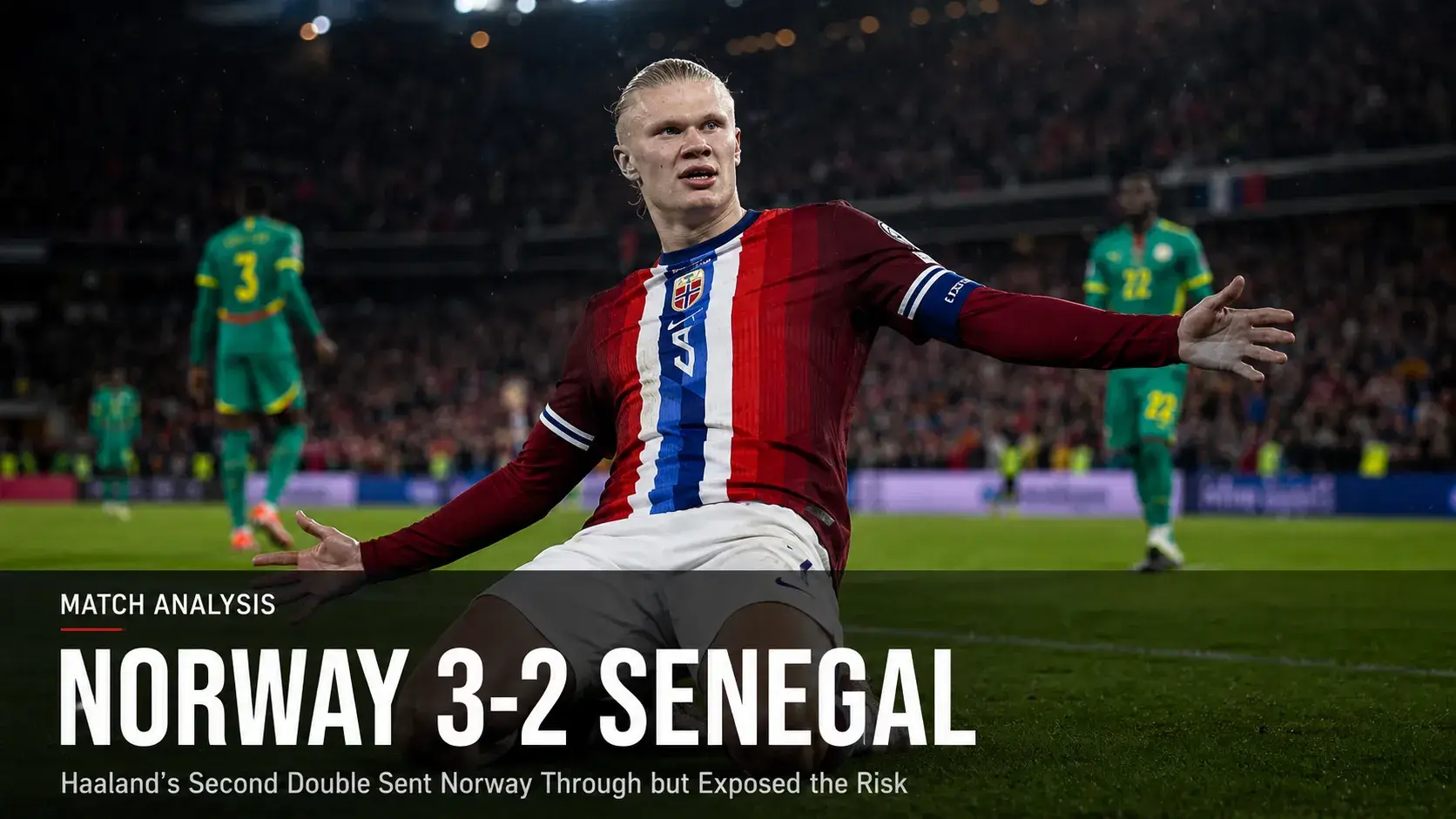
How Norway Secured Round of 32 Qualification Despite Late Senegal Pressure
Norway secured their Round of 32 place through Marcus Pedersen’s first-half opener and Erling Haaland’s clinical second-half double, though Ismaila Sarr’s late brace exposed defensive frailties that made the conclusion unnecessarily tense. Pedersen’s strike before halftime capitalized on early space created by Solbakken’s direct approach against Senegal’s high defensive line, establishing a platform that allowed Norway to control the tempo before the break.
Haaland’s two goals after the interval demonstrated the Manchester City striker’s tournament dominance, taking his tally to four goals in two matches through intelligent movement off Martin Ødegaard’s vertical service. The forward’s first finish exploited gaps in Senegal’s reorganizing defense, while his second showcased the ruthless efficiency that has defined Norway’s campaign, though the team created fewer clear chances than the 3-2 scoreline suggests.
Sarr’s stoppage-time finish and earlier strike turned a comfortable 3-0 advantage into a nervy conclusion that highlighted structural weaknesses first evident in Norway’s opening 4-1 victory over Iraq. Senegal’s two goals exposed the same defensive fragility that the scoreline against Iraq had masked, turning what appeared a straightforward victory into a warning sign that individual brilliance at one end cannot permanently mask organizational issues at the other.
Tactical Breakdown: Solbakken’s Vertical Efficiency vs Thiaw’s Aggressive Transitions
Solbakken’s direct vertical approach proved more decisive than Pape Thiaw’s transition-based system, converting limited opportunities with greater efficiency despite Senegal matching Norway’s intensity for extended periods. Norway’s attacking structure relied on rapid vertical progression through Ødegaard’s distribution, bypassing midfield buildup to feed Haaland’s runs in behind the defense, a system that maximized the captain’s creative range while minimizing defensive exposure.
Senegal employed an aggressive transition approach that generated numerous counter-attacking opportunities through Sarr and the wide areas, repeatedly testing Norway’s backline with pace and direct running. The African side created significant chances during open play and maintained pressure through sustained periods, yet struggled to maintain defensive organization during Norway’s quick combinations in the final third.
Goal-scoring efficiency represented the decisive tactical difference between the sides, as Senegal’s individual errors and poor marking at key moments proved costlier than Norway’s more economical attacking display. While Thiaw’s system produced goals and late pressure that nearly salvaged a point, the absence of defensive concentration during transitions allowed Norway to exploit space that a more organized unit might have closed, ultimately separating the two sides despite comparable effort levels.
Group I Standings and Kenya Time Schedule for Decisive Final Matches
Norway’s six points and +4 goal difference guarantee a top-three finish and Round of 32 qualification, setting up a winner-takes-first-place clash with France that will determine knockout bracket positioning. The result against Senegal secures Norway’s place in the expanded 48-team tournament’s knockout phase regardless of the final group match outcome, though Solbakken will demand improved defensive solidity before facing stronger opposition that will punish similar lapses.
Senegal remain on zero points with a -3 goal difference, requiring victory against Iraq in their final match and a significant goal swing to challenge for one of the four best third-place spots available in the new format. The defeat leaves Pape Thiaw’s side facing elimination unless they can secure three points and overturn their negative goal difference, a scenario that demands both offensive productivity and defensive discipline against an Iraqi side also seeking their first points.
East African fans should consult the full World Cup 2026 schedule in Kenya Time (EAT, UTC+3) to catch the simultaneous Group I finales, as Norway versus France and Senegal versus Iraq will kick off at identical times to preserve competitive integrity. These simultaneous fixtures ensure no team gains an advantage by knowing specific result requirements beforehand, adding tension to what will be a decisive final matchday for both African and European representatives in the tournament.