
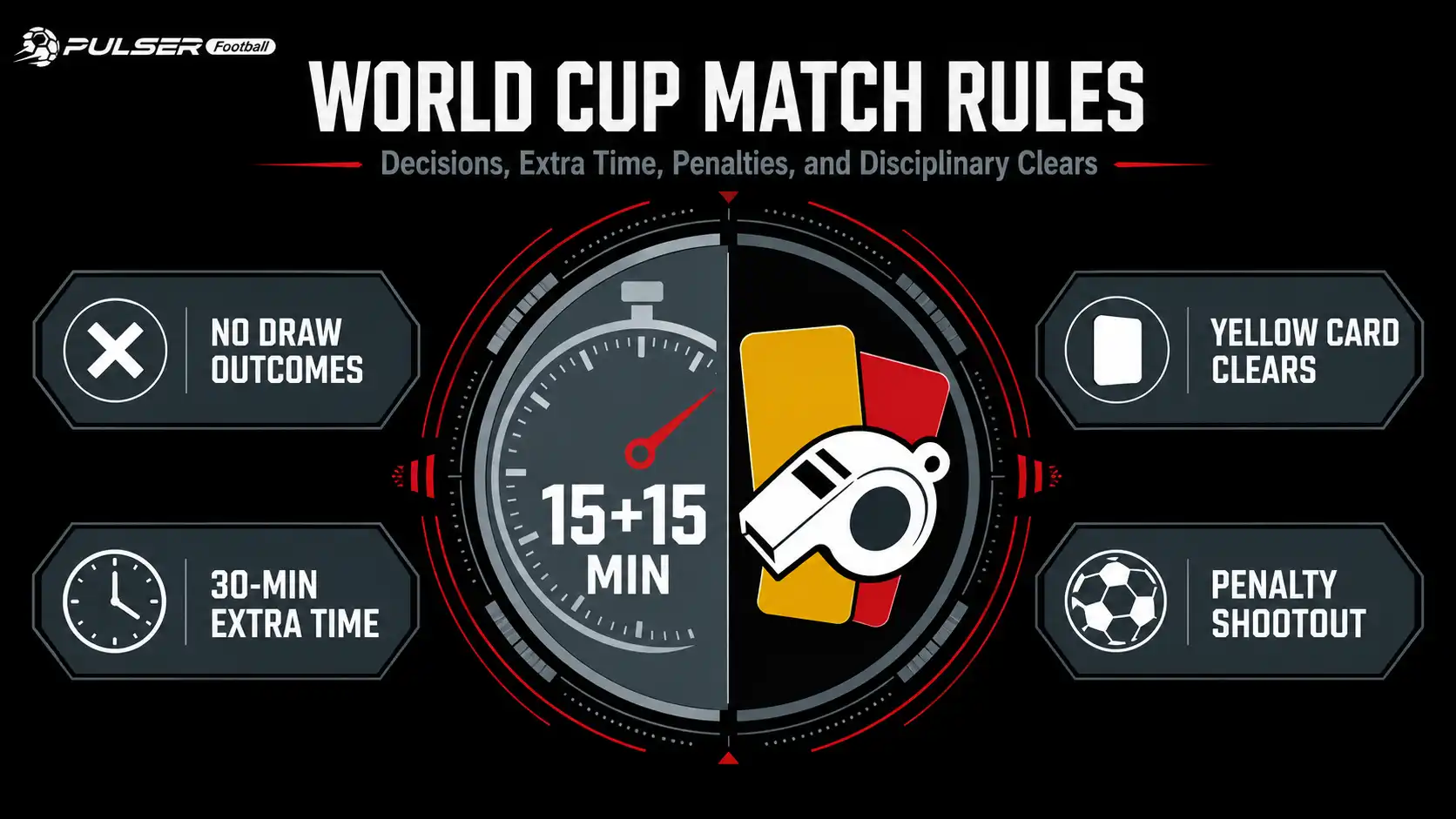
When Yellow Cards Are Cleared at the 2026 World Cup
FIFA regulations for the 2026 tournament establish that accumulated yellow cards clear following the conclusion of specific early knockout phases, typically occurring before the semi-final stage. This regulatory mechanism ensures that players advancing to the decisive latter rounds of the competition do not carry minor disciplinary marks accumulated during group-stage fixtures or initial elimination matches, maintaining competitive integrity in the final phases.
The expansion to 48 teams and the inclusion of a Round of 32 extends the accumulation period significantly compared to the 32-team format used in previous editions. Players must now navigate three group matches plus a potential Round of 32 appearance—representing up to four fixtures—before the caution slate wipes clean, substantially increasing the risk of hitting suspension thresholds during the opening phases of the knockout bracket.
World Cup 2026 knockout stage guide
Tournament regulations explicitly distinguish between the clearing of accumulated cautions and the serving of triggered suspensions. While the slate of yellow cards resets to zero for surviving players at designated milestones, any ban earned through accumulation in earlier rounds remains on the player’s record until served, meaning a suspended player misses the next match even if the reset occurs between the offense and the scheduled fixture.
The reset system serves to balance disciplinary accountability with competitive fairness, ensuring that players are not unduly penalized for minor infractions committed early in a tournament that spans more than a month. By clearing cautions before the semi-final stage, FIFA allows teams to field their strongest available lineups during the most critical matches, provided those players have not already triggered suspensions through accumulation.
How Yellow Card Accumulation Works in the 48-Team Format
Accumulated cautions operate as a cross-match tally where each yellow card received in separate fixtures counts toward a specific disciplinary threshold. Once a player receives cautions in two distinct matches during the designated accumulation window, FIFA regulations mandate an automatic one-match suspension that the player must serve in their team’s next outing, irrespective of whether the tournament’s general reset schedule intervenes between the triggering offense and the ban.
Second yellow cards issued within the same fixture result in immediate expulsion from the pitch and carry an automatic one-match ban for the following game. This single-match dismissal operates under a separate administrative track from the cross-match accumulation system and does not contribute to the multi-game caution tally used to track persistent infringement across different matches, effectively treating the dismissal as a distinct disciplinary category.
Direct red cards issued for serious foul play, violent conduct, or denial of obvious goal-scoring opportunities trigger mandatory suspensions determined by the FIFA Disciplinary Committee on a case-by-case basis. These sanctions exist entirely outside the yellow-card accumulation framework and remain completely unaffected by the tournament’s scheduled reset points for accumulated cautions, often carrying heavier bans than those triggered by yellow-card accumulation.
Squad rotation strategies become essential management tools for coaches navigating the extended accumulation window. A player carrying a yellow card from the group stage into the Round of 32 faces heightened pressure to avoid a second caution that would trigger a quarter-final absence, forcing managers to balance competitive needs against the risk of losing key personnel for subsequent matches.
Coaches must track individual player tallies carefully across the group stage and Round of 32, as the expanded format means a player cautioned in the opening match and again in the Round of 32 will miss the following fixture. This extended window requires more sophisticated squad management than in previous tournaments, where the reset typically occurred earlier in the knockout phase.
What Kenya Fans Should Know About Tracking Discipline
Supporters watching matches in East Africa Time (EAT, UTC+3) should closely monitor their team’s progression through the 12-group format and the Round of 32, as these initial knockout fixtures represent the final opportunities for key players to hit accumulation thresholds before any potential caution reset occurs later in the bracket.
The expanded 2026 format creates a longer path to the reset point than previous 32-team tournaments, meaning teams contest more elimination matches where cautions count toward pre-reset accumulation. This structure makes discipline management particularly critical for African nations and other sides aiming for deep runs into the quarter-finals and beyond, as a single mistimed challenge in the Round of 32 could sideline a star player for a quarter-final appearance while the team still navigates the accumulation period.
Kickoff times across the three host nations—United States, Canada, and Mexico—translate to various morning and afternoon slots in Nairobi and Mombasa time zones. Fans tracking whether suspended players will miss afternoon fixtures in East Africa should consult the full World Cup 2026 schedule in Kenya Time to align their viewing plans with confirmed team news regarding disciplinary absences.
Verification of suspension status should always occur through official channels rather than unofficial social media lists. FIFA releases definitive disciplinary updates after each matchday, and predicting referee decisions or publishing unverified suspension tables risks spreading misinformation about player availability that could mislead fans planning to watch specific fixtures.
Social media speculation often confuses the timing of card resets with the serving of suspensions, leading to false claims about player availability for crucial matches. Kenyan fans should bookmark the Pulser FIFA hub for real-time updates rather than relying on viral posts that may conflate accumulation thresholds with reset dates or incorrectly predict disciplinary outcomes.
FAQ
At what specific stage are yellow cards cleared in the 2026 World Cup?
FIFA regulations specify that accumulated yellow cards are cleared after designated knockout rounds, typically before the semi-final stage. In the expanded 48-team format, this reset occurs following the early elimination phases. Check the official Pulser FIFA hub for the exact matchday confirmation once FIFA releases the final disciplinary regulations.
Does a second yellow card in the same match count toward the cross-match accumulation total?
No. A second yellow card received in a single match results in immediate expulsion and an automatic one-match suspension for the next game, but it does not add to the accumulation tally that spans multiple matches. The two systems—single-match dismissal and cross-match accumulation—are tracked separately.
If yellow cards are cleared after the quarter-finals, does that cancel a suspension earned in the Round of 32?
No. Once a player accumulates enough yellow cards to trigger a suspension, that ban must be served in the team’s next match even if a general card reset occurs in between. The clearing of yellow cards only affects future cautions, not suspensions that have already been earned.
Reference
- FIFA World Cup 26™ Regulations (Article 10)