
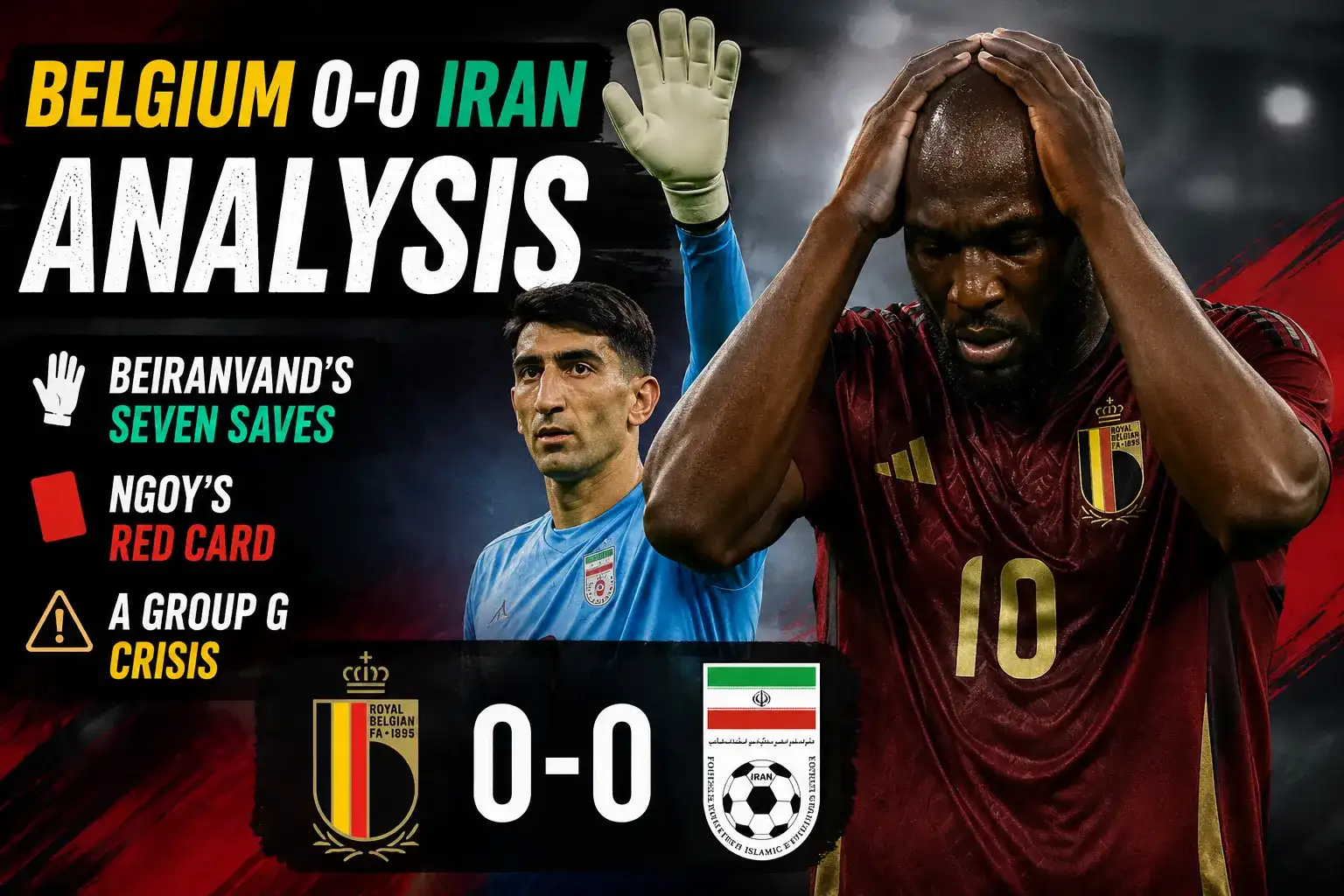
Beiranvand’s Seven Saves and Iran’s Defensive Wall: How Belgium’s Attack Was Neutralised
Alireza Beiranvand’s seven saves and Iran’s disciplined defensive structure proved decisive in nullifying Belgium’s territorial dominance at the 2026 World Cup. The Iranian goalkeeper produced a match-defining performance that included a stunning point-blank denial of Maxim De Cuyper during a second-half scramble, alongside six other stops that prevented Belgium from converting sustained pressure into goals. Beiranvand demonstrated exceptional reflexes when De Cuyper met a low cross from the right, spreading himself to block the shot from six yards out with his legs before smothering the rebound. Additional saves from Kevin De Bruyne’s long-range effort and a header from Jan Vertonghen following a corner demonstrated the goalkeeper’s command of his penalty area and his ability to maintain concentration despite Belgium’s prolonged spells of possession.
Amir Ghalenoei’s tactical approach relied on a compact low block that suffocated Belgium’s build-up play through the center of the pitch. Iran’s defensive spacing denied Belgium’s midfielders the passing lanes necessary to thread balls through to Romelu Lukaku and Lois Openda, forcing Rudi Garcia’s side to resort to hopeful crosses from wide areas. The central defensive pairing of Morteza Pouraliganji and Hossein Kanaanizadegan maintained disciplined positioning, stepping forward to intercept Belgian through-balls while covering the channels to prevent Lukaku from turning in dangerous areas. This defensive discipline represented a clear strategic priority following their chaotic 2-2 draw with New Zealand, where Ghalenoei identified resilience as the key requirement against superior opposition.
Belgium’s inability to break down Iran’s defensive wall highlights recurring structural issues that first emerged in their opening 1-1 draw with Egypt. Rudi Garcia’s possession-based approach generated significant ball control but produced few clear-cut chances, with Belgium’s attack appearing predictable and lacking the incisive movement necessary to unlock compact defenses. De Bruyne and Youri Tielemans struggled to find pockets of space between Iran’s defensive and midfield lines, resulting in sideways passing that failed to stretch the Iranian defense. The pattern of control without penetration suggests Belgium’s midfield lacks the creative spark to complement their forward talent, a concern that grows as the tournament progresses and opposition teams increasingly sit deep against them.
The Ngoy Red Card and Iran’s Failure to Exploit the Advantage
Nathan Ngoy’s 66th-minute dismissal for denying Mehdi Taremi a clear goal-scoring opportunity gave Iran a numerical advantage they ultimately failed to convert into a winning goal. The Belgian defender received a straight red card after hauling down Taremi on a swift counter-attack, leaving Belgium to contest the final 24 minutes with ten men. The incident occurred when Taremi broke free from Belgium’s high defensive line after intercepting a loose pass in midfield, forcing Ngoy into a desperate foul on the edge of the penalty area that left the referee with no option but to reduce Belgium to ten. The resulting free-kick from Taremi himself sailed harmlessly over the crossbar, summing up Iran’s inability to translate the pivotal moment into tangible reward.
Iran’s inability to capitalize on the extra man stemmed from a combination of Belgium’s tactical reshuffle and Ghalenoei’s conservative risk management. Belgium immediately reorganized into a 4-4-1 formation with Lukaku isolated up front, crowding the defensive third and denying Iran space between the lines. Timothy Castagne and Arthur Theate dropped deeper to form a back five during defensive phases, while the midfield quartet compressed horizontally to block passing lanes. Rather than committing numbers forward to overwhelm the depleted Belgian defense, Iran retained their cautious approach, prioritizing the security of a valuable point over the possibility of three points that risked leaving them exposed to Lukaku’s pace on the break.
Mehdi Taremi’s earlier disallowed offside goal influenced Iran’s mentality following the red card incident. The Porto forward had seen a clinical finish ruled out by VAR for a marginal offside in the 38th minute, creating a psychological dynamic where Iran’s coaching staff emphasized solidity over ambition. The chalked-off strike, which came from a similar transition moment to the foul that produced the red card, convinced Ghalenoei that Belgium’s defensive vulnerabilities were best exploited through patience rather than sustained pressure. Iran’s subsequent reluctance to push additional attackers forward reflected a calculated gamble that one point would prove more valuable than risking defeat in pursuit of victory, a decision that preserved their qualification hopes but denied them the maximum reward their performance arguably deserved.
Group G Crisis: Qualification Math and the Decisive Final Matchday
The goalless draw leaves both Belgium and Iran on two points with zero goal difference, creating a high-stakes final matchday where only victory guarantees progression in the expanded 48-team tournament. Group G standings now show both teams trailing Egypt and New Zealand, with the top two automatic qualification spots and the potential third-place berth all remaining mathematically possible for the four competing nations. The expanded format introduces complexity to the calculations, as the four best third-placed teams across the twelve groups will advance to the Round of 32 alongside the top two from each section. Belgium and Iran both sit on two points with identical goal differences, meaning the final fixtures will likely be decided by goals scored or head-to-head records if teams finish level on points.
Belgium face New Zealand in their final fixture knowing that anything less than victory risks elimination, while Iran must defeat Egypt to secure automatic qualification or potentially settle for a third-place calculation dependent on other groups. A draw for Belgium against New Zealand might suffice depending on the Iran-Egypt result and the final goal difference calculations, though such uncertainty favors teams that control their own destiny. If Belgium secure three points and Iran draw with Egypt, the Europeans would advance on goals scored assuming they find the net against the Oceania representatives. Conversely, an Iranian victory combined with a Belgian draw would see Iran leapfrog Belgium into second place, creating a scenario where the European side must rely on being among the best third-placed teams.
Kenyan supporters following the tournament should consult the full World Cup 2026 schedule in Kenya Time to confirm exact kickoff times for these decisive fixtures in East Africa Time. The matches will likely be played simultaneously to prevent tactical manipulation based on other results, meaning East African viewers should plan for late evening or early morning viewing depending on the specific scheduling. The final Group G matches will determine whether Belgium’s golden generation extends their international relevance or whether Iran’s resilient defensive organization earns them a historic place in the knockout stages. Both fixtures carry significant implications for African football given Egypt’s involvement, making the conclusion of Group G particularly relevant for East African viewers who can follow all developments through the Pulser FIFA hub.