
Same-Group Rematches Are Possible But Path-Dependent in 2026
Same-group rematches are possible in the 2026 World Cup, but only under specific structural conditions that require both teams to advance deep into the tournament while maintaining winning records against external opponents.
The 2026 FIFA World Cup does not include any regulation permanently banning teams from playing each other again after the group stage concludes. Previous tournament formats sometimes created assumptions that group stage opponents were separated for the remainder of the competition, but the expanded 48-team format utilizes a fixed bracket system that allows for potential convergence in the later rounds.
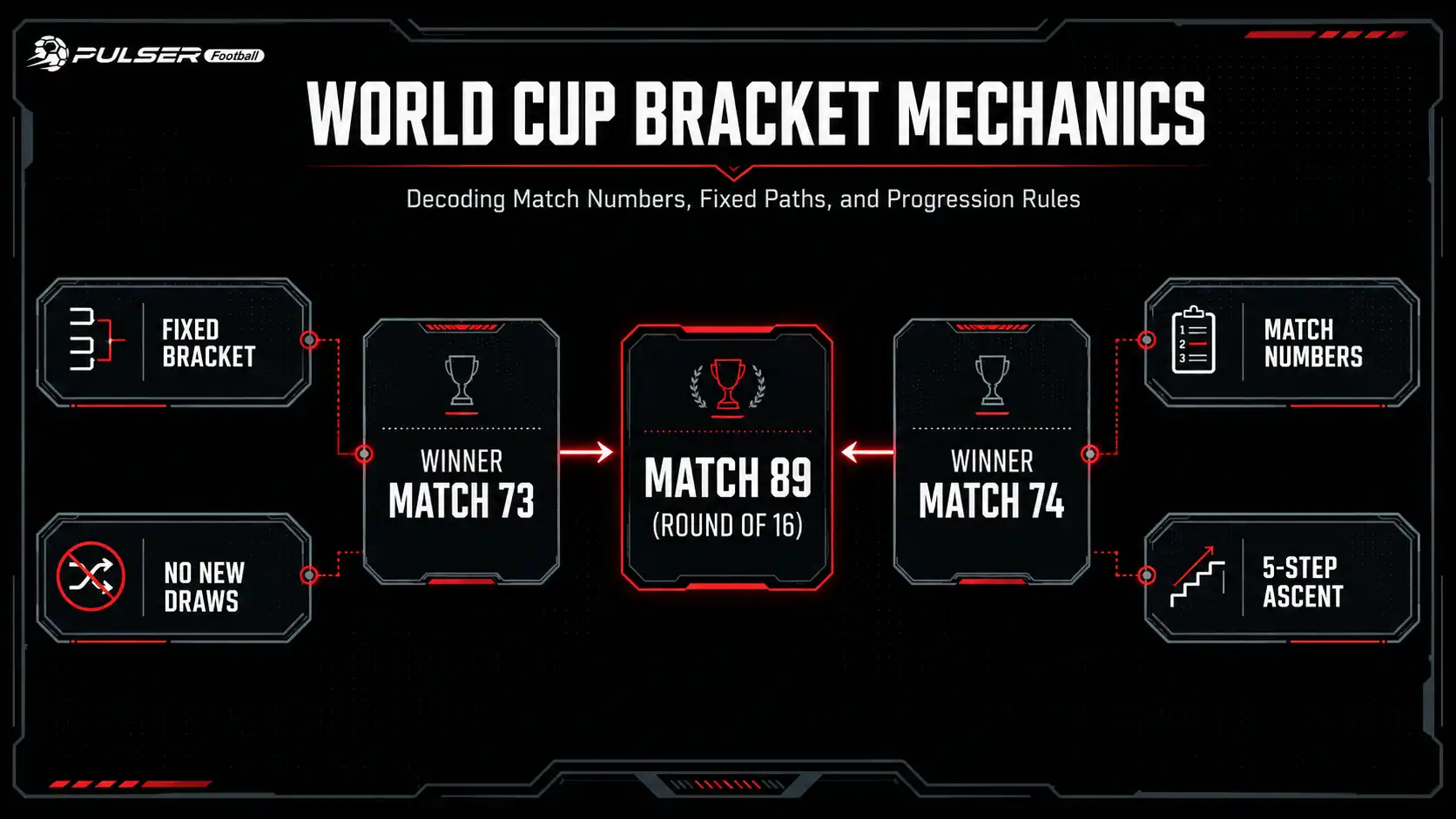
Group winners and runners-up from the same group receive predetermined slots in the knockout bracket that place them on opposite trajectories through the early elimination rounds. A group winner might enter the top half of the bracket while the runner-up enters the bottom half, or they may be placed in different quadrants, depending on the official FIFA matrix for the 12-group structure.
The tournament architecture deliberately separates group contemporaries to prevent early rematches while maintaining the possibility of a later convergence if both teams continue winning. This design ensures competitive variety in the Round of 32 and Round of 16 while preserving the integrity of the group stage results, as teams must earn their way back to a rematch through multiple victories rather than receiving a fixed elimination bracket that guarantees separation.
How the Fixed Knockout Bracket Determines When Group Rivals Could Meet
The fixed knockout bracket for the expanded 48-team tournament assigns specific positions to group winners, runners-up, and the eight best third-placed teams that determine exactly when former group rivals could theoretically converge in the elimination phase.
The 2026 format features 12 groups feeding into a Round of 32, with each group’s top two finishers and the best third-placed teams receiving fixed seeds in the bracket. The World Cup 2026 knockout stage guide provides the complete mapping of how each group position translates to specific match slots, showing that group winners and runners-up are systematically distributed to opposite sections of the draw.
Group winners typically enter the bracket in positions that route them through one half of the knockout stage, while runners-up from the same group enter through different Round of 32 fixtures that place them on an alternate trajectory. For example, a group winner might progress through the upper quarter of the bracket while the runner-up navigates the lower quarter, meaning their paths would only converge in the semi-finals or final if both teams defeat all external opponents in their respective sections.
Structural barriers make rematches impossible in the Round of 32 and Round of 16 regardless of results, as the fixed seeding matrix ensures group contemporaries cannot occupy opposing slots in these early knockout fixtures. Teams must advance through at least the quarter-finals and potentially further before the bracket architecture permits a same-group meeting, with the exact convergence point depending on whether the specific group winner and runner-up slots align in the quarter-finals, semi-finals, or only in the final match.
Planning Your Viewing Schedule Around Potential Rematches in Kenya
Kenyan football fans monitoring potential same-group rematches should track bracket progression using East Africa Time schedules to identify when group rivals might converge in the later knockout rounds.
The World Cup 2026 schedule in Kenya time helps East African supporters plan viewing times in EAT (UTC+3), which remains consistent throughout the tournament without daylight saving changes. Morning and afternoon kickoffs in the United States, Canada, and Mexico will translate to evening and late-night viewing windows in Nairobi, making the bracket progression particularly important for fans hoping to watch potential rematches that could occur in quarter-final or semi-final slots.
Tracking tools available through Pulser allow supporters to map which half of the bracket each team occupies once group positions are finalized. Fans can calculate that if both a group winner and runner-up continue winning, their paths will cross in a specific later round, allowing you to block that date in your calendar weeks in advance.
Updated bracket scenarios appear on the FIFA World Cup 2026 teams and groups page after each matchday, providing clarity on rematch possibilities once the Round of 32 pairings are set. The fixed bracket means that once groups conclude, the potential meeting points become mathematically certain, allowing Kenyan supporters to prepare for high-stakes reunion matches between familiar opponents.
FAQ
Can two teams from the same group play each other in the Round of 16 at the 2026 World Cup?
No. The fixed bracket structure for the 48-team tournament ensures that group winners and runners-up are seeded into different sections of the knockout phase, making a Round of 16 rematch structurally impossible regardless of results.
If Kenya qualifies for the 2026 World Cup, when is the earliest they could face a group opponent again?
The earliest possible rematch round depends on Kenya’s final group position and the specific pathway mapped in the official FIFA bracket. Check the Pulser knockout stage guide for the verified bracket matrix showing where group winners and runners-up converge.
Does FIFA prevent teams from the same confederation from meeting in the knockout stage?
No. Unlike group stage seeding, the 2026 knockout bracket does not use confederation restrictions to prevent meetings. Only group stage finishing position determines the path, meaning two teams from the same confederation (but different groups) can meet at any stage.