
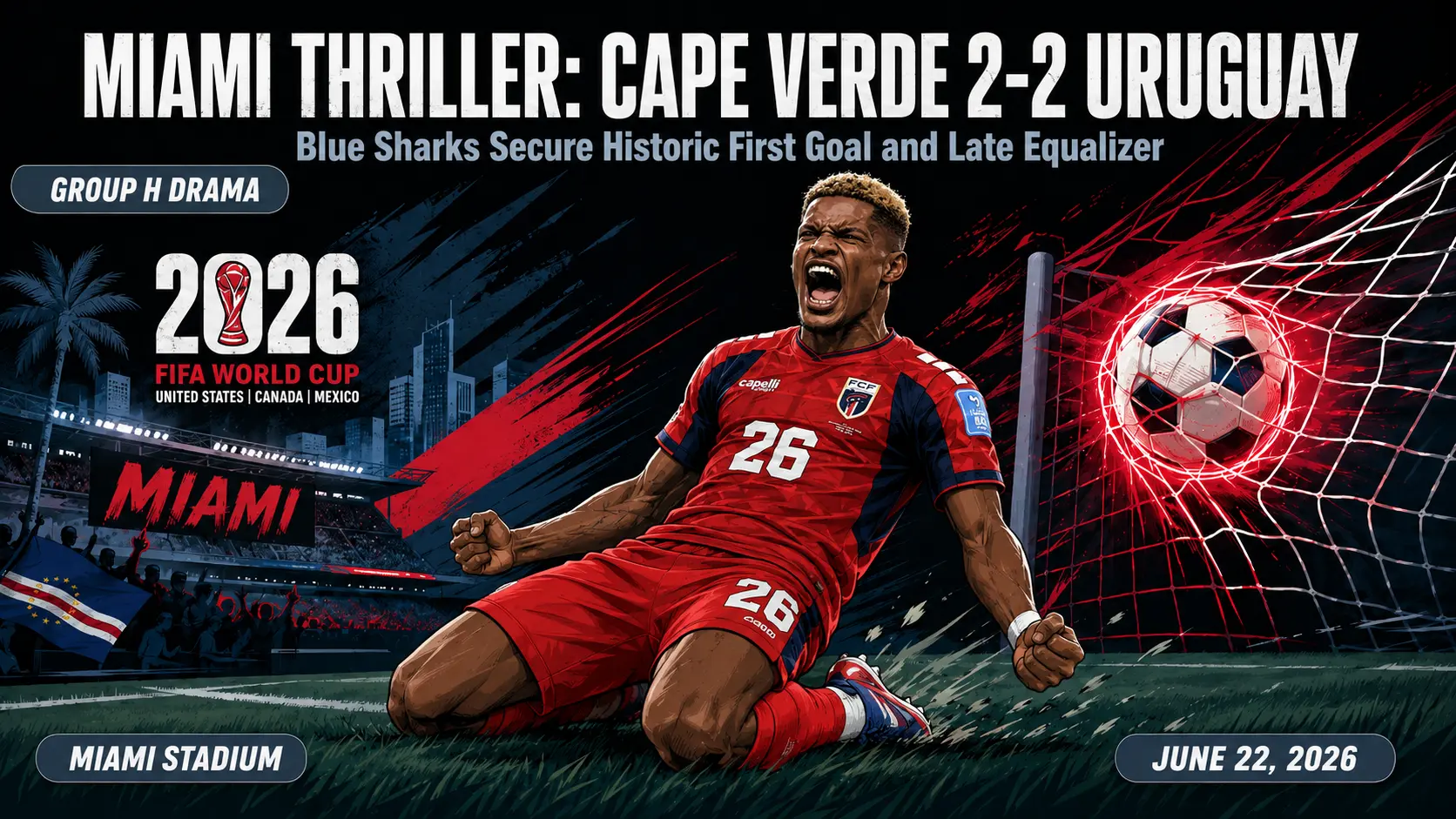
Cape Verde produced another remarkable result at the 2026 FIFA World Cup by holding Uruguay to a 2-2 draw at Miami Stadium. Kevin Pina scored the country’s first-ever World Cup goal with a direct free kick, while substitute Hélio Varela equalised only 136 seconds after coming on. The Blue Sharks nearly completed the comeback in stoppage time, but Rodrigo Bentancur denied Varela with a decisive goal-saving challenge.
The result left Cape Verde unbeaten after their opening 0-0 draw with Spain and kept the World Cup debutants firmly involved in the Group H qualification race. Cape Verde had two points from two matches as of 22 June 2026, with their final fixture against Saudi Arabia likely to determine whether they reach the Round of 32 directly or enter the ranking of third-placed teams.
This analysis explains the four-goal match, Cape Verde’s compact defensive structure, Vozinha’s actual statistics against Uruguay, the latest Group H standings and the FIFA tie-breaker rules that could decide qualification. It also examines why Cape Verde’s rise is not an isolated surprise, connecting their World Cup performance with a successful African qualifying campaign, four previous AFCON appearances and a squad strengthened by players developed across overseas football systems.
Explore all 48 qualified teams, group details and tournament profiles in our 2026 FIFA World Cup teams guide.
How Cape Verde Stunned Uruguay in a Historic 2-2 Draw
Cape Verde stunned Uruguay by recovering from a losing position twice to earn a historic 2-2 draw at Miami Stadium. The World Cup debutants combined resilience, set-piece quality and efficient transition attacks to collect their second point in Group H.
The result carried more weight than an ordinary group-stage draw. Six days after holding Spain to a 0-0 draw, the Blue Sharks again avoided defeat against a former world champion and remained unbeaten after their first two FIFA World Cup matches.
Kevin Pina Scored Cape Verde’s First World Cup Goal
Kevin Pina scored Cape Verde’s first FIFA World Cup goal with a powerful direct free kick after Rodrigo Bentancur fouled Telmo Arcanjo outside the penalty area. The midfielder’s strike gave the tournament debutants an immediate answer after Uruguay had taken the lead.
The goal was historically significant because Cape Verde had failed to score against Spain despite creating several promising transitions. Pina therefore became the first player to put the Cape Verde national football team on a men’s World Cup scoresheet.
Hélio Varela Completed Cape Verde’s Second Comeback
Hélio Varela completed Cape Verde’s second comeback by punishing a defensive mistake and scoring the 2-2 equaliser. The substitute remained composed as the opportunity opened, carrying the ball beyond the goalkeeper before finishing one of the most important goals in the country’s football history.
His intervention showed that Cape Verde still had attacking options after falling behind for the second time. Rather than retreating and accepting a narrow defeat, the Blue Sharks continued to attack the space behind Uruguay’s defensive line.
Cape Verde Remained Unbeaten After Facing Two Champions
Cape Verde remained unbeaten after opening their World Cup campaign against Spain and Uruguay, two countries that have previously won the tournament. The Blue Sharks earned two points from those matches without needing to dominate possession.
This record does not automatically make the debutants favourites to qualify, but it changes how their final Group H match must be viewed. Cape Verde are no longer simply participating in their first World Cup; they are competing for a place in the Round of 32.
How Cape Verde and Uruguay Produced Four Decisive Goals
Cape Verde and Uruguay produced four goals through a match shaped by set pieces, defensive errors and rapid changes in momentum. The contest repeatedly appeared to move in Uruguay’s favour, but each advantage was answered by the tournament newcomers.
Uruguay created more territorial pressure, while the Blue Sharks were more selective about when to attack. That contrast turned the match into a test of efficiency rather than a simple comparison of possession.
Bentancur’s Foul Created Pina’s Free-Kick Opportunity
Rodrigo Bentancur created Kevin Pina’s free-kick opportunity when the Uruguay midfielder brought down Telmo Arcanjo near the penalty area. The foul connected Bentancur directly to the historic moment because Pina converted the resulting set piece for Cape Verde’s first World Cup goal.
The incident also demonstrated the value of Arcanjo’s direct running. His ability to carry the ball through midfield forced Uruguay into a late challenge in an area from which Pina could threaten the goal.
Uruguay Recovered Before Taking the Lead
Uruguay recovered from Cape Verde’s first equaliser by increasing the pressure around the penalty area and eventually restoring their advantage. The South American side moved the ball quickly enough to expose moments when the Blue Sharks’ defensive block became stretched.
The second Uruguay goal appeared capable of deciding the match because Cape Verde had already spent long periods without the ball. However, the favourites failed to control the transition immediately after losing possession, leaving another route back into the contest.
Varela Punished Uruguay’s Defensive Error
Hélio Varela punished Uruguay’s defensive error by reacting quickly when Mathías Olivera failed to control the danger. The Cape Verde substitute turned the mistake into an equalising goal instead of allowing the defenders time to recover.
His finish was therefore more than a fortunate break. The Blue Sharks had continued to place attackers in positions where a loose touch, misplaced pass or failed clearance could be converted into a clear chance.
Hélio Varela Changed the Match Within 136 Seconds
Hélio Varela changed the match within 136 seconds of entering as a substitute for Cape Verde. The winger’s immediate impact gave the Blue Sharks a second equaliser and transformed what looked like a likely defeat into another historic World Cup result.
The timing matters because substitutes often need several minutes to adjust to a match’s speed and tactical demands. Varela instead recognised the available space immediately and attacked Uruguay before the defensive structure could settle.
Varela Scored on His World Cup Debut
Hélio Varela scored on his FIFA World Cup debut and registered his first senior international goal for Cape Verde. The substitute used his first major opportunity to give the national team another landmark moment in its debut tournament.
His contribution also strengthened Cape Verde’s attacking depth. The Blue Sharks had already relied on disciplined starters, but Varela showed that head coach Bubista could alter the match from the bench rather than simply protect the existing score.
Bentancur Denied Varela a Stoppage-Time Winner
Rodrigo Bentancur denied Hélio Varela a stoppage-time winner with a goal-saving defensive challenge. The Uruguay midfielder recovered at the decisive moment and prevented Cape Verde from completing a remarkable 3-2 turnaround.
The action should not be described as a confirmed controversial foul because reliable match reporting presents it as a legitimate and important intervention. It nevertheless shows how close Varela came to turning a historic draw into Cape Verde’s first World Cup victory.
Cape Verde’s Defence Restricted Uruguay Without Vozinha Saves
Cape Verde restricted Uruguay by protecting central shooting areas rather than depending on repeated saves from Vozinha. The South American side produced only two shots on target, and both attempts resulted in goals, leaving the goalkeeper without an officially recorded save.
This distinction matters because Vozinha’s performance against Uruguay has sometimes been confused with his seven-save display against Spain. In Miami, the defenders in front of him carried more of the responsibility for reducing the quality of Uruguay’s attempts.
Uruguay Converted Both of Their Shots on Target
Uruguay converted both of their shots on target against Cape Verde. The perfect conversion rate explains why the match felt dangerous for the Blue Sharks even though the favourites did not consistently test Vozinha.
The figure also exposes the remaining weakness in Cape Verde’s defensive performance. Limiting shots is valuable, but isolated breakdowns can still be punished when the opponent possesses elite technical quality.
Cape Verde Blocked Uruguay’s Higher-Quality Shooting Routes
Cape Verde blocked Uruguay’s higher-quality shooting routes by keeping multiple defenders between the ball and the centre of goal. The compact unit encouraged the opposition to shoot from less favourable areas or attempt difficult passes through crowded spaces.
The Blue Sharks were not flawless, but their defensive strategy reduced the number of clean finishes available to Marcelo Bielsa’s team. This helps explain why a large advantage in possession did not become a large advantage in shots on target.
Vozinha’s Seven Saves Came Against Spain
Vozinha made seven saves against Spain rather than Uruguay. The Cape Verde goalkeeper was the central figure in the opening 0-0 draw, while the defence in front of him played the larger statistical role in limiting Uruguay.
The contrast reveals two different ways in which the Blue Sharks can survive pressure. They can rely on an experienced goalkeeper when opponents break through repeatedly, or they can prevent those attempts from reaching the target in the first place.
Where Cape Verde Stand in the Latest Group H Table
Cape Verde had two points after drawing their first two Group H matches against Spain and Uruguay. The Blue Sharks remained firmly involved in the qualification race before their final fixture against Saudi Arabia.
| Position | Team | Played | Won | Drawn | Lost | Goal Difference | Points |
|---|---|---|---|---|---|---|---|
| 1 | Spain | 2 | 1 | 1 | 0 | +4 | 4 |
| 2 | Uruguay | 2 | 0 | 2 | 0 | 0 | 2 |
| 3 | Cape Verde | 2 | 0 | 2 | 0 | 0 | 2 |
| 4 | Saudi Arabia | 2 | 0 | 1 | 1 | -4 | 1 |
The table is a snapshot after the second round of Group H matches. The official order remains subject to FIFA’s tie-breaker procedure, while all four teams still have one match left to play.
Cape Verde Collected Two Points From Two Draws
Cape Verde collected two points by drawing 0-0 with Spain and 2-2 with Uruguay. The debutants scored two goals, conceded two and entered the final match without a defeat.
Two points do not guarantee qualification, but they keep several routes open. A first World Cup victory would produce the clearest path, while another draw would require a closer examination of the other Group H result and the third-place table.
Spain Uruguay and Saudi Arabia Remain Connected
Spain, Uruguay and Saudi Arabia remain directly connected to Cape Verde’s qualification chances. The final standings depend on both last-round matches because Spain face Uruguay while the Blue Sharks meet Saudi Arabia.
No team can evaluate its position in isolation. A goal in either match may change the order of the group, the identity of the top two teams and the strength of the third-placed side’s Round of 32 claim.
FIFA Rules Determine the Official Group Order
FIFA World Cup 2026 Regulations determine the official order when two or more teams finish level on points. The rules apply specific head-to-head criteria before moving to broader group statistics.
This means a standings table cannot always be sorted by overall goal difference alone. The number and identity of the tied teams must first be established after all group matches have finished.
How Can Cape Verde Reach the Round of 32
Cape Verde can reach the Round of 32 by finishing among Group H’s top two teams or by becoming one of the eight best third-placed sides. The safest route is to defeat Saudi Arabia and avoid relying on results from other groups.
The final scenarios can be divided into three basic outcomes:
- Cape Verde win: The Blue Sharks move to five points and create a strong route to the knockout stage, although the exact group position still depends on Spain versus Uruguay and any applicable tie-breakers.
- Cape Verde draw: The Blue Sharks finish with three points and may need the other Group H result plus the ranking of third-placed teams to work in their favour.
- Cape Verde lose: The Blue Sharks remain on two points and face a serious risk of elimination.
A Cape Verde Win Creates the Strongest Qualification Route
Cape Verde would reach five points by defeating Saudi Arabia. That total would place the debutants in a powerful position to finish in the top two or, at minimum, hold an unusually strong third-place record.
A win would also remove Saudi Arabia from direct competition with them. The remaining issue would be how Spain versus Uruguay affects the final order and whether multiple teams finish level on five points.
A Draw Leaves Cape Verde Dependent on Other Results
Cape Verde would finish the group with three points if they draw with Saudi Arabia. The Blue Sharks would then need to compare their record with Uruguay’s final total and potentially with third-placed teams from the other 11 groups.
Three points may be enough to advance in the expanded 48-team format, but it is not an automatic qualification total. Goal difference, goals scored and disciplinary points may become important in the cross-group ranking.
A Defeat Could End Cape Verde’s Historic Campaign
Cape Verde would remain on two points if Saudi Arabia win the final match. The Blue Sharks would then be overtaken by their opponents and would probably require an exceptional combination of results to remain alive.
That scenario makes game management essential. Cape Verde cannot approach the fixture as though another draw or a narrow defeat carries the same value as the two impressive results already earned.
How FIFA Tie-Breakers Could Decide Cape Verde’s Future
FIFA tie-breaker rules are the official criteria used to separate teams that finish the group stage with the same number of points. Their main function is to determine the group order and identify which teams advance to the Round of 32.
For teams tied within the same group, FIFA first considers results among the teams concerned. The sequence then expands if those criteria cannot separate them.
Head-to-Head Results Come Before Overall Goal Difference
FIFA Article 13 places head-to-head results before overall group goal difference when teams are level on points. The relevant sequence begins with points earned in matches among the tied teams, followed by head-to-head goal difference and head-to-head goals scored.
If the teams remain level, FIFA then considers:
- Overall goal difference in all group matches
- Total goals scored in all group matches
- Team conduct or disciplinary score
- The latest applicable FIFA men’s ranking criteria
The calculation becomes especially important if three teams finish on the same number of points. In that situation, a mini-table involving only those teams may be required before the wider group figures are applied.
Third-Placed Teams Follow a Different Ranking System
The eight best third-placed teams follow a different ranking process from teams tied inside one group. The cross-group comparison begins with total points, followed by overall goal difference and total goals scored.
Head-to-head results cannot be used because third-placed teams from different groups have not played one another. Team conduct and FIFA ranking therefore become the later criteria if the main statistical measures remain equal.
Disciplinary Points and FIFA Ranking May Become Decisive
Disciplinary points and the FIFA ranking may separate Cape Verde from another team only when the earlier criteria remain equal. These measures are later tie-breakers rather than the first method used to decide qualification.
The practical lesson is that every goal and card can matter. A late consolation goal, unnecessary booking or avoidable dismissal may influence the third-place comparison even after the match result appears settled.
How Cape Verde Neutralised Marcelo Bielsa’s Uruguay
Cape Verde neutralised Marcelo Bielsa’s Uruguay by defending compactly and attacking quickly when possession changed. The Blue Sharks did not attempt to defeat the high press through prolonged passing sequences; they frequently moved the ball forward before Uruguay could rebuild its defensive shape.
From my reading of the match pattern, the central contest was not possession against possession. It was Uruguay’s ability to convert territorial control against Cape Verde’s ability to make a small number of transitions count.
Cape Verde Shifted Between 4-1-4-1 and 4-3-3
Cape Verde shifted between a 4-1-4-1 defensive structure and a 4-3-3 shape when pushing players forward. The changing formation allowed the midfield to protect the centre without completely removing the wide outlets needed for counter-attacks.
In the deeper phase, the holding midfielder screened passes into dangerous central zones. Once possession was recovered, the wide players moved higher and gave the team immediate routes away from pressure.
Compact Midfield Lines Disrupted Uruguay’s High Press
Cape Verde disrupted Uruguay’s high press by keeping short distances between the midfield and defensive lines. The compact arrangement reduced the space available for Bielsa’s players to receive between the lines and turn towards goal.
Uruguay still controlled large periods, but control did not consistently become penetration. The Blue Sharks accepted passes around the outside while prioritising the central corridor and the area directly in front of Vozinha.
Counter-Attacks and Set Pieces Exposed Uruguay’s Spaces
Cape Verde exposed Uruguay through counter-attacks and set pieces rather than sustained possession. The free kick won by Arcanjo and converted by Pina demonstrated how one direct run could turn defensive resistance into an immediate scoring opportunity.
Varela’s equaliser followed a different route but reflected the same principle. The Blue Sharks kept an attacker ready to exploit a loose touch, and Uruguay’s failure to control the transition gave him the chance to score.
Why Cape Verde’s World Cup Rise Is Not Accidental
Cape Verde reached the 2026 FIFA World Cup through sustained national-team development rather than a single fortunate qualification result. The Blue Sharks finished ahead of Cameroon in African qualifying after collecting 23 points from 10 matches.
The campaign built on more than a decade of continental tournament experience. Cape Verde had already learned how to compete against larger football nations through four AFCON appearances before arriving at their first World Cup.
Cape Verde Qualified Ahead of Cameroon
Cape Verde qualified ahead of Cameroon by producing the more consistent campaign across the African preliminary competition. The island nation secured its historic place with a 3-0 victory over Eswatini.
The achievement challenged the assumption that population size or past World Cup pedigree determines qualification. Cape Verde created an organised national-team structure capable of outperforming a country with a much longer tournament history.
AFCON Experience Prepared the Blue Sharks
Cape Verde first qualified for the Africa Cup of Nations in 2013 and later appeared in the 2015, 2021 and 2023 editions. Those tournaments exposed the Blue Sharks to knockout pressure, contrasting tactical styles and matches decided by small details.
That experience is visible in their World Cup game management. The players rarely appear surprised by long defensive periods, and the team remains capable of attacking after conceding rather than losing its structure.
Overseas Players Strengthened Cape Verde’s Competitive Level
Cape Verde strengthened the national team by drawing on players developed across overseas football systems. The wider diaspora gives the Blue Sharks access to professionals accustomed to European leagues, different tactical cultures and high-pressure club competitions.
This network does not remove the challenges faced by a small football nation, but it raises the squad’s technical and tactical baseline. It also helps explain why Cape Verde can look physically and organisationally comfortable against teams with far greater World Cup experience.
When Cape Verde Face Saudi Arabia in Group H
Cape Verde face Saudi Arabia in their final Group H match at Houston Stadium on 27 June 2026 at 3:00 am East Africa Time. The fixture will determine whether the Blue Sharks convert two historic draws into a place in the Round of 32.
For Kenyan readers, the match begins early on Saturday morning. The timing is important because Uruguay versus Spain is scheduled within the same final-round window, allowing the group positions to develop simultaneously.
Cape Verde Play at 3 AM Kenya Time
Cape Verde play Saudi Arabia at 3:00 am Kenya Time on Saturday, 27 June 2026. The EAT conversion places the Houston evening fixture in the early hours for viewers in Nairobi and across Kenya.
Supporters should check the official FIFA fixture page before kickoff in case of operational changes. The published schedule nevertheless makes this one of the most important early-morning matches for African viewers during the final group round.
Uruguay and Spain Kick Off at the Same Time
Uruguay and Spain play during the same final Group H window as Cape Verde and Saudi Arabia. The simultaneous scheduling reduces the opportunity for teams to adjust their approach after learning the completed result of the other match.
Both scorelines will still affect the live standings. Cape Verde may therefore need to balance their own match situation with information arriving from Spain versus Uruguay.
Cape Verde Must Turn Resilience Into Their First Win
Cape Verde must turn resilience into their first World Cup victory if they want the clearest route to the knockout stage. The Blue Sharks have shown that they can recover from pressure, but the Saudi Arabia match may require them to control more possession and create against a cautious defensive block.
The tactical challenge could therefore differ from the Spain and Uruguay games. Cape Verde may receive fewer open counter-attacking spaces and will need patient combinations, accurate set pieces and disciplined protection against Saudi transitions.
What the Uruguay Draw Means for Cape Verde
Cape Verde transformed the 2-2 draw with Uruguay into proof that their opening result against Spain was not an isolated shock. The Blue Sharks have now demonstrated defensive organisation, set-piece quality, bench impact and the emotional control required to recover after conceding.
The result still represents progress rather than completion. Cape Verde have made history, but the final judgment on their first World Cup group stage will depend on whether they can finish the job against Saudi Arabia.
Pina and Varela Created Two Historic Moments
Kevin Pina and Hélio Varela created two historic moments for Cape Verde in the same match. Pina scored the national team’s first World Cup goal, while Varela became an immediate substitute hero by equalising 136 seconds after entering.
The two goals also came from different attacking mechanisms. One followed a direct free kick, while the other came from pressure on a defensive error, giving future opponents more than one Cape Verde threat to consider.
Cape Verde Proved They Can Trouble Elite Teams
Cape Verde proved they can trouble elite teams by taking points from Spain and Uruguay in consecutive matches. The Blue Sharks did so through structure and efficiency rather than by attempting to copy the possession style of their opponents.
The next step is consistency against a team they may be expected to attack more aggressively. Performing as an underdog and breaking down a direct qualification rival are related but different tests.
Saudi Arabia Will Decide Cape Verde’s Next Chapter
Saudi Arabia will decide the next chapter of Cape Verde’s first World Cup campaign. The Blue Sharks enter the match with their qualification hopes alive and with the opportunity to secure the country’s first victory on football’s biggest stage.
A positive result could turn a memorable debut into a knockout-stage breakthrough. A defeat would not erase the achievement of drawing with two former champions, but it would leave a sense that the historic opportunity was not fully converted.
FAQ
Cape Verde attracts searches that extend beyond the Uruguay match, including questions about the country, the national team’s tournament history and its current competitive level. The following answers use information available as of 22 June 2026.
Is Cape Verde a rich or poor country?
Cape Verde is generally classified as a middle-income developing country rather than accurately described through a simple rich-or-poor label. The island nation has achieved political stability and important development progress, but it still faces economic constraints linked to limited natural resources, import dependence, climate vulnerability and a relatively small domestic market.
Its football success should not be treated as a direct measure of national wealth. The Cape Verde national football team benefits from organisation, diaspora players and long-term sporting development despite operating with fewer resources than many larger countries.
Have Cape Verde ever played in the World Cup?
Cape Verde are playing in the men’s FIFA World Cup for the first time in 2026. The Blue Sharks qualified by finishing ahead of Cameroon in their African qualifying group and securing their place with a 3-0 victory over Eswatini.
The draws against Spain and Uruguay are therefore the country’s first two World Cup results. Kevin Pina’s free kick against Uruguay was also Cape Verde’s first goal in the tournament.
How many times has Cape Verde qualified for AFCON?
Cape Verde have qualified for four Africa Cup of Nations final tournaments as of 22 June 2026. The Blue Sharks appeared in the 2013, 2015, 2021 and 2023 editions but did not qualify for AFCON 2025.
The team reached the knockout stage during more than one of those campaigns, giving many players and staff valuable tournament experience before the country’s first World Cup appearance.
What is Cape Verde ranked in FIFA?
Cape Verde were ranked 67th in the official FIFA men’s world ranking published on 11 June 2026. The ranking should always be presented with its publication date because FIFA updates the table periodically and World Cup results may affect the next edition.
The official FIFA records use the Portuguese name Cabo Verde, while Cape Verde remains the widely searched English name for the country and national football team.
Is the Cape Verde football team good?
The Cape Verde national football team is a competitive African side capable of challenging higher-ranked opponents through disciplined defending, fast transitions and experienced overseas players. The Blue Sharks qualified ahead of Cameroon, have reached AFCON knockout rounds and opened their first World Cup by drawing with Spain and Uruguay.
Cape Verde are not yet an established global powerhouse, and the team can still struggle when required to dominate possession. However, their recent results show that describing them as a weak or purely fortunate underdog no longer reflects their actual level.
References
- Cabo Verde Draw With Uruguay — Match Report and Highlights (FIFA)
- FIFA World Cup 2026 Standings (FIFA)
- World Cup 2026 Group H Teams, Fixtures and Standings (FIFA)
- Regulations for the FIFA World Cup 2026 (FIFA)
- Cabo Verde vs Saudi Arabia Match and Kick-Off Information (FIFA)
- Cape Verde Ready to Make History With a First Appearance on Football’s Biggest Stage (Confederation of African Football)
- Cape Verde Historically Qualifies for the FIFA World Cup (Confederation of African Football)
- Cabo Verde FIFA Men’s World Ranking (FIFA)
- Cape Verde Soon to Be a Force to Be Reckoned With in Africa (Confederation of African Football)
- Ghana vs Cape Verde Facts and Figures (Confederation of African Football)