
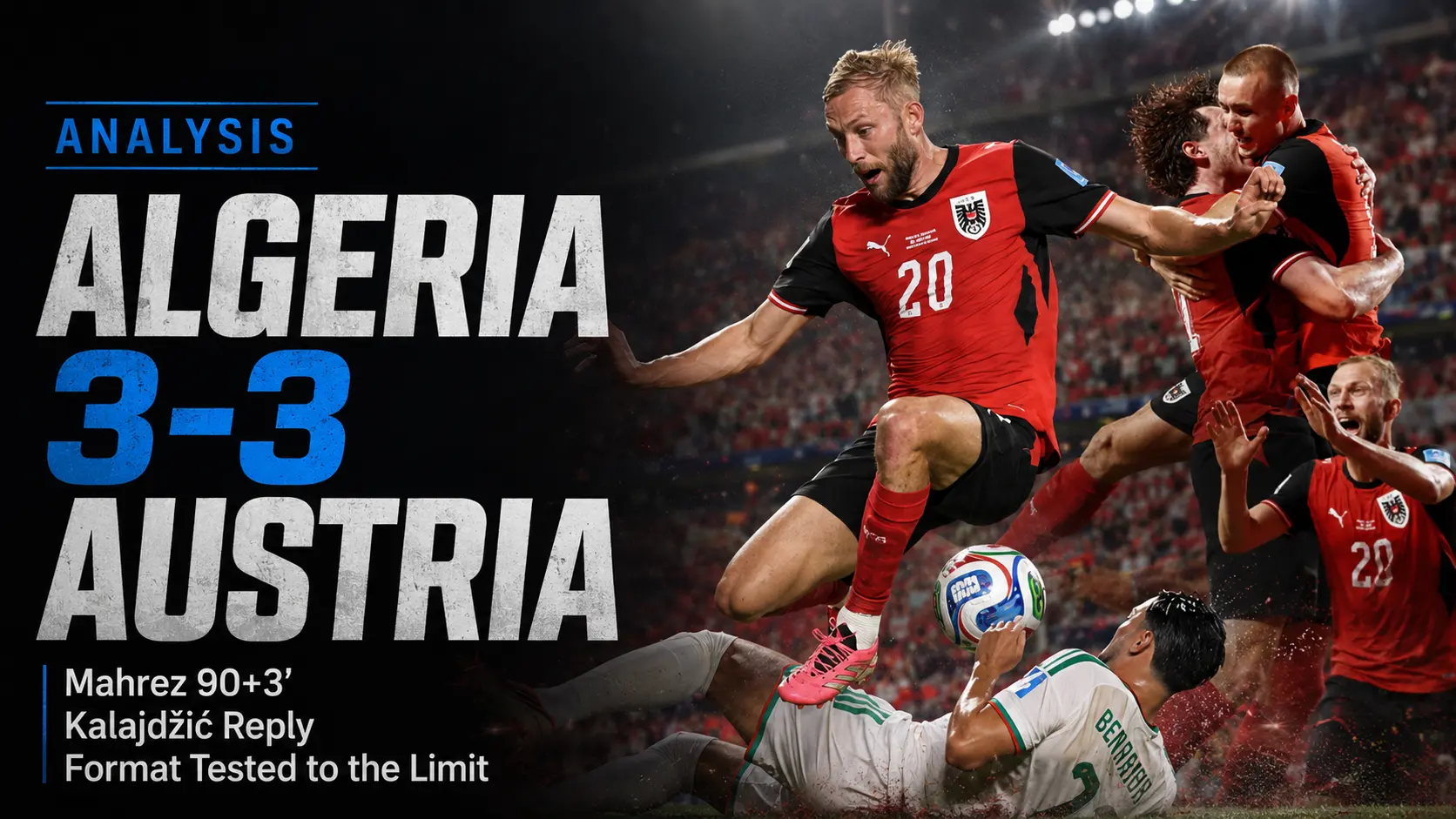
How the 3-3 Drama Unfolded and Who Qualified from Group J
The final three minutes of stoppage time produced two decisive goals that permanently altered the Group J standings, with Mahrez’s 93rd-minute finish appearing to secure maximum points for Algeria before Kalajdžić’s 96th-minute header forced the draw that ultimately satisfied both teams’ qualification requirements. Chaos erupted in the Algeria technical area when Mahrez converted what seemed to be the winner, only for Austrian substitutes to spark one last attack that culminated in Kalajdžić’s predatory header past the goalkeeper. That final strike confirmed the mathematical elimination of Iran, who also finished on four points but suffered an inferior goal difference to the North Africans.
Final Group J calculations revealed Austria in second position with four points and a plus-one goal difference, while Algeria’s four points and minus-two goal difference proved sufficient for advancement as one of the tournament’s best third-placed finishers. Iranian players watched from their team hotel as the results confirmed their exit despite matching the points tally of both advancing teams, highlighting the brutal efficiency of FIFA’s tiebreaker hierarchy. Algerian supporters celebrated across North Africa and in diaspora communities including Nairobi’s Eastleigh neighborhood, recognizing that their team had navigated the expanded format’s complex permutations to survive elimination.
Round of 32 fixtures are now confirmed with Austria facing Spain and Algeria meeting Switzerland, matches that will test whether the energy expended in this exhausting draw hinders either team’s knockout preparation. The World Cup 2026 Round of 32 bracket reveals challenging pathways for both squads, with the European side confronting one of the pre-tournament favorites while the African representatives battle a defensively organized Swiss unit. Kenyan fans can track both teams’ progress through the best third-place standings page to understand how Algeria squeezed through the qualification mechanics.
Tactical Breakdown and the 48-Team Format Controversy
Ralf Rangnick’s high-tempo pressing system generated two separate leads for Austria through vertical transitions and aggressive counter-pressing, yet Vladimir Petković’s possession-oriented Algeria repeatedly recovered through substitute injections and emotional resilience that shifted momentum back toward the African side. Austrian midfielders harried Algerian build-up phases effectively during the opening hour, creating turnovers that translated into quick attacking sequences and two distinct advantages on the scoreboard. Algerian substitutes provided fresh legs and altered passing angles that exploited fatigue in Rangnick’s intense system, enabling the Fennec Foxes to equalize twice before the dramatic finale.
Six goals in ninety-six minutes demonstrated genuine competitive hunger rather than calculated game management, contradicting critics who warned that the best third-place system might encourage conservative draws when mutual advancement appeared mathematically possible. Mahrez’s late winner attempt and Austria’s immediate response through Kalajdžić proved that neither side retreated into defensive shells despite the draw suiting both teams’ qualification needs. Format skeptics had suggested that expanded tournaments dilute intensity, yet the sustained attacking intent from both benches provided compelling evidence that World Cup stakes override tactical caution.
Physical fatigue in Rangnick’s squad became increasingly apparent during the final fifteen minutes of both halves, with Austria’s high defensive line leaving dangerous spaces that Algerian attackers exploited for late chances. Tactical exhaustion contrasted sharply with Algeria’s emotional belief, a psychological factor that Petković must harness quickly before the Swiss encounter while Rangnick repairs his side’s late-game fragility. Defensive vulnerabilities exposed by Algeria’s counter-attacks will require immediate correction before facing Spain’s precise possession game in the next round.
Knockout Stage Pathways and Kenya Viewing Context
Defensive adjustments must be implemented by Austria before facing Spain, as the high line that facilitated pressing against Algeria left spaces that Spanish playmakers will exploit with greater efficiency than the North Africans managed. Austrian center-backs struggled with aerial challenges and through balls during the final quarter of the match, vulnerabilities that become fatal against opponents capable of intricate passing combinations behind defensive blocks. Rangnick’s philosophy requires complete physical commitment from players, yet the energy expended in the Algerian match may force tactical compromises against a Spanish side that dominates possession.
Swiss tactical discipline awaits Algeria in the Round of 32, pitting Petković’s momentum-driven squad against one of the tournament’s most organized defensive units. Swiss compactness typically suffocates third-placed qualifiers who rely on emotional energy rather than structured buildup, meaning Algeria must translate their comeback spirit into concrete attacking patterns against entrenched defensive blocks. The underdog status that accompanies best third-placed qualification might actually suit Algeria’s counter-attacking profile, allowing them to absorb pressure and release Mahrez into transition spaces against Swiss full-backs.
Broadcast schedules for East Africa are available through the full World Cup 2026 schedule in Kenya time, providing exact EAT kickoff details for the upcoming knockout fixtures. Kenyan supporters can track Austria versus Spain and Algeria versus Switzerland through Pulser’s dedicated FIFA hub, which provides continuous updates on the 48-team competition structure. Both matches carry significant implications for the continent’s representation in the later rounds, with Algerian progression offering hope for African football while Austrian success would validate their controversial but effective high-intensity methodology.