
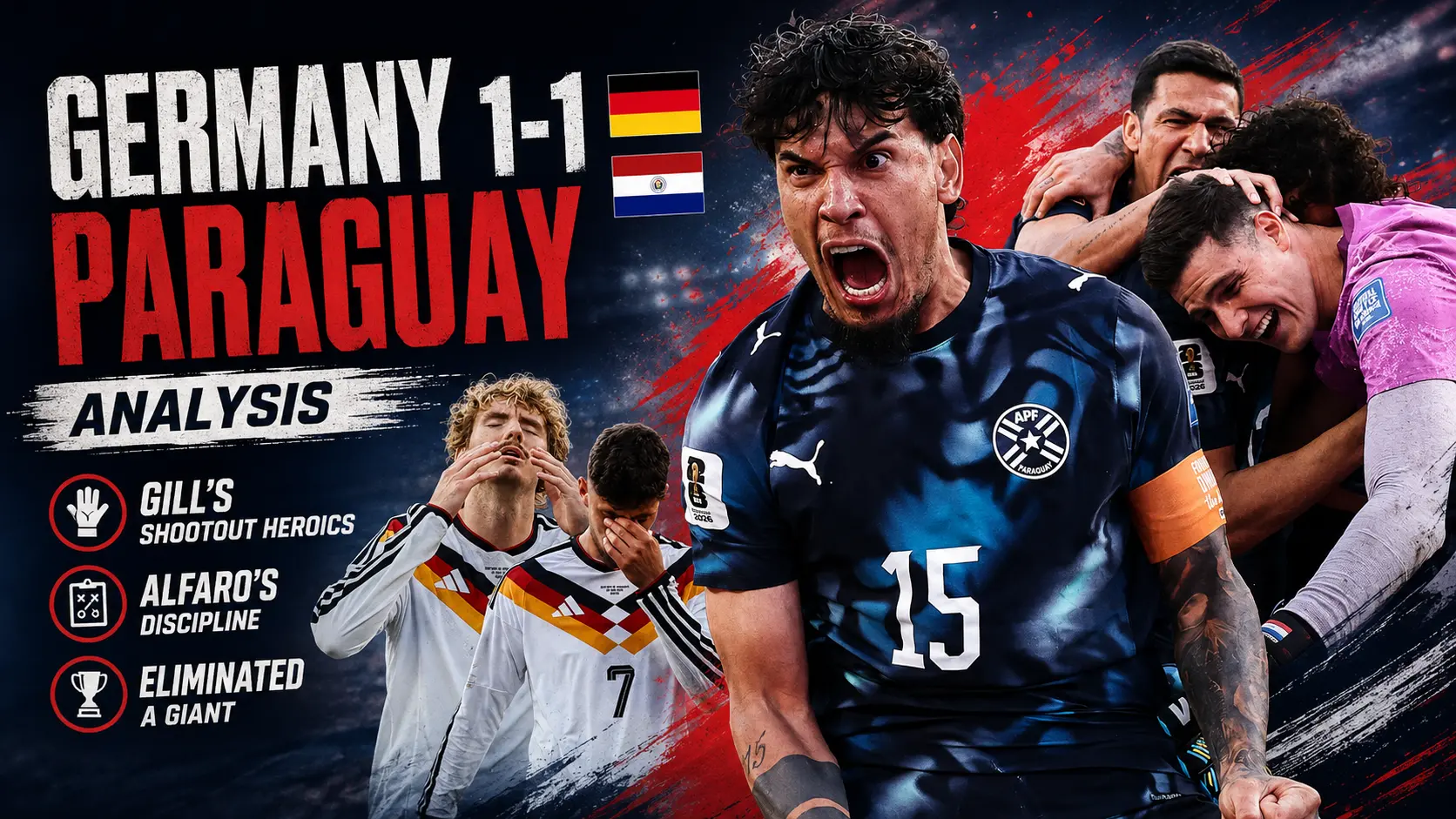
How Paraguay Dethroned Germany: From Enciso’s Opener to Gill’s Penalty Heroics
Paraguay dethroned Germany through a resilient defensive display that survived 120 minutes of pressure before Orlando Gill’s penalty saves and José Canale’s decisive spot-kick sealed a historic 4-3 shootout victory following a 1-1 draw. Julio Enciso’s first-half opener gave Paraguay a shock lead against the run of play, rewarding a rare incisive break from Gustavo Alfaro’s compact side. Kai Havertz restored parity with a powerful header midway through the second half, yet Germany could not find a winner despite prolonged spells of control. The deadlock persisted through 30 minutes of extra time, where fatigue and tension replaced fluid football, setting the stage for the decisive lottery from the spot.
Kenyan fans watching the 23:30 EAT kickoff endured a marathon session past midnight as extra time and penalties unfolded. The emotional rollercoaster peaked when goalkeeper Orlando Gill denied German efforts from twelve yards, turning the Estadio Azteca into a scene of South American celebration and European despair. Witnessing a third-place group finisher eliminate a football giant through sheer resilience provided a stark reminder of knockout football’s unforgiving nature.
Germany’s superior Group E record of six points and a plus-six goal difference offered no protection once the whistle blew for the penalty shootout. Paraguay’s path through the best third-place standings with just four points and a minus-two goal difference became irrelevant the moment Canale converted the winning kick. Single-elimination mechanics erased all prior dominance, validating Alfaro’s strategy of survival above spectacle.
Tactical Breakdown: Alfaro’s Defensive Discipline vs Nagelsmann’s Possession Trap
Gustavo Alfaro’s compact 4-5-1 structure absorbed German pressure for extended phases without abandoning counterattacking threats, maintaining emotional discipline and organizational solidity that Julian Nagelsmann’s possession-heavy approach could not break down. Paraguay’s defensive block sat deep, denying Germany space between the lines where creative players typically operate. The five-man midfield screened the back four effectively, forcing German attackers to attempt low-percentage shots from distance or attempt intricate combinations in crowded areas. Emotional discipline prevented Paraguayan players from overcommitting to tackles, ensuring the shape remained intact through 120 minutes of physical and mental strain.
Julian Nagelsmann’s side dominated territory and completed passes at will, yet major attacking names struggled to convert this control into clear-cut chances against the low block. Germany’s build-up patterns lacked the vertical penetration necessary to split Paraguay’s compact unit, resulting in predictable wide circulation that the South American defense managed comfortably. The possession trap snapped shut whenever Germany reached the final third, where numerical inferiority and excellent shot-blocking from the Paraguayan backline frustrated the European giant.
Central areas became a battlefield of attrition where Paraguay’s willingness to defend deep neutralized Germany’s technical superiority. Midfielders prioritized defensive positioning over possession retention, breaking up rhythm and forcing Germany to restart attacks repeatedly. This tactical patience prevented high-quality opportunities despite Germany’s evident individual quality, ultimately forcing the match toward the penalty lottery where Alfaro’s psychological preparation and Gill’s heroics decided the tie.
The 48-Team Format Fallout and Paraguay’s Quarter-Final Path
Paraguay’s advancement as a third-place qualifier from Group D with just four points and a minus-two goal difference exemplifies the expanded 48-team World Cup format’s unpredictability, where survival trumps style and single-elimination creates giant-killing opportunities. Expansion to 48 teams has redefined qualification merit, allowing sides with four points and negative goal difference to reach the knockout stage through the best third-place route. This new structure rewards tactical flexibility and squad depth over group-stage dominance, allowing disciplined underdogs to target specific knockout scenarios rather than chasing goal difference. Germany’s elimination despite winning their group illustrates how the format separates qualification merit from knockout success.
Alfaro’s next tactical challenge involves a quarter-final clash against the winner of France vs Sweden, a fixture detailed in the Round of 32 bracket. The upcoming opponent will likely demand even more defensive discipline and transition efficiency against superior firepower. The knockout stage path narrows considerably, with Paraguay facing either the reigning champions or a highly organized Scandinavian side. Adjustments to the 4-5-1 structure may be necessary to handle specific threats, though the core principle of defensive solidity must remain non-negotiable.
East African football observers can view Paraguay’s route through the 2026 FIFA World Cup as a blueprint for how underdog nations can navigate future expanded tournaments. The format proves that navigating the group stage with minimal damage allows teams to reset tactically for single-elimination warfare, where one moment of brilliance or one saved penalty can redefine a nation’s footballing history. Kenya and neighboring countries can study Alfaro’s model as a viable pathway for continental representatives who may lack the star power of traditional powers but possess collective discipline and shootout nerve. Full details of the match are available on the Germany vs Paraguay match page.