
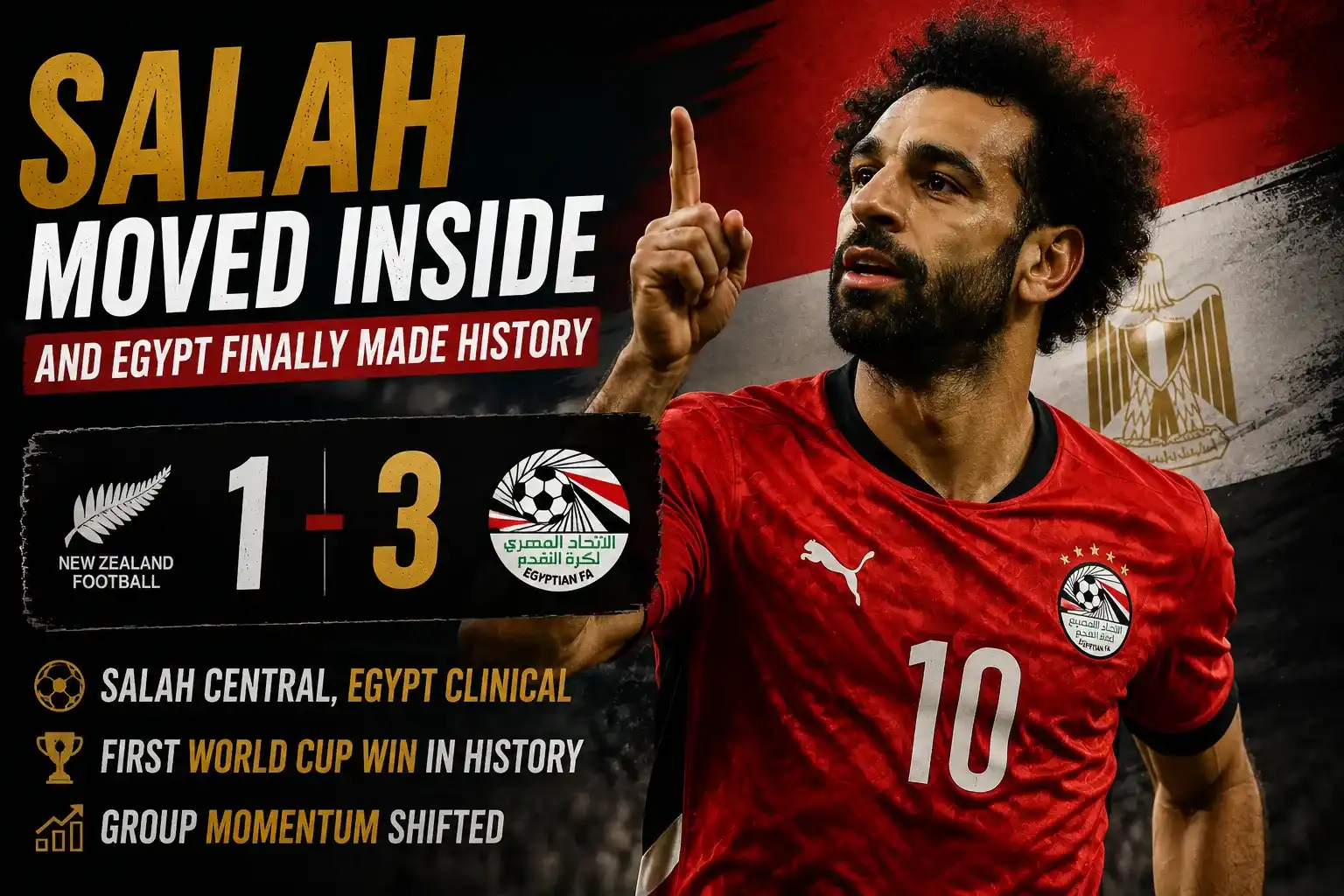
How Egypt Made History: From 1-0 Down to Their First World Cup Victory
Egypt recorded their first World Cup victory in 92 years by recovering from a set-piece deficit to defeat New Zealand 3-1 in Group G.
Ninety-two years of waiting ended in this fixture. Egypt debuted at the World Cup in 1934, managing only three draws from eight matches across seven tournament appearances before this 3-1 triumph. The full match report and timeline documents how Hossam Hassan’s side finally erased the record of never having won a finals match.
Finn Surman’s headed opener from a corner exposed Egypt’s persistent aerial vulnerability, a weakness Darren Bazeley’s side targeted effectively during the opening forty-five minutes. Mostafa Ziko answered almost immediately with a header of his own, demonstrating the set-piece discipline that would characterize Egypt’s response. Mohamed Salah’s second-half strike, arriving after his positional shift, and Trézéguet’s late finish from a set piece completed a comeback that rewards decades of Egyptian football development.
African representation in the expanded 48-team format receives a significant boost from this result. Egypt now stand poised to become the second African nation after the host continent’s representatives to secure Round of 32 qualification, validating the confederation’s competitive depth on the global stage.
Tactical Analysis: Why Moving Salah Inside Changed Everything
Hossam Hassan’s decision to move Mohamed Salah into central attacking positions at halftime transformed Egypt’s impotent first-half display into a fluid attacking performance that produced three goals.
Darren Bazeley deserves credit for constructing a first-half approach that maximized New Zealand’s physical advantages. The All Whites employed a direct aerial strategy that bypassed Egypt’s midfield entirely, creating the corner that led to Surman’s headed opener and consistently forcing Egypt into uncomfortable defensive transitions. This approach nullified Egypt’s technical superiority for forty-five minutes by preventing the Pharaohs from establishing rhythm in possession.
Egypt’s initial tactical setup positioned Salah near the touchline, where New Zealand’s fullbacks could double-team him effectively and prevent access to the penalty area. Emam Ashour found himself isolated between the lines, unable to receive passes in dangerous positions because the touchline positioning compressed the available space. The previous match against Iran showed New Zealand’s defensive vulnerabilities, but Egypt could not exploit them while Salah remained wide.
Hassan’s halftime adjustment shifted Salah into central attacking positions, immediately drawing New Zealand’s defenders inward and creating space for Ashour to operate in the half-spaces. Salah’s movement prevented the All Whites from defending him only near the touchline, unlocking the compact defensive block that had frustrated Egypt initially. The incisive passes from Ashour that followed directly resulted in the equaliser and winner, raising the question of whether individual quality or tactical adjustment won the match—though the evidence suggests Hassan’s change enabled Salah’s influence.
Group G Qualification Race: What Egypt Needs to Reach the Round of 32
Egypt’s four points and plus-two goal difference place them in a commanding position to qualify for the Round of 32, while New Zealand face a must-win scenario against Belgium in their final fixture.
The Group G standings and qualification scenarios reveal Egypt sitting on four points with a plus-two goal difference, putting them level with or ahead of Belgium depending on concurrent results. New Zealand remain on one point with a minus-two goal difference, a position that severely complicates their advancement hopes despite showing competitive quality in both fixtures.
The 48-team tournament format mathematics heavily favor Egypt at this stage. The top two teams from each group automatically advance, while the eight best third-placed teams across twelve groups also reach the knockout stage. Egypt likely need only avoid a heavy defeat in their final match to progress, whereas New Zealand must defeat Belgium and rely on favorable goal difference calculations among third-place teams to have any hope of continuing.
Kenyan viewers planning to follow the decisive fixtures should consult the remaining Group G fixtures in Kenya Time for accurate EAT kickoff times. Egypt’s final match result will determine whether they face a group winner or runner-up in the Round of 32 knockout stage, with significant implications for their tournament trajectory. For comprehensive coverage of the tournament, visit the FIFA hub on Pulser.