
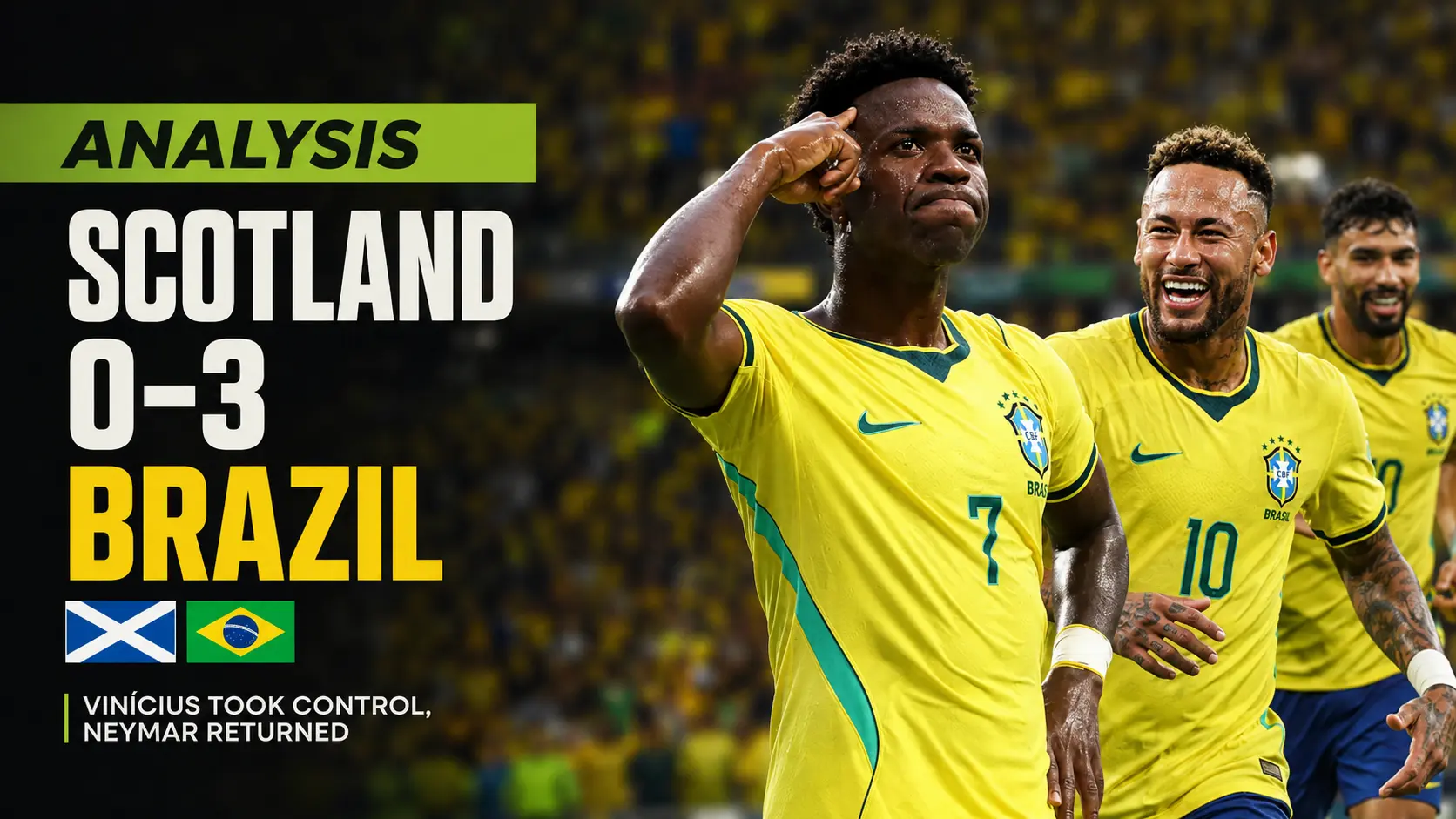
How Brazil Beat Scotland 3-0 to Win Group C
Vinícius Júnior’s first-half brace and a composed finish from Matheus Cunha delivered Brazil’s 3-0 victory over Scotland, confirming the Seleção as Group C winners and eliminating any doubt about their knockout stage qualification. The Real Madrid forward opened the scoring in the seventh minute, latching onto a through ball that split Scotland’s backline before calmly slotting past the goalkeeper. His anticipation of space behind the defensive line exposed the limitations of Steve Clarke’s compact system, which had previously organized effectively against Haiti but lacked the pace to recover once Vinícius accelerated into the channels.
His second goal arrived before halftime, again capitalizing on aggressive runs that Scotland’s fullbacks could not track, leaving the Tartan Army with a mountain to climb against a team that rarely surrenders leads at major tournaments. The movement demonstrated a striker at the peak of his powers, timing his sprints to remain onside while stretching the defensive shape to breaking point.
Matheus Cunha extended the lead on the hour mark, capping a flowing move that demonstrated Brazil’s growing cohesion in the final third and putting the result beyond doubt. The Atletico Madrid striker’s finish reflected the comfort of a team that had already found its rhythm, having previously beaten Haiti 3-0 and drawn 1-1 with Morocco in their opening two fixtures. Seven points from three matches, with seven goals scored and only one conceded, represents a commanding group stage performance for a squad still adjusting to Ancelotti’s methods.
Scotland’s three points and minus-three goal difference leave them waiting on the final calculations for the best-third-place rankings, a precarious position that contrasts sharply with their opening 1-0 victory over Haiti. The Tartan Army’s physical approach, effective against less technically gifted opposition, proved insufficient against Brazil’s ruthless punishment of defensive errors and spaces in behind the fullbacks. Readers can find detailed statistics and a minute-by-minute breakdown in our Scotland vs Brazil full match report.
Ancelotti’s Tactical Balance vs Scotland’s Physical Approach
Carlo Ancelotti’s tactical structure provided the defensive solidity necessary to release Vinícius Júnior into attacking areas without exposing Brazil to dangerous counter-attacks. The Italian manager positioned his midfield trio to screen the back four effectively, ensuring that Scotland’s long balls and physical challenges rarely progressed into genuine goal-scoring opportunities. This disciplined foundation allowed Vinícius to sprint into the channels and behind the defense, knowing that any turnover would be met by organized pressure rather than vulnerable transitions that plagued Brazil in previous tournaments.
Bruno Guimarães operated as the essential connector between defense and attack, receiving possession from the center-backs and advancing it quickly to the front three. The Newcastle United midfielder’s distribution maintained Brazil’s tempo, preventing Scotland from settling into their low defensive block and creating the conditions for the early goals that decided the contest. His ability to find space between Scotland’s compact lines gave Brazil the midfield control that Haiti had struggled to establish in their previous encounter with Clarke’s side, while his defensive positioning protected the backline whenever Scotland attempted to bypass the press with direct balls.
Scotland’s approach, which yielded a hard-fought 1-0 win over Haiti through disciplined defending and set-piece pressure, collapsed after conceding the early opener against superior opposition. The early error disrupted their game plan of frustrating Brazil and hitting on the break, leaving them exposed to the technical superiority of players like Vinícius and Rodrygo. Physical challenges that unsettled Haiti merely resulted in fouls and free-kicks against Brazil, as the Seleção’s technical security prevented the Scottish pressing game from generating momentum. The World Cup 2026 Group C standings now reflect this gulf in class, with Brazil finishing three points clear at the summit while Scotland anxiously monitor other groups.
Neymar’s Return and the New Brazilian Hierarchy
Neymar’s introduction from the substitute’s bench marked his first appearance for Brazil since 2023, ending an 18-month absence from international duty and providing Ancelotti with additional creative options for the knockout rounds. The Al-Hilal playmaker entered the match with twenty minutes remaining, showing flashes of his trademark dribbling ability without being rushed back into a high-intensity contest that Brazil already controlled. His presence alone signals a significant boost to squad depth as Brazil prepare to face a third-place qualifier in the Round of 32, offering a different profile of creativity compared to the direct pace that characterized the victory over Scotland.
Vinícius Júnior’s commanding performance against Scotland strengthens the argument that the 26-year-old has assumed the mantle of Brazil’s primary attacking leader, regardless of Neymar’s historical status as the team’s talisman. Two goals created through direct running and clinical finishing demonstrated a maturity and consistency that places him at the center of Ancelotti’s plans, raising legitimate questions about whether the team should now flow through him rather than around Neymar’s creative hub. The hierarchy appears to be shifting toward a new generation that combines the Real Madrid star’s pace with the defensive work rate demanded by modern tournament football, potentially redefining Brazil’s identity after years of dependency on Neymar’s individual brilliance.
Ancelotti now faces a fascinating tactical decision before Brazil’s next match, with several days to determine whether to build around Vinícius’s vertical threat or reintegrate Neymar as the central creative force. The knockout stage schedule offers the Italian manager time to experiment with combinations that might feature both players in their optimal roles, though the ease of victory against Scotland suggests that disrupting the current balance carries unnecessary risks. Kenya fans planning to watch the Round of 32 should check our 2026 World Cup schedule in Kenya time for kickoff times in East Africa Time, ensuring they do not miss Brazil’s next step toward potential World Cup glory. Additional coverage of the tournament is available on our FIFA hub.