
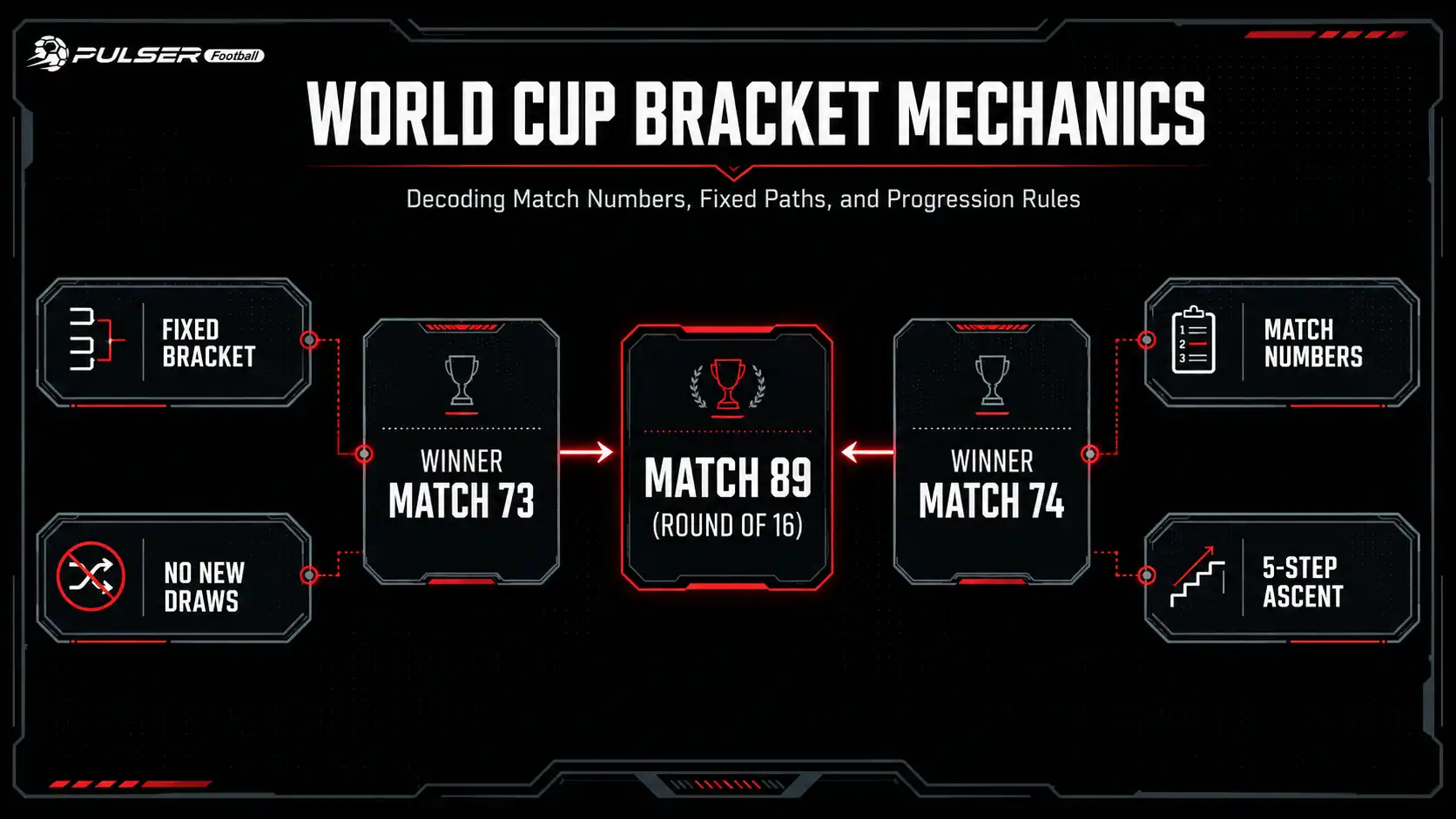
The Fixed Bracket Mechanism: How 16 Winners Become 8 Fixtures
FIFA’s 48-team expansion for the 2026 tournament introduces a fixed bracket architecture where each of the 16 Round-of-32 victories feeds into a predetermined Round-of-16 position. This system eliminates the redraw procedures that characterized previous World Cup formats, ensuring the tournament pathway remains geographically and logistically consistent from the opening group stage through the knockout rounds. Organizers established these pairings before the tournament draw, allowing venues to prepare specific hosting assignments regardless of which national teams qualify for each slot.
Every Round-of-16 fixture receives exactly two designated Round-of-32 winners through these pre-assigned pathways. The winner of Match 73 will face the winner of Match 74 in Match 89, regardless of which national teams secure those victories or their confederation origins. World Cup 2026 Round of 32 guide provides comprehensive details on how these opening knockout matches are structured. This predetermined pairing ensures the bracket pathway remains constant from the tournament’s opening kickoff, allowing broadcasters and host cities to lock logistics months in advance.
Geography and group seeding determine the bracket layout before any ball is kicked, creating a deterministic map through the knockout stages. Fans can trace a team’s potential route by identifying which Round-of-32 slot their squad occupies, knowing that victory leads to a specific, unchangeable Round-of-16 appointment. This structure rewards group-stage performance with favorable pathways while maintaining competitive integrity through the fixed advancement mechanics.
Why One Round-of-16 Side Is Confirmed Before the Other
Kickoff schedules across Canada, Mexico, and the United States span multiple time zones and host-city logistics, creating significant temporal gaps between paired Round-of-32 matches. These staggered fixtures often conclude 24 to 48 hours apart, meaning one Round-of-16 slot fills while its counterpart remains contested on a different day. The continental spread of venues necessitates this scheduling to accommodate stadium turnover and broadcast windows across three nations while maximizing attendance capacity.
Fixed bracket mechanics allow a victorious team to immediately identify their specific Round-of-16 date, stadium, and opponent slot once their Round-of-32 match concludes. Coaches receive immediate clarity on recovery timelines and travel logistics, even while waiting to learn which team will fill the designated opposing slot. This advance notice enables medical staff to begin recovery protocols and analysts to prepare preliminary scouting reports based on the potential opponents likely to emerge from the pending fixture.
Preparation periods vary significantly between confirmed teams and their pending opponents, creating strategic asymmetries in the buildup to Round-of-16 encounters. A squad winning an early fixture gains additional recovery hours while their future adversary battles through a later match, potentially affecting squad freshness and tactical availability. Coaching staffs monitor these disparities using the full World Cup 2026 schedule in Kenya Time to track confirmation windows and adjust training cycles accordingly.
Tracking Your Team’s Route: A Practical Guide for Kenya Fans
East Africa Time operates at UTC+3 throughout the tournament, providing Kenyan fans consistent reference points without daylight saving adjustments that affect host-nation clocks. Match confirmations occurring across Atlantic, Pacific, and Central time zones all resolve to fixed EAT timestamps, allowing supporters to predict exactly when each Round-of-16 slot will populate. Kenyan viewers should note that while North American venues shift between daylight saving and standard time during the tournament months, East Africa maintains steady UTC+3 timing throughout June and July.
Bracket navigation requires tracking slot pairings rather than memorizing complex fixture tables to understand advancement possibilities. The pathway connecting Match 73 versus Match 74 into Match 89 illustrates the broader system: identify your team’s designated Round-of-32 position, then locate its fixed Round-of-16 destination to map progression scenarios without consulting the full schedule. This slot-based approach simplifies tracking for supporters following multiple teams or potential cross-confederation matchups that emerge from the group stage.
Pulser’s tournament coverage updates these slot narratives in real-time as winners confirm across the three host nations. Readers should bookmark the FIFA hub for centralized bracket diagrams and progression trackers that display which Round-of-32 victories have secured Round-of-16 placement and which matchups await confirmation. Kenyan supporters can plan viewing parties around confirmed fixtures while monitoring pending slots that will determine their team’s next opponent and kickoff time in Nairobi or Mombasa.
FAQ
How many teams from the Round of 32 advance to the Round of 16?
All 16 winners of the Round-of-32 matches advance to the Round of 16. These 16 teams are paired into 8 predetermined fixtures based on the fixed bracket structure.
Is there a redraw after the Round of 32 in the 2026 World Cup?
No. The 2026 tournament uses a fixed bracket where each Round-of-16 matchup is pre-assigned to receive winners from two specific Round-of-32 matches, so no redraw is necessary.
Can a team know their Round-of-16 opponent before the Round of 32 finishes?
A team will know the specific match slot of their future opponent immediately after winning their own Round-of-32 game, but they will not know which team it is until the paired Round-of-32 match concludes.
Reference
- FIFA World Cup 2026 Knockout Stage Match Schedule
- FIFA World Cup 26 Regulations
- Standings | FIFA World Cup 2026