
How Pépé’s Brace Ended Curaçao’s Dream and Made Ivory Coast History
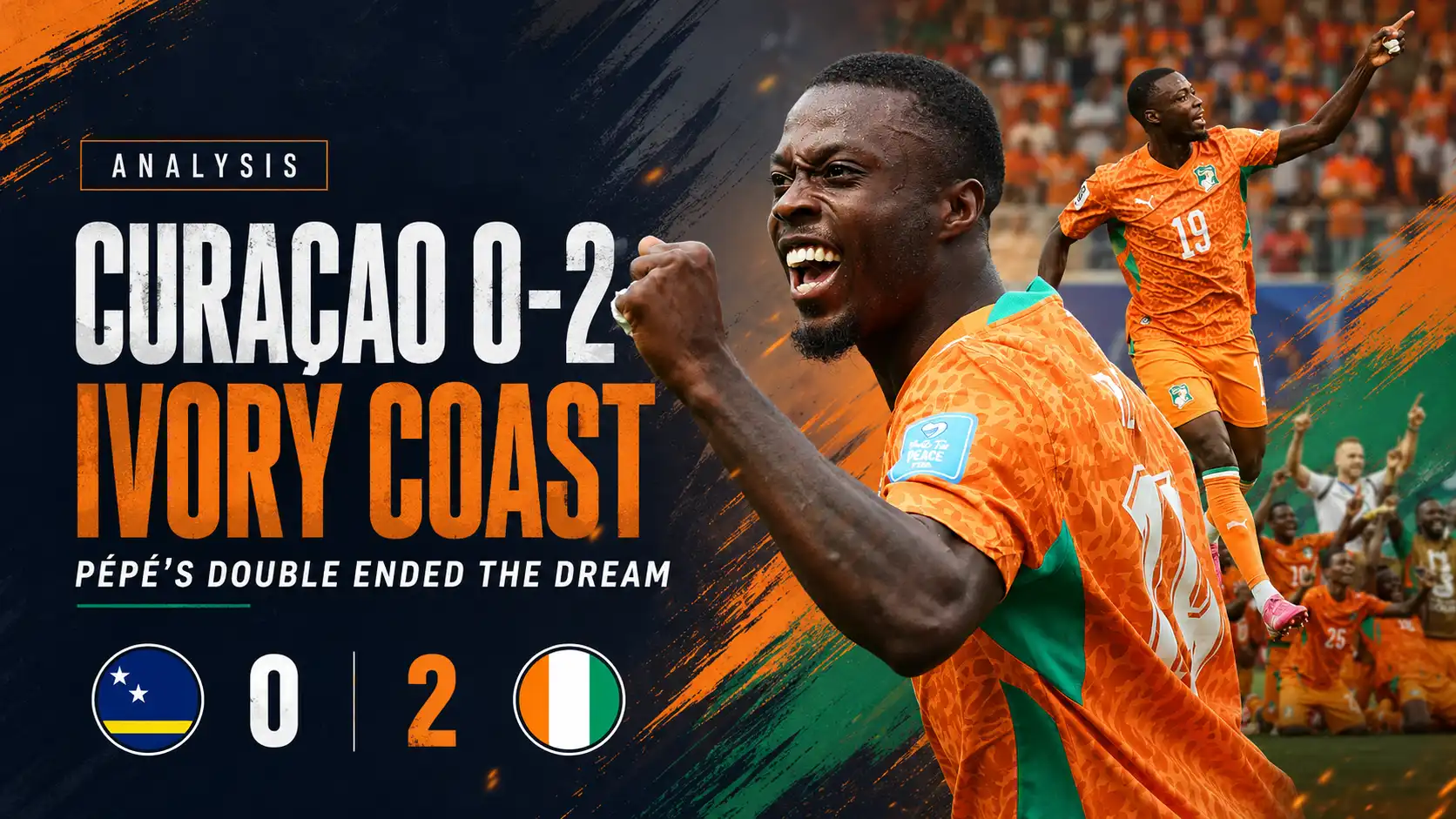
Nicolas Pépé scored both goals in the 2-0 victory, securing Ivory Coast’s first-ever qualification for the World Cup knockout stage and completing a Group E campaign that yielded 6 points and a +2 goal difference as runners-up behind Germany. The winger’s clinical finishing proved decisive in a match where the Elephants needed only a win to guarantee their progression, and his brace ensured there was no late drama in a fixture that carried immense historical weight for the West African nation. Prior to this tournament, Ivory Coast had participated in three previous World Cup editions without ever surviving the group stage, making this breakthrough a moment of genuine national significance that transcends the current generation of players.
Curaçao’s defeat eliminated them from their debut World Cup appearance despite their historic achievement of earning a first-ever point in a 0-0 draw with Ecuador, leaving them with 1 point and a -8 goal difference after recovering from an opening 7-1 loss to Germany. The Caribbean side’s tournament narrative had already been one of remarkable resilience, having bounced back from that heavy defeat to the Germans to frustrate the South Americans through disciplined defensive organization and heroic goalkeeping. That point against Ecuador represented the first World Cup finals point in the nation’s history, an achievement that will be celebrated long after the disappointment of this elimination fades, though the energy expended in that defensive masterclass appeared to leave them with insufficient resources to resist Ivory Coast’s sustained pressure in this decisive fixture.
Ivory Coast’s 2-0 victory demonstrated their ability to deliver under pressure, building upon their 1-0 victory over Ecuador and recovering from their 2-1 defeat to Germany to seal qualification through a controlled performance. Emerse Faé’s side showed maturity in navigating a must-win scenario without succumbing to the panic that has historically plagued teams in similar positions, maintaining composure even when Curaçao’s defensive resistance threatened to extend the deadlock into dangerous territory. The Group E standings and final table reflect a thoroughly deserved second-place finish that sets up a historic Round of 32 encounter, confirming that the Elephants have finally conquered the group stage hurdle that had denied them in previous appearances.
Tactical Breakdown: Faé’s Patience Against Advocaat’s Compact Resistance
Emerse Faé implemented a disciplined, patient attacking approach that prioritized width and sustained pressure without overcommitting players forward, deliberately avoiding the counter-attacking vulnerabilities that had exposed Ivory Coast against Germany. The Elephants’ defeat to the Germans in their second match had stemmed partly from defensive disorganization when pushing for an equalizer, leaving them exposed to rapid transitions that capitalized on space behind the defensive line. Faé learned from that experience, ensuring his full-backs maintained positional discipline while his wide forwards stretched Curaçao’s defensive block to create space for Pépé to operate centrally, resulting in a more balanced structure that controlled possession without sacrificing defensive solidity.
Dick Advocaat organized Curaçao into a compact defensive block that relied heavily on their goalkeeper’s shot-stopping ability, replicating the resilience shown in their historic clean sheet against Ecuador but ultimately succumbing to repeated waves of Ivory Coast attacks. The veteran Dutch manager, whose experience spans multiple international tournaments, set his team up in a low block designed to frustrate the Elephants and potentially snatch a point through set-pieces or late fatigue. This strategy had proven remarkably effective against Ecuador, where Curaçao’s organization and determination earned them a famous point, and they employed similar tactics here, sitting deep and narrow to deny penetration through the center while forcing Ivory Coast to find solutions through patient buildup rather than quick transitions.
Pépé’s clinical finishing ultimately decided the match, though the tactical structure created the conditions for his success. By maintaining possession in wide areas and avoiding risky central passes through densely populated zones, Faé ensured that Curaçao could not utilize their preferred strategy of blocking central corridors and hitting on the break. The spatial conditions created by this emphasis on width provided the platform for the match-winner to find the pockets of space necessary to deliver the historic victory, while the disciplined defensive shape prevented Curaçao from generating the dangerous transitions that might have exposed Ivory Coast’s occasional defensive frailties.
What Next for the Elephants: Kenya Time Viewing and Round of 32 Prospects
Ivory Coast advance to the Round of 32 as Group E runners-up under the expanded 48-team format, marking their historic debut in the knockout phase where they will face a group winner in the next round. The expanded tournament structure has offered African nations additional pathways to the knockout stages, and the Elephants have capitalized on this opportunity by securing six points from their three matches. However, the challenge intensifies significantly in the knockout phase, where a single defeat ends the campaign, and Ivory Coast will confront one of the tournament’s top seeds who have demonstrated dominant form in winning their respective group.
Kenyan and East African fans can follow the Elephants’ continued journey by checking the complete World Cup 2026 schedule in Kenya Time (EAT), ensuring they do not miss kick-off times due to timezone confusion. All Round of 32 fixtures will be displayed in UTC+3 without daylight saving adjustments, allowing supporters from Nairobi to Mombasa to plan their viewing schedules accurately without the risk of converting from Eastern or Central European times incorrectly. Kenyan viewers who have adjusted their schedules to follow the 48-team tournament will now need to prepare for knockout fixtures that may fall on different days than the group stage rhythm they have established, making the schedule page an essential resource for the remaining matches.
Football followers should monitor Pulser’s FIFA hub and dedicated match pages for confirmed fixture details, opponent announcements, and ongoing analysis tailored to East African audiences as the tournament progresses beyond the group stage. The identity of Ivory Coast’s next opponent will be confirmed once all group matches conclude, and Pulser will provide updated fixture information including venue details and exact kick-off times in Kenya Time as soon as the matchups are finalized. For those seeking comprehensive background on this historic fixture, full match details and statistics remain available on the dedicated match page, offering lineups, timeline, and verified match data for reference.