
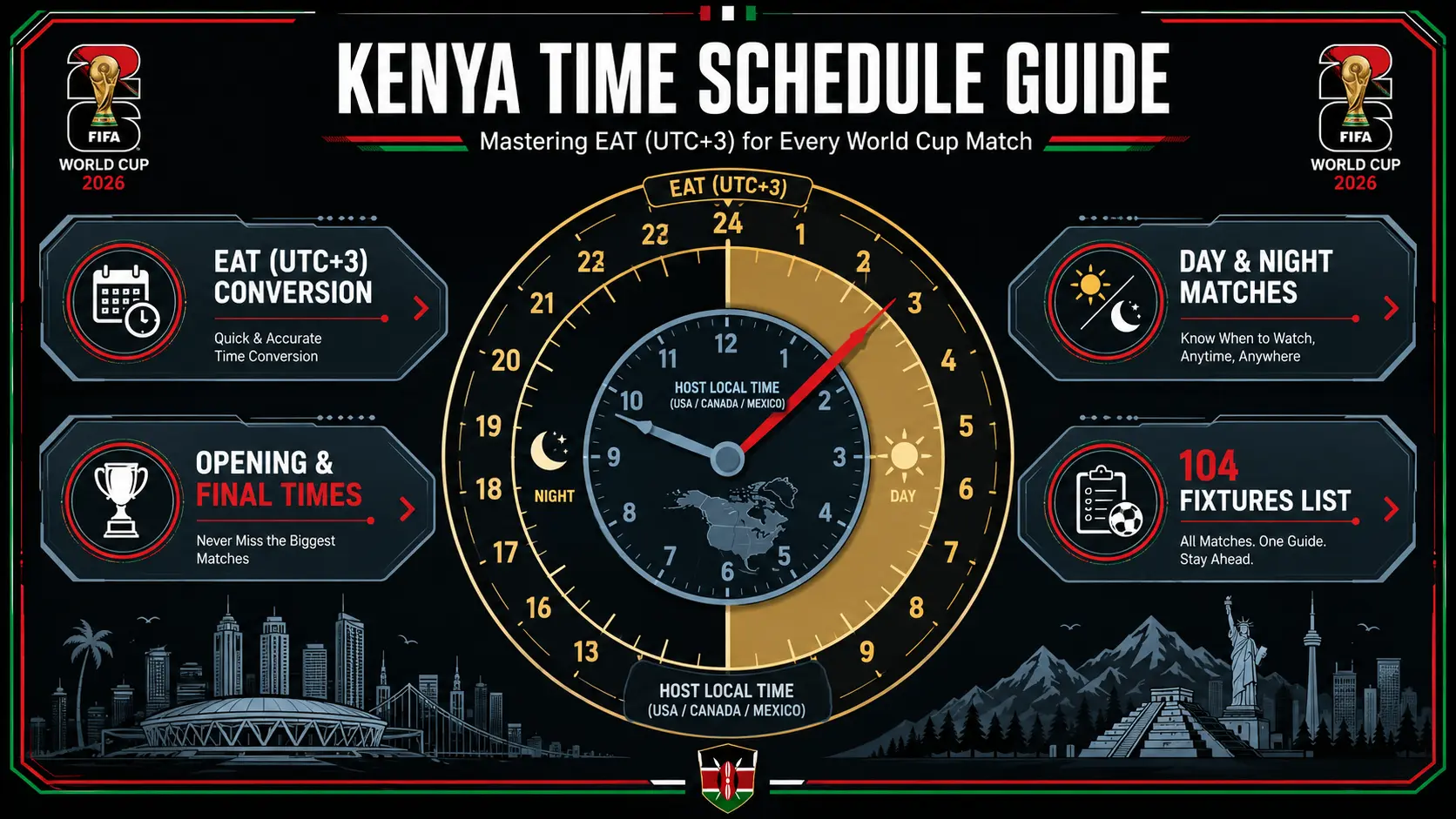
What Is EAT and Why It Matters for Kenya Football Fans
East Africa Time (EAT) represents the UTC+3 time zone used across Kenya and neighboring East African nations, providing a consistent reference point that remains unchanged throughout the year. Kenya operates under this standard alongside Tanzania, Uganda, Rwanda, Burundi, Ethiopia, and Madagascar, ensuring regional consistency for football fans sharing identical local times for international events. The UTC+3 designation places Kenya three hours ahead of Coordinated Universal Time, creating a stable temporal anchor for scheduling purposes.
Host nations of the 2026 World Cup observe daylight saving time practices that Kenya does not implement, creating variable time gaps throughout the tournament. Unlike the United States, Canada, and Mexico, Kenya maintains East Africa Time continuously without implementing seasonal clock adjustments. Clocks in Nairobi remain constant throughout June and July, avoiding the shifts that affect North American timekeeping and providing Kenyan supporters with a reliable, unchanging baseline when planning to watch matches.
The 2026 tournament spans 16 host cities across three countries, covering multiple North American time zones including Eastern, Central, Mountain, and Pacific times. Each of these zones observes daylight saving time, meaning their offset from UTC changes during the tournament months. Kenyan fans attempting manual calculations must account for these shifting differences, which vary depending on whether the United States and Canada are in standard time or daylight saving time during specific match dates.
The Risk of Manual Time Conversion for World Cup 2026
Manual conversion of World Cup 2026 kickoff times introduces significant risks of error due to the complexity of North American daylight saving practices and the similarity between time zone names. Naming similarities between East Africa Time and North American Eastern Time create significant confusion due to entirely different UTC offsets and seasonal practices. Eastern Standard Time (EST) functions as UTC-5, but shifts to Eastern Daylight Time (EDT) at UTC-4 during summer months, creating potential miscalculations of several hours for fans relying on social media posts showing “8 PM EST” without clarification.
International sports media and social platforms typically publish fixture times using the local time of the specific host city, listing kickoffs as Eastern, Central, Mountain, or Pacific times without clarifying the current DST status. Fans in Nairobi attempting to convert these times mentally must track which American cities observe daylight saving time on which dates, a calculation complicated by Mexico’s different DST schedule and Arizona’s non-observance of clock changes. Arithmetic errors become increasingly likely when processing 104 different matches across varying time zones over the tournament month.
The tournament format includes 104 matches played across 16 venues in three nations, creating an unmanageable workload for fans attempting individual time zone mathematics for each fixture. Single-digit hour differences shift unpredictably depending on the date, requiring constant recalculation rather than memorizing a fixed offset. Missed kickoffs represent the tangible consequence of these errors, with fans potentially arriving an hour late to viewing parties or switching on televisions after goals have already been scored.
How to Access the World Cup 2026 Schedule in Kenya Time
Pulser Kenya provides dedicated resources displaying the complete World Cup 2026 schedule already converted to East Africa Time, eliminating manual calculation errors entirely. The full World Cup 2026 schedule in Kenya Time page presents all 104 fixtures with kickoff times pre-converted to EAT, allowing fans to read their local viewing times directly without mathematical conversion. This comprehensive resource accounts for all North American daylight saving transitions automatically, ensuring accuracy regardless of whether matches occur in June or July.
Individual match pages on Pulser display specific kickoff times in East Africa Time for each fixture, enabling fans to save or share exact local times for games featuring their favorite teams. These pages provide single-match focus without requiring navigation through complex tables, displaying the EAT kickoff time prominently alongside match details. Fans planning around work schedules or local commitments can rely on these specific times without secondary verification.
Supporters seeking to track specific national teams can visit the team group schedules page to view their preferred side’s fixtures filtered and presented in Kenya time. The FIFA World Cup 2026 hub connects these resources seamlessly, offering navigation between group overviews and individual match details while maintaining consistent EAT formatting throughout. This integrated approach ensures Kenyan fans access accurate temporal information regardless of which specific matches they prioritize.
FAQ
What does EAT stand for in Kenya?
East Africa Time. It is UTC+3 and serves as the standard time zone for Kenya and neighboring East African countries.
Does Kenya change clocks for daylight saving time during World Cup 2026?
No. Kenya maintains EAT (UTC+3) throughout the year without seasonal clock changes, unlike the United States, Canada, and Mexico which will adjust their clocks during the tournament period.
How can I find World Cup 2026 kickoff times in Kenya time?
Use the Pulser full schedule page which lists all 104 matches already converted to East Africa Time, or visit individual match pages for specific fixture times in EAT.