
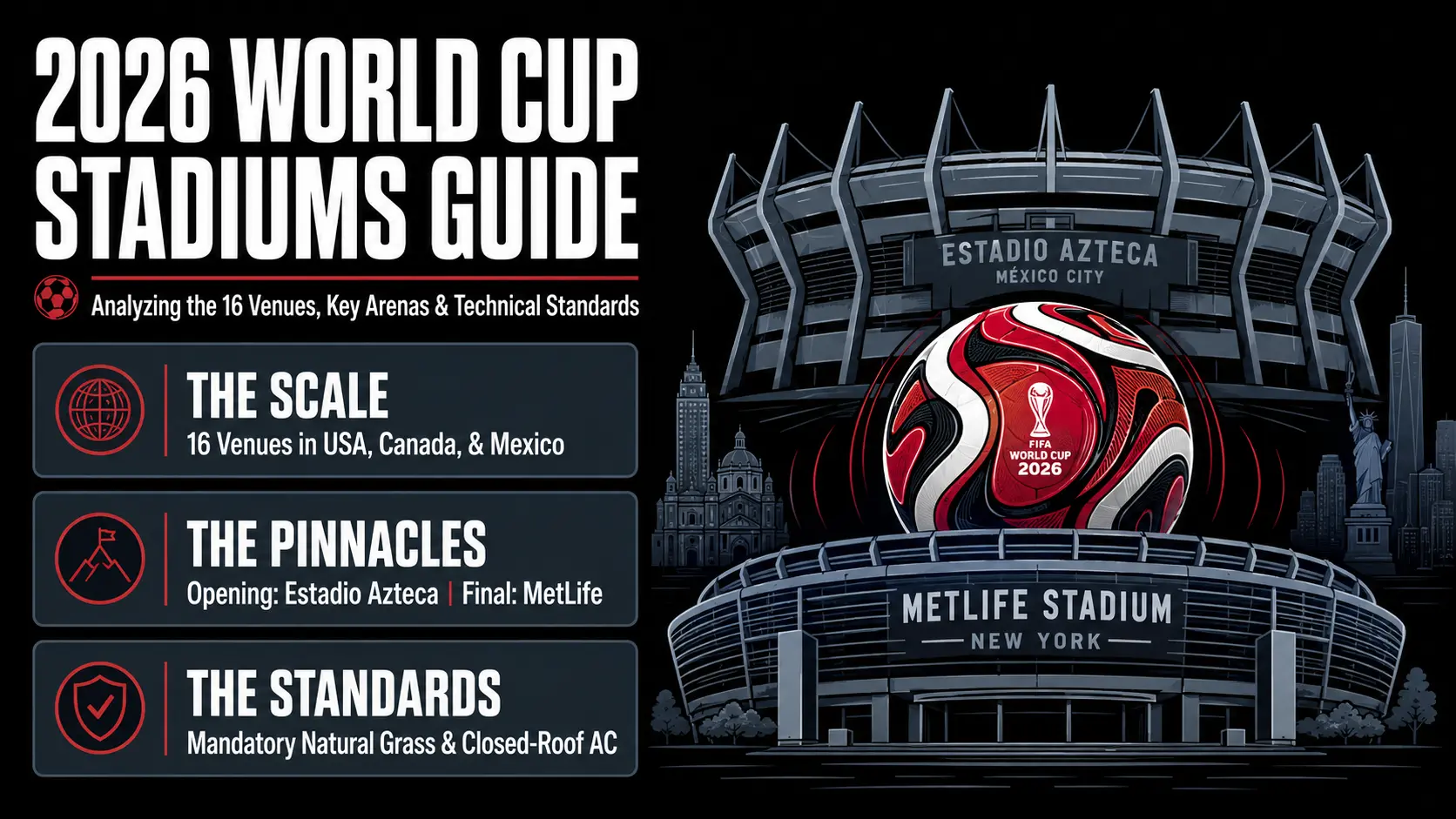
FIFA World Cup 2026 will kick off on June 11, 2026, making history by introducing an expanded 48-team format staged across 16 iconic venues in the United States, Mexico, and Canada. For traveling fans and local football enthusiasts alike, navigating this massive cross-continental event presents significant logistical challenges, ranging from tracking diverse stadium capacities and match schedules to managing regional travel distances across multiple time zones. This comprehensive guide serves as your ultimate planning resource, breaking down every host city, tournament venue, and transit solution. We analyze critical infrastructural details, including the historic opening match at Mexico City’s legendary Estadio Azteca and the crowning final showdown at MetLife Stadium (temporarily renamed the New York New Jersey Stadium). Additionally, our guide explores the physiological impacts of high-altitude playing environments, the technical specifications of mandatory natural grass installations, and transit tips. Whether you are looking for ticket pricing guidelines, stadium maps, or venue capacities, our objective analysis provides the precise information needed to successfully navigate this historic tournament.
How will the FIFA World Cup 2026 redefine athletic infrastructure from the opening whistle to the ultimate final?
The FIFA World Cup 2026 represents an unprecedented expansion in sports hosting, uniting three nations to stage 104 matches across 16 world-class venues. These world cup stadiums 2026 are undergoing significant structural and technological transformations to prepare for the massive influx of international teams and spectators. This monumental tournament will welcome 48 teams, making it the largest in football history, and its physical footprint will alter the sporting landscape of North America.
Estadio Azteca prepares to secure its legacy by hosting the historic opening match
Estadio Azteca in Mexico City will secure its position as a historic pillar of global football by hosting the highly anticipated opening match of the tournament on June 11, 2026. This iconic venue is the first in history to host matches in three separate iterations of the tournament, having previously anchored the finals in 1970 and 1986. While it retains its deep emotional legacy, extensive renovations have modernized its seating and facilities to meet current spectator demands.
MetLife Stadium steps up to anchor the world cup final under a temporary identity
MetLife Stadium, located in East Rutherford, New Jersey, will host the prestigious final match of the tournament on July 19, 2026, under the temporary name of New York New Jersey Stadium. This 87,157-capacity venue will serve as the climax of the competition. Because governing rules restrict the use of commercial sponsor names during the event, its identity has been temporarily shifted to highlight the surrounding metropolitan region rather than its corporate benefactor.
Why does FIFA mandate temporary grass installations alongside high-performance climate systems in major world cup stadiums 2026?
The upcoming FIFA World Cup 2026 has put intense pressure on host venues to meet rigid regulatory standards. Indeed, FIFA mandates that all matches during the tournament must be played on natural grass surfaces to ensure consistent ball rolling and optimal player safety across all world cup stadiums 2026. This requirement poses a major challenge for eight American venues that normally use synthetic turf for domestic American football games. To resolve this, specialized engineering teams have developed temporary grass systems that must integrate with advanced stadium technology.
Realizing the mandatory natural grass pitch transition across several premier NFL venues
The transition to a temporary Natural Grass Pitch at major NFL stadiums requires installing sophisticated turf layers directly over existing artificial turf. These installations must maintain strict soil moisture and turf density profiles throughout the grueling 39-day tournament. At venues such as SoFi Stadium, engineers even excavated millions of cubic yards of earth to adjust the pitch height and accommodate the broader FIFA dimensions.
Utilizing retractable roof designs and advanced air conditioning to manage extreme summer heat
Retractable roof configurations and high-performance climate control systems will play a decisive role in protecting players and spectators from the extreme summer heat of North America. Indoor venues in Dallas, Houston, and Atlanta will keep their roofs closed during matchdays to run internal air conditioning. This ensures a stable playing environment, avoiding the heavy humidity and heatwaves that typically affect outdoor matches in the southern United States.
How do regional venue clusters and severe altitude differences impact player stamina and travel logistics?
The FIFA World Cup 2026 organizers have divided the 16 host cities into three regional clusters to simplify the complicated travel logistics and reduce carbon emissions. These world cup stadiums 2026 are grouped using geographic clustering to divide the 16 venues into Western, Central, and Eastern regions. This geographic organization allows teams to play their group-stage matches within a single zone, avoiding exhausting transcontinental flights.
| Venue (Tournament Name) | Host City | Region | Capacity | Special Feature |
|---|---|---|---|---|
| New York New Jersey Stadium | East Rutherford, USA | Eastern | 87,157 | World Cup Final Venue |
| Estadio Azteca | Mexico City, Mexico | Central | 83,000+ | Opening Match Venue, High Altitude |
| Dallas Stadium | Arlington, USA | Central | ~94,000 | Highest Capacity, Retractable Roof |
| Los Angeles Stadium | Inglewood, USA | Western | 70,000+ | Translucent Roof, Lowered Pitch |
Examining the division of host cities into western central and eastern regions
Host cities in the Western, Central, and Eastern regions are clustered to limit total travel distances and help fans navigate the tournament’s 2,800-mile footprint. For example, the United States national team will play its group matches entirely in the Western region, utilizing venues in Los Angeles and Seattle. This grouping ensures that travel times remain manageable during the initial phase of the competition.
Understanding the physiological strain of playing in thin air at high elevation venues
Altitude challenges at high-elevation host cities like Mexico City and Guadalajara will test the physical limits of competing athletes. Playing at 2,200 meters above sea level in Estadio Azteca or 1,600 meters in Estadio Akron significantly reduces oxygen intake. It also alters the aerodynamic behavior of the ball, forcing players and coaching staffs to adjust their tactical approaches and conditioning routines well in advance.
Modern world cup stadiums 2026 seek to balance rigorous green certification with public transit connectivity challenges
Modern world cup stadiums 2026 face the dual challenge of achieving prestigious environmental certifications while managing the difficult transport realities of suburban North American infrastructure. As we look at the logistics of the FIFA World Cup 2026, finding a balance between green design and fan accessibility is critical. However, the contrast between green venue design and car-centric local transportation highlights the complexity of organizing a truly sustainable mega-event.
Implementing LEED certification standards alongside smart stadium infrastructure for sustainable event hosting
Sustainability and LEED certification standards have been integrated into the design and retrofitting plans of nearly all participating tournament venues. These green credentials are supported by smart stadium infrastructure, including energy-efficient LED lighting, water recycling systems, and 5G-powered crowd-management technologies. This combination allows operators to track resource consumption in real-time, significantly lowering waste during high-attendance matchdays.
- 5G Ultra-Wideband Connectivity: Facilitates seamless real-time data transfer for stadium operations and digital fan engagement.
- Automated Energy Management Systems: Reduces power consumption by automatically adjusting lighting and climate control based on occupancy.
- Contactless Concessions and Turnstiles: Speeds up stadium entry and transaction times to prevent bottlenecking at the gates.
Combining high-end luxury suites with local attractions to deliver an elevated fan experience
Luxury suites and high-end hospitality spaces within the venues are designed to merge elite sports viewing with premium local tourism. These premium spaces offer corporate and high-net-worth fans exclusive amenities while promoting local attractions and cultural landmarks in the surrounding host cities. This integration ensures that the economic benefits of the tournament extend far beyond the pitch itself.
FAQ
The following frequently asked questions address the most critical aspects of the world cup stadiums 2026 to help spectators plan their journeys. We have compiled these answers to cover key details of the FIFA World Cup 2026 venues.
Where are the World Cup stadiums in 2026?
The World Cup stadiums in 2026 are distributed across 16 host cities in the United States, Mexico, and Canada, strategically divided into Western, Central, and Eastern regions. The United States features 11 host venues, Mexico has 3, and Canada provides 2. This wide geographic distribution ensures that communities throughout North America can experience the live matches of this expanded tournament.
Which stadium will be used for the 2026 World Cup final?
New York New Jersey Stadium, commonly known as MetLife Stadium in East Rutherford, New Jersey, will host the highly anticipated final match of the tournament. This massive stadium will hold more than 87,000 spectators for the concluding game on July 19, 2026. Because of tournament naming regulations, its commercial name has been temporarily suspended.
Which countries are hosting the World Cup 2026?
The United States, Mexico, and Canada are jointly hosting the tournament, marking the first time in history that three nations have co-hosted a world cup. While the majority of the knockout matches will take place in the United States, both Canada and Mexico will host crucial group stage matches and early knockout rounds within their territories.
What’s the biggest stadium in the World Cup 2026?
Dallas Stadium, officially known as AT&T Stadium in Arlington, Texas, is the largest venue in terms of capacity, accommodating up to 94,000 spectators. This stadium features a giant high-definition screen and a fully retractable roof system. It will also host the highest number of matches in the tournament, including a semifinal.
Where are all the locations for the World Cup?
The complete locations for the tournament include major metro areas across North America, including Vancouver, Seattle, San Francisco, Los Angeles, and Guadalajara in the West. The Central region includes Kansas City, Dallas, Houston, Atlanta, Monterrey, and Mexico City. The Eastern region completes the list with Toronto, Boston, New York, Philadelphia, and Miami.
How expensive are World Cup tickets in 2026?
World Cup tickets in 2026 are expected to vary significantly depending on the seat category, match phase, and official hospitality packages. While early group-stage tickets remain the most accessible option for local and international fans, high demand is driving secondary market values higher. All host cities have passed legislation to exempt these tickets from local sales taxes, helping to reduce the overall burden on fans.
References
- 2026 FIFA World Cup (Wikipedia)
- Stadiums | FIFA World Cup 2026™ (FIFA)
- World Cup 2026 | Match schedule, fixtures & stadiums (FIFA)