
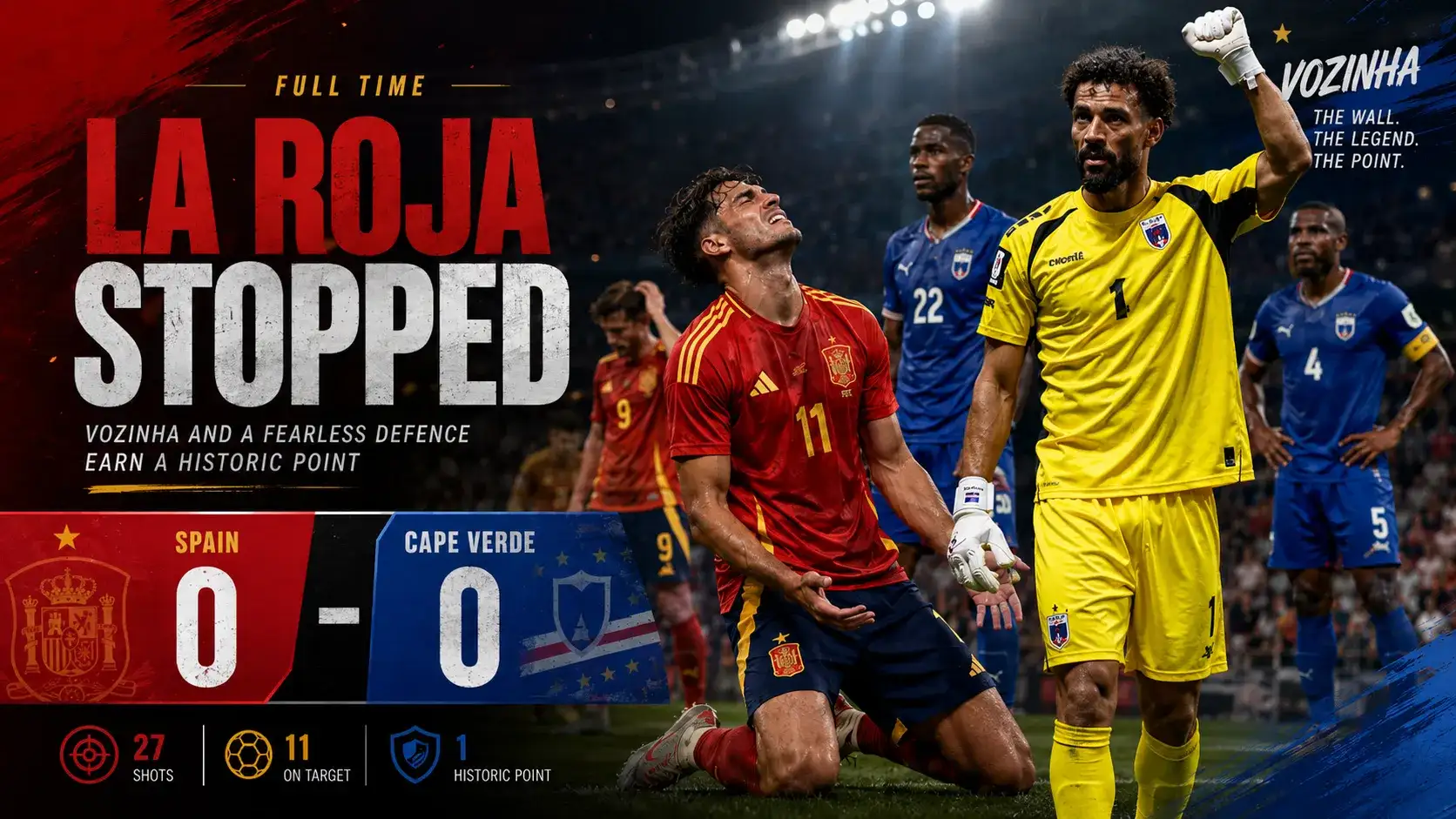
Why Spain’s 27 Shots Produced No Goals: Volume vs Quality
Twenty-seven attempts look impressive on a match summary, yet the majority arrived from outside the penalty area or struck congested Cape Verde bodies rather than testing Vozinha with clear-cut chances. Speculative efforts from Fabian Ruiz and other Spanish midfielders inflated the statistics without genuinely troubling the forty-year-old goalkeeper, who faced fewer than five shots from inside the six-yard box despite Spain’s territorial dominance. Blocked shots and deflected attempts further padded the numbers without representing genuine scoring opportunities.
Possession statistics painted a picture of Spanish dominance, but the rhythm of La Roja’s play allowed Cape Verde to maintain their defensive structure without panic. Slow, lateral circulation across midfield gave the Blue Sharks ample time to shuffle across and protect central corridors, resulting in sterile domination that rarely penetrated the final third with incision or speed. The predictable tempo enabled Cape Verde to defend in a low block that never had to stretch or recover from being pulled out of position, effectively neutralizing Spain’s technical superiority through organization rather than individual duels.
Specific moments defined Spain’s attacking frustration and highlighted a lack of clinical execution under pressure. Ferran Torres rattled the crossbar with a fierce strike after cutting inside from the right flank, and later found himself denied by Vozinha from close range after excellent positioning in the six-yard box. Mikel Oyarzabal squandered a promising opening through a heavy first touch that allowed defenders to recover when a cleaner connection would have produced a clear shooting opportunity. Fabian Ruiz repeatedly elected to shoot from ambitious angles outside the penalty area rather than probing for better options, while crosses from advanced positions found Cape Verde defenders who had organized themselves to deal with aerial threats comfortably.
Second-half substitutions involving Lamine Yamal and Dani Olmo injected pace and directness, but the changes arrived too late to dismantle Cape Verde’s well-established defensive organization. By the time these creative outlets entered the match, the Blue Sharks had settled into a rhythm of clearances and recovery runs that minimized the impact of fresh legs. Spain’s inability to vary their attacking approach from the opening whistle ultimately cost them two valuable points in a group where goal difference and head-to-head records could determine qualification fate. For full match details and line-ups, Pulser has complete coverage of this Group H fixture.
Cape Verde’s Defensive Masterclass: Vozinha and the Compact Block
Vozinha, competing at forty years of age, commanded his penalty area with seven crucial saves while organizing a backline that refused to panic despite sustained Spanish pressure. His handling of crosses and aggressive positioning when claiming loose balls eliminated second-phase opportunities that Spain typically convert against less organized opposition, while his vocal leadership ensured defenders maintained their shape during extended periods without the ball. Veteran presence between the posts provided the psychological foundation for Cape Verde’s historic resilience.
Tactical discipline formed the foundation of the Blue Sharks’ resistance against technically superior opponents. A compact mid-block denied Spain access to dangerous central spaces between the defensive and midfield lines, with Pico Lopes producing a crucial defensive block when La Roja finally worked the ball into threatening positions inside the penalty area. Cape Verde deliberately funnelled Spanish attacks toward the flanks, knowing that crosses into a prepared box posed less danger than intricate combination play through the middle. The defensive unit maintained vertical compactness that prevented Spain’s attacking midfielders from finding pockets of space in front of the center-backs, forcing La Roja to attempt lower-percentage options from distance.
Set-piece situations highlighted Cape Verde’s organizational preparation, as they successfully defended numerous corners and free-kicks without conceding clear headers or scrambled goals. Spanish aerial threats found themselves matched physically and tactically, with Cape Verde’s markers maintaining contact and clearing their lines decisively rather than allowing sustained pressure to build from dead-ball scenarios. Vozinha’s command of his six-yard box proved particularly decisive during these moments.
Energy levels remained remarkably high throughout the ninety minutes, allowing Cape Verde to threaten more than just a defensive point as the match progressed. Counterattacking sequences involving Diney Borges and Ryan Mendes created genuine anxiety in the Spanish defense during the closing stages, with Mendes utilizing his experience to hold possession and draw fouls that relieved pressure on the backline. These late moments suggested the African side could have stolen a famous victory rather than merely holding on for a draw, with Borges demonstrating the pace to trouble Spain’s high defensive line on transitions. The ability to maintain defensive concentration while still posing an attacking threat spoke to excellent physical preparation and mental toughness from a squad making their first appearance on football’s biggest stage.
Group H Implications: Spain Under Pressure, Cape Verde Dreaming
Spain now faces genuine qualification pressure ahead of their remaining Group H fixtures against Saudi Arabia and Uruguay. La Roja must secure positive results in both matches to avoid a humiliating group stage exit, requiring Luis de la Fuente to introduce greater penetration and vertical speed from the opening whistle rather than relying on late introductions of impact substitutes like Yamal. The draw against Cape Verde leaves Spain vulnerable to the possibility that both Uruguay and Saudi Arabia could accumulate more points from their opening fixtures, forcing La Roja into must-win scenarios that increase psychological pressure on a squad expected to challenge for the trophy.
Cape Verde’s historic achievement in earning their first ever World Cup point validates their conservative tactical approach and creates genuine optimism for progression beyond the group stage. The defensive masterclass demonstrated that the Blue Sharks possess the organizational quality to compete with established football nations, providing a psychological platform for their remaining group matches. Manager Bubista can approach fixtures against Uruguay and Saudi Arabia with the confidence that his defensive system has proven effective against one of the tournament’s most possession-heavy sides, potentially allowing Cape Verde to target specific moments in those matches where counterattacking opportunities arise against more adventurous opponents.
Group H dynamics have shifted dramatically following this result, creating a genuinely open qualification battle. Uruguay and Saudi Arabia must recalculate their approach knowing that Spain no longer looks guaranteed to top the group, while Cape Verde enters their subsequent fixtures with momentum and the belief that they can frustrate favorites. The qualification mathematics now suggest that a single victory in their remaining two matches could be sufficient for Cape Verde to advance, while Spain cannot afford another slip against opponents who will study this match intently to identify weaknesses in La Roja’s approach to compact defensive blocks. Kenyan fans should check the complete World Cup 2026 schedule in Kenya Time to plan viewing for these decisive fixtures, while updated Group H standings and fixtures will track the qualification race.