
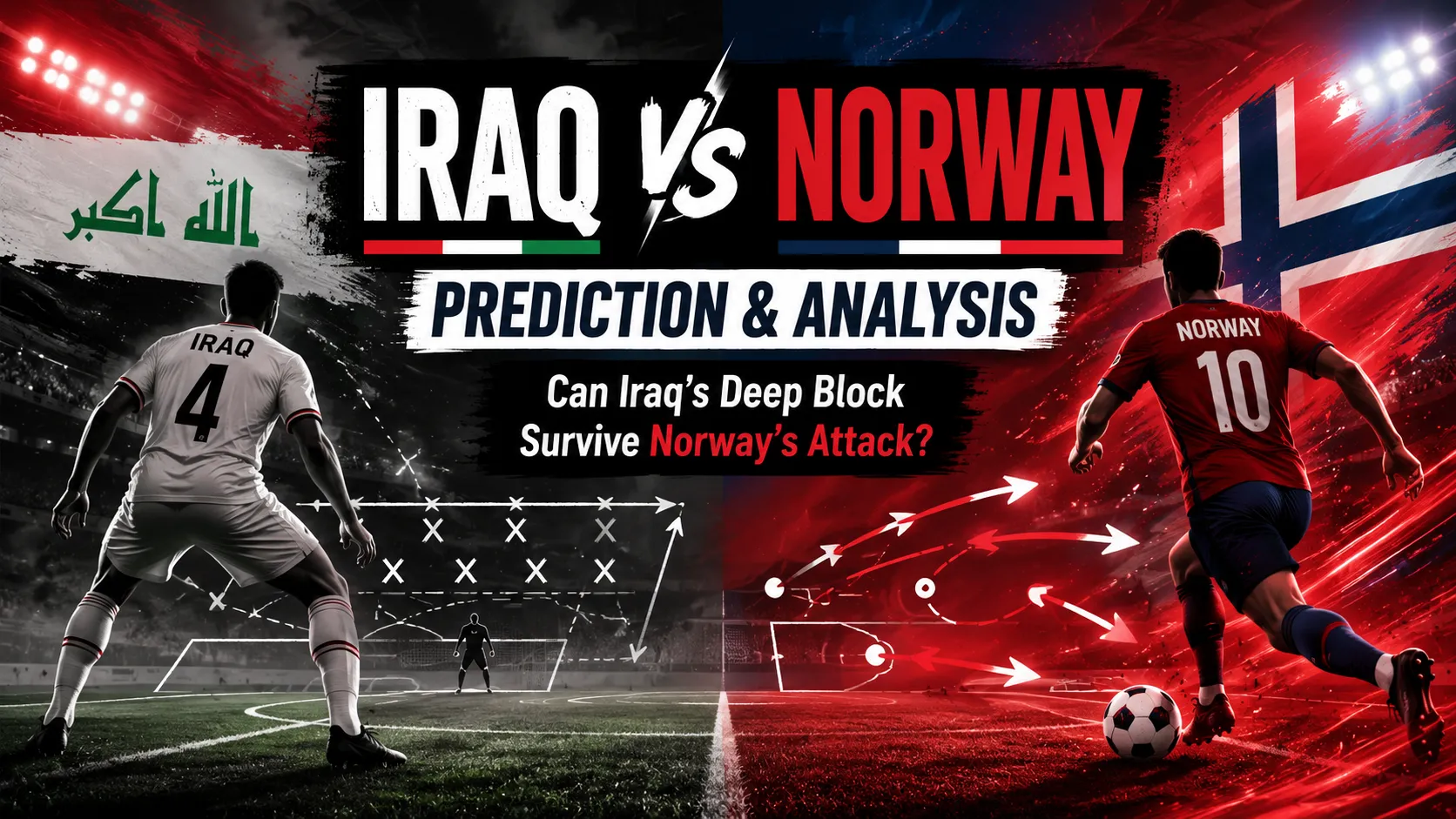
Match Prediction and Kenya Time Viewing Guide
Norway are predicted to secure a 2-0 victory against Iraq in their Group I encounter at Boston Stadium on 17 June 2026, with the match kicking off at 01:00 East Africa Time (EAT) and creating a demanding late-night viewing schedule for football fans across Kenya, Tanzania, and Uganda. The 01:00 EAT start time corresponds to 18:00 local time in Boston on 16 June, meaning East African supporters must set alarms for the early hours of Tuesday morning to catch the Lions of Mesopotamia’s first World Cup appearance in four decades. The full World Cup 2026 schedule in Kenya Time confirms this fixture as part of a packed opening week requiring significant nocturnal commitment from audiences in the UTC+3 timezone, with many Group I matches falling similarly late.
Historical significance elevates this fixture beyond a standard group-stage opener, as Iraq return to football’s biggest stage for the first time since their 1986 campaign in Mexico, while Norway end a 28-year absence stretching back to the 1998 tournament in France where they memorably defeated Brazil. Graham Arnold guided Iraq through an arduous 21-match qualification marathon to secure this berth, instilling a collective defensive identity that contrasts sharply with Norway’s star-driven approach featuring Erling Haaland and Martin Ødegaard. The Group I standings reveal the brutal competitive context, with reigning champions France and dangerous African qualifiers Senegal completing a quartet where even a single point could prove decisive in the race for second place.
Norwegian optimism rests upon a flawless qualification record that saw Ståle Solbakken’s side win all eight matches while scoring 37 goals, a tally heavily inflated by Haaland’s remarkable 16 strikes during the campaign. Solbakken has constructed a system maximizing the Manchester City striker’s movement between center-backs, supported by Ødegaard’s creative passing from advanced midfield positions and the varied threats of Alexander Sørloth, Antonio Nusa, and Oscar Bobb stretching defensive structures horizontally. Editorial analysis suggests that while Iraq’s organized resistance can limit clear-cut opportunities for 60-70 minutes, Norway’s sustained pressure and set-piece quality should eventually produce the breakthrough moments necessary for a comfortable 2-0 margin. The Iraq vs Norway match page provides stadium-specific details and real-time updates for Kenyan readers tracking the action live.
Tactical Breakdown: Can Iraq’s Deep Block Neutralize Haaland and Ødegaard?
Iraq’s compact defensive block possesses the structural discipline to frustrate Haaland and Ødegaard for substantial periods, yet completely nullifying Norway’s multi-layered attacking system for the full 90 minutes without conceding appears statistically improbable given the European side’s varied chance-creation methods. Graham Arnold has implemented a flexible 4-5-1 or 5-4-1 formation that prioritizes central space denial above all other defensive principles, recognizing that Haaland becomes significantly less dangerous when service lines are severed rather than when he receives the ball with defenders committed to direct physical confrontations. Amir Al Ammari operates as the primary screening midfielder, tasked with intercepting passes intended for Ødegaard between the lines while maintaining positional discipline to prevent Norwegian runners from exploiting the gaps that open when defenders focus too intently on Haaland’s positioning.
Norway’s attacking threat extends far beyond Haaland’s individual finishing capabilities, with Ødegaard providing the creative glue through half-space receptions and penetrative final balls that complement the striker’s blindside runs behind center-backs. Ødegaard’s pre-tournament fitness concerns have been dismissed by the Norwegian medical staff, ensuring the Arsenal captain arrives at full capacity to unlock compact defenses through combination play rather than relying solely on crosses from wide areas. Supporting attackers including Sørloth’s aerial presence from the right, Nusa’s dribbling threat from the left, and Bobb’s ability to invert from wide positions create a multi-directional assault that prevents Iraq from simply double-marking Haaland and hoping to survive.
The critical tactical battleground emerges in the midfield third, where Iraq must decide whether to apply pressure to Ødegaard and risk leaving space behind the midfield line, or to drop into a deep block and allow the Norwegian playmaker time to survey the field from static positions 30 yards from goal. Arnold’s defensive strategy specifically aims to force Norway toward the flanks and away from the high-value central zones where Haaland feasts on cutbacks and through-balls, betting that crossing scenarios against multiple defenders represent lower-risk propositions. Historical evidence from Norway’s qualification campaign demonstrates that even well-organized opponents eventually crack under the relentless volume of attacks, with Haaland averaging a goal every 47 minutes during that dominant sequence.
Iraq’s Counterattack Threat and Group I Qualification Pressure
Iraq’s offensive escape routes rely primarily on Ali Jasim’s explosive pace in wide transition moments and Aymen Hussein’s physical ability to secure long diagonals against Norway’s high defensive line, offering a plausible counterattacking formula if they can bypass the initial press. Direct balls targeting Hussein’s chest or feet provide the platform for lay-offs to Jasim, whose acceleration down the channels represents Iraq’s most dangerous weapon against Norway’s aggressive full-backs when both push forward simultaneously. Set-piece efficiency offers another potential equalizer, with Jalal Hassan’s commanding presence from goal kicks and corner situations capable of generating headed opportunities against a Norwegian backline that has occasionally shown vulnerability when defending organized aerial deliveries into the six-yard box.
Norway’s defensive structure carries inherent transition risks that Iraq must exploit ruthlessly to have any realistic chance of avoiding defeat, particularly the pockets of space that appear behind the full-backs when both commit to advanced supporting positions during sustained attacks. The psychological weight of expectation sits heavily on Norwegian shoulders given their 28-year absence and the narrative surrounding Haaland’s first World Cup appearance, meaning a scoreless first hour could induce tactical impatience and individual over-commitment from Solbakken’s side. Iraq’s players benefit from the relative freedom of underdog status, with the 40-year gap since their last finals appearance insulating them somewhat from the crushing pressure that might otherwise accompany such a historic occasion.
Group I qualification dynamics intensify the stakes for both managers, as the presence of France and Senegal means neither team can realistically afford to drop points in this fixture and still expect to advance to the knockout rounds. Norway enters as heavy favorites and must therefore attack with numbers and authority, a requirement that paradoxically creates the transitional vulnerabilities Jasim and Hussein are tasked with exploiting. The FIFA hub at Pulser provides comprehensive coverage of how results here will reverberate through the group, with a draw serving Norwegian interests far better than Iraqi ones given the remaining fixtures against the section’s superpowers.