
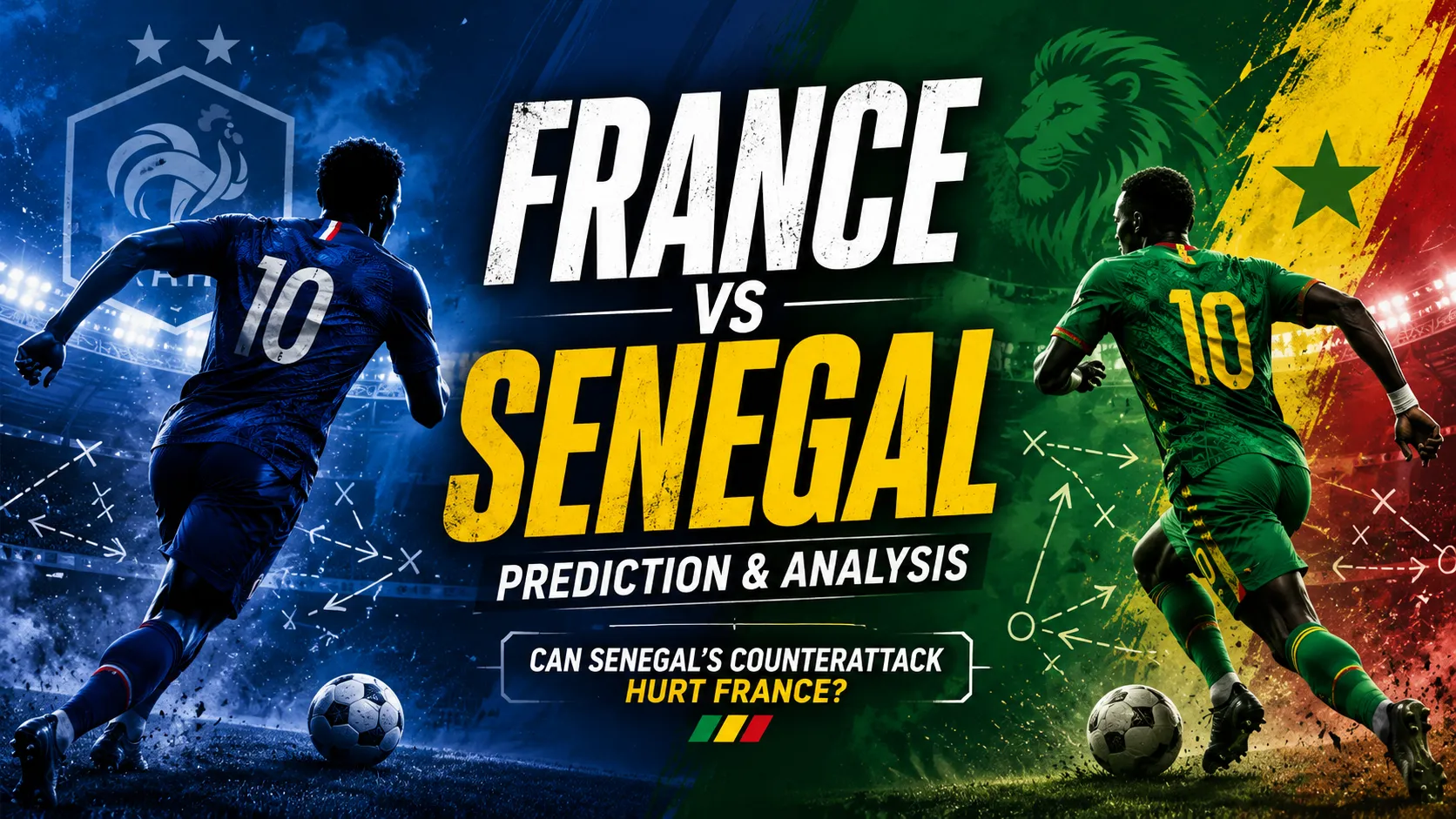
France vs Senegal Prediction: Match Overview and Kenya Viewing Details
France enter this World Cup opener as clear favorites with a projected 2-1 victory, though Senegal possess the tactical discipline and individual quality to punish any complacency from Didier Deschamps’ star-studded squad. The match represents one of the most intriguing opening-day fixtures of the tournament, pitting European individual brilliance against African collective organization in a group that promises little margin for error.
Kickoff at New York New Jersey Stadium arrives on 16 June 2026 at 22:00 East Africa Time, providing Kenyan viewers with convenient evening viewing. Fans seeking complete fixture information should consult the full World Cup 2026 schedule in Kenya Time to plan their viewing calendar around this and other Group I matches. The 22:00 EAT start time places the game squarely in prime time for East African audiences, avoiding the late-night kickoffs that often complicate following European-based tournaments.
Evening kickoffs at 22:00 EAT allow Kenyan supporters to watch the full match without the fatigue of post-midnight finishes that often accompany European club football. This scheduling places the game within ideal social viewing hours, enabling fans to follow the action on television or streaming platforms before midnight, then process the result’s implications for the group table ahead of the next day’s fixtures.
Group I presents a challenging pathway for both teams, containing Norway’s organized pressing system and Iraq’s tactical flexibility alongside these two heavyweights. The Group I standings and fixtures reveal that only the top two teams advance automatically to the Round of 32, with the third-place team facing an uncertain qualification path dependent on comparisons with other groups. A defeat for either side in this opener would immediately place enormous pressure on their remaining fixtures against Norway and Iraq, making the first goal and early momentum critical psychological factors.
Historical context inevitably circles back to the 2002 World Cup, when Senegal defeated defending champions France 1-0 in Seoul. Current Senegal coach Pape Thiaw sat on the bench as an unused substitute during that famous victory, providing a direct narrative thread between the two eras. That result serves as a warning against French complacency rather than a predictive template, as the 2026 tactical landscape bears little resemblance to the personnel and systems deployed 24 years prior. The psychological weight of that upset may linger in French minds, but Thiaw’s current squad must generate its own history rather than rely on past glories.
Tactical Analysis: France’s Attacking Coordination vs Senegal’s Counterattacking Discipline
France’s overwhelming individual talent in attack creates selection headaches for Didier Deschamps that could determine whether Les Bleus dominate possession or become vulnerable to Senegal’s organized transitions. The manager faces the luxury problem of accommodating Kylian Mbappé, Ousmane Dembélé, Michael Olise, Désiré Doué and Bradley Barcola without creating positional congestion that stifles the team’s fluidity.
Deschamps must decide whether to deploy these forwards in rigid positional structures or grant them rotational freedom that risks defensive imbalance. Mbappé’s tendency to drift centrally from nominal wide positions, combined with Dembélé’s preference for hugging the touchline before cutting inside, could create overlapping runs that confuse Senegal’s backline or conversely clog the central channels. The addition of Olise’s left-footed creativity from the right flank and Doué’s versatility adds further complexity to the attacking chemistry. France’s success likely depends on whether these individual stars can develop coordinated movement patterns that create space for one another, rather than devolving into isolated one-on-one duels against Senegal’s physically imposing defenders.
Senegal’s primary threat emerges through rapid vertical transitions orchestrated by Sadio Mané’s experience and Ismaïla Sarr’s explosive running. Pape Thiaw’s system relies on compact midfield coverage to force turnovers before releasing these wide forwards into channels behind France’s advanced full-backs. Iliman Ndiaye’s clever movement between the lines and Nicolas Jackson’s direct running offer varied attacking profiles that can exploit different phases of French defensive transition. The physical presence of Senegal’s midfield disrupts passing rhythms, while the pace of their front three ensures France cannot afford cheap possession losses in advanced areas.
The individual duel between Mbappé and Kalidou Koulibaly carries particular significance, as the Senegalese captain’s combination of physical strength and reading of the game presents a different challenge to the pace-based defenders Mbappé typically faces in La Liga. Koulibaly’s ability to delay and channel runners without committing to early tackles could force Mbappé into wider areas less dangerous to Edouard Mendy’s goal.
Defensive vulnerabilities on both flanks present decisive tactical battlegrounds. Senegal must protect the diagonal spaces between full-back and centre-back when France rotate their wide forwards centrally, a channel that Mbappé particularly favors when cutting inside from the left. Conversely, France’s midfield must provide adequate protection against Senegal’s quick breaks, requiring disciplined positioning from their pivot players when attacks break down. The aerial presence of Koulibaly and Mendy’s command of the penalty area provide Senegal with defensive security against crosses, forcing France to break down a compact low block through intricate combination play rather than direct service.
Key Decisive Factors: Team News, Critical Duels and Group I Stakes
William Saliba’s return to full training following a back issue and Jules Koundé’s recovery from a knock provide defensive reassurance for France, yet Kylian Mbappé enters under pressure after failing to score in warm-up matches against Ivory Coast and Northern Ireland. The Arsenal defender’s availability stabilizes France’s backline, allowing Deschamps to field his preferred partnership alongside Dayot Upamecano or Ibrahima Konaté. Koundé’s versatility across the backline offers tactical flexibility, though his fitness remains crucial for maintaining width in France’s buildup play.
Mbappé’s goal drought in pre-tournament friendlies introduces an intriguing subplot regarding his psychological state heading into football’s biggest stage. The Real Madrid forward’s World Cup record remains exceptional, but his recent struggles in front of goal could either motivate a statement performance or deepen frustration against organized opposition. Senegal’s defensive planning will center on denying Mbappé space in transition, forcing him to receive possession with his back to goal against Koulibaly’s physical marking.
Set pieces and midfield turnovers represent match-deciding elements beyond open play. Both teams possess significant aerial threats from defensive positions, with France’s center-backs and Senegal’s Koulibaly presenting danger from corners and free-kicks. The importance of the first goal looms large in a tight Group I opener; an early French lead would force Senegal to abandon their compact defensive shape, while a Senegalese opener would allow them to deploy their devastating counterattack against a desperate French press. Midfield duels between Senegal’s physical enforcers and France’s technical playmakers will determine which team controls the tempo and territorial advantage.
The expanded 48-team format creates complex qualification mathematics where third-place teams can advance, yet dropping points against a direct rival like Senegal would still compromise France’s seeding for the knockout rounds and their ability to avoid early meetings with other group winners. A draw would leave both teams vulnerable to Norway’s organized pressing or Iraq’s counterattacking efficiency in subsequent matches, making this opener effectively a qualification six-pointer despite the tournament’s expanded format.
The France vs Senegal match page will provide live updates, confirmed lineups and team news as the fixture approaches, while the FIFA hub offers comprehensive tournament coverage beyond this single fixture. Qualification implications extend beyond this result, as the pathway to the Round of 32 requires navigating Norway’s organized approach and Iraq’s tactical flexibility. A Senegal victory would still constitute a significant achievement in 2026, though perhaps less shocking than the 2002 upset given the current development of African football and the Teranga Lions’ established status as a competitive international force. Three points for France would establish immediate control of the group, while any other result would open fascinating permutations for the remaining fixtures.