
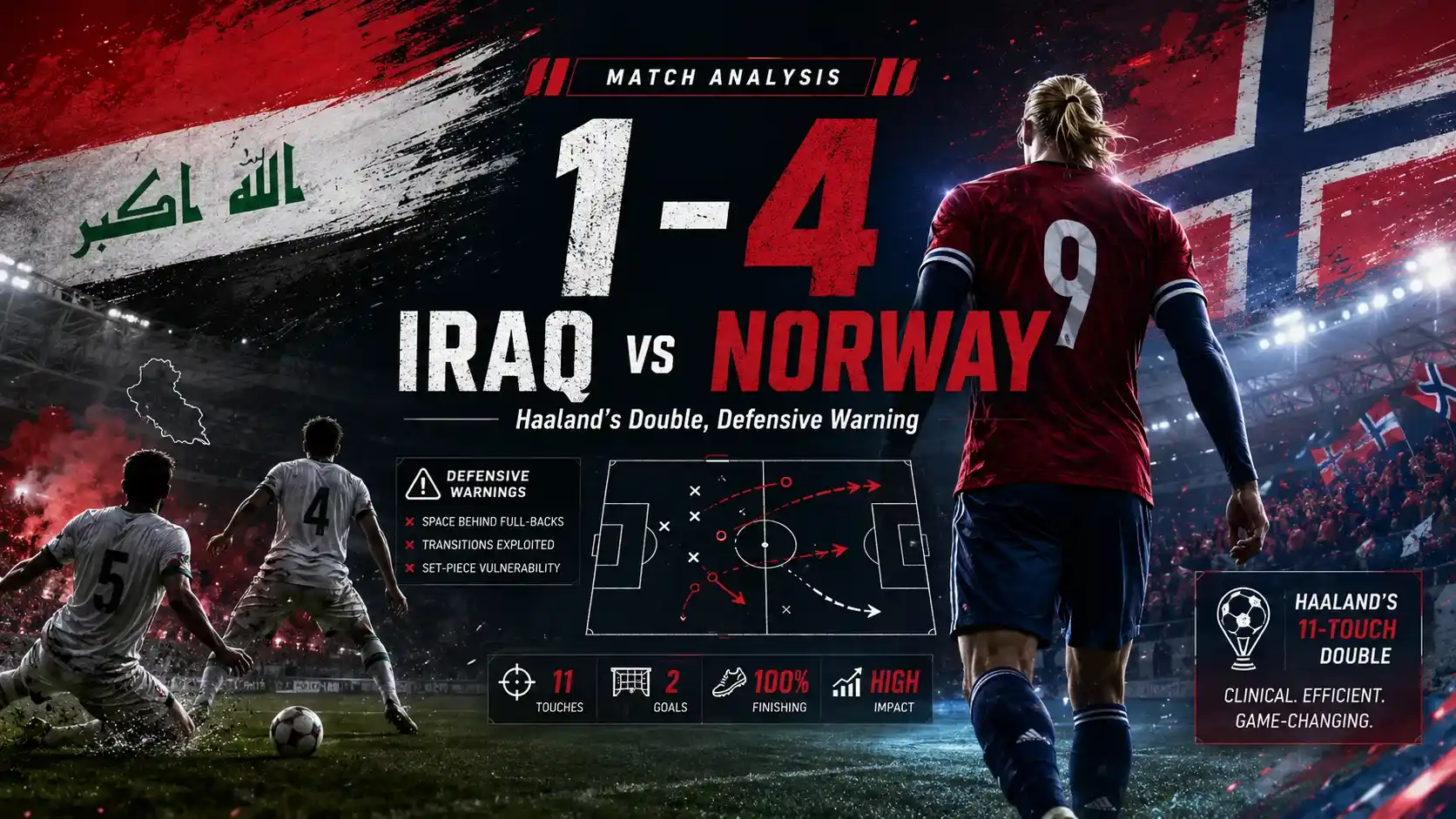
The Scoreline vs The Story: Why Iraq Made Norway Sweat Despite a 4-1 Defeat
The four-goal margin recorded in the full match details suggests a comfortable Norwegian stroll through their World Cup opener, yet the actual flow of play revealed a far more contested affair that should concern Ståle Solbakken ahead of tougher assignments. Iraq controlled large portions of the first half, particularly during the final fifteen minutes before the interval when their midfield pressure forced Norway into hurried clearances and exposed the Scandinavian side’s discomfort when pressed high up the pitch. Rather than managing the game from a position of authority, Norway found themselves pinned back for significant stretches, with Iraqi runners finding space between the lines and delivering crosses that repeatedly tested Norway’s aerial organization.
Aymen Hussein’s 39th-minute equaliser demonstrated exactly how vulnerable Norway appeared when defending direct balls into the channels. The goal arrived from Amir Al Ammari’s whipped cross from the right flank, with the Iraqi striker beating his marker to the delivery and finishing clinically past the Norwegian goalkeeper. This was no fortunate strike against the run of play but rather the culmination of sustained Iraqi pressure that saw Martin Ødegaard forced deeper and deeper to collect possession, reducing Norway’s creative output to sporadic moments rather than sustained control. The defensive transition issues that plagued Norway during these sequences—full-backs caught high, central defenders retreating awkwardly, and a midfield unable to screen the back four—will certainly have been noted by Senegal’s coaching staff ahead of their upcoming encounter.
When comparing this result to our pre-match prediction of a 2-0 Norway victory, the win itself was correctly anticipated, but Iraq’s capacity to score and create multiple chances invalidated the expectation of a Norwegian clean sheet. The prediction had warned that Norway could be exposed when committing players forward, yet the reality proved more severe than anticipated, with Iraq generating enough pressure to suggest they were the superior side during the first half’s closing stages. The final fifteen minutes before halftime belonged to Iraq, whose intensity in the tackle and willingness to run beyond Norway’s defensive line created a scenario where the 4-1 scoreline became almost unrecognizable from the actual pattern of play.
Haaland’s 11-Touch Masterclass: Efficiency That Masks Norway’s Flaws
Erling Haaland’s World Cup debut delivered exactly the ruthlessness that defines his international career, with the Manchester City striker converting two first-half opportunities from a mere eleven touches to reach 57 goals in 51 appearances for his country. The opening goal in the 29th minute showcased Haaland’s world-class movement, as he darted toward the far post to meet David Møller Wolfe’s low driven cross, guiding the ball home with the precision of a player who needs only half a chance to change a match. This finish required no sustained possession dominance from Norway, no intricate passing sequences through midfield, and no particular control of the game’s tempo—only Haaland’s innate understanding of space and timing to drift away from his marker and apply the decisive contact.
The second goal four minutes before halftime arrived through entirely different means but equally demonstrated why Haaland remains one of the most devastating strikers in world football. Iraq goalkeeper Jalal Hassan hesitated fatally while attempting to deal with a weak back pass under pressure, and Haaland’s relentless closing down forced the error that saw the ball rebound off the striker’s body and into the net. This was not a constructed team goal but rather the product of individual defensive panic induced by Haaland’s presence, a reminder that he can punish opponents without requiring service or possession. The efficiency was almost absurd: eleven touches, two goals, and a match-winning contribution before halftime had even concluded.
Yet this extreme efficiency masks fundamental concerns about Norway’s overall play that cannot be ignored when assessing their prospects against stronger opposition. Martin Ødegaard endured a quieter and less controlled performance than his reputation suggests, struggling to dictate tempo against Iraq’s aggressive midfield pressing and often finding himself bypassed by quicker, more physical opponents. The question looming over Norway’s campaign is whether they can continue to depend on Haaland’s clinical nature when facing the superior quality of France or the athletic intensity of Senegal, given that their midfield struggled to establish dominance against an Iraqi side that, while spirited, lacks the individual quality of their upcoming opponents. If Norway requires Haaland to score twice from eleven touches to win every match, their tournament may end prematurely against sides that do not offer such generous defensive moments.
Set-Piece Relief, Late Goals and the Group I Reality Check
Norway’s ability to extend their lead in the second half relied less on fluent attacking football and more on the physical advantages that eventually wore down Iraqi resistance, with substitute Leo Østigård’s 76th-minute glancing header from a set-piece illustrating how aerial dominance exaggerated the final margin beyond the actual balance of play. The delivery, swung in from a corner kick, found Østigård stealing a yard on his defender to direct the ball into the far corner, finally giving Norway the breathing space that their overall play had not necessarily warranted. The stoppage-time own goal, arriving during another aerial scramble from a subsequent delivery into the box, further padded a scoreline that flattered Norway’s overall performance while masking the defensive vulnerabilities that stronger sides will exploit with greater punishment.
Iraq’s performance deserves recognition as a genuinely positive tournament opening despite the eventual defeat, with their midfield intensity and quick transitions when breaking pressure repeatedly causing problems for Norway’s defensive structure. Their refusal to abandon their attacking principles even at two goals down speaks to a tactical courage that could yield points against other Group I opponents, particularly if they maintain the aerial threat of Aymen Hussein and the crossing quality of Al Ammari. The ease with which Iraq accessed the final third during the first half’s final quarter suggests that Norway’s backline may struggle against the pace of Senegal’s forwards or the technical quality of France’s attackers, both of whom will offer more consistent threat than Iraq managed.
For Norway, the defensive warning signs—slowness to react to crosses, vulnerability when opponents bypassed the midfield, and Ødegaard’s inability to impose his usual control—create serious doubts about their capacity to advance deep into the tournament if these patterns persist. While the Group I standings currently show Norway with an excellent +3 goal difference, the methodology of the victory offers little comfort for the challenges ahead. Football fans following the tournament can check the full World Cup 2026 schedule in Kenya Time to track when Norway face their next tests, but Solbakken must address these structural issues before facing Senegal’s physicality, or risk seeing Haaland’s goals become mere consolation strikes rather than match-winning moments.