
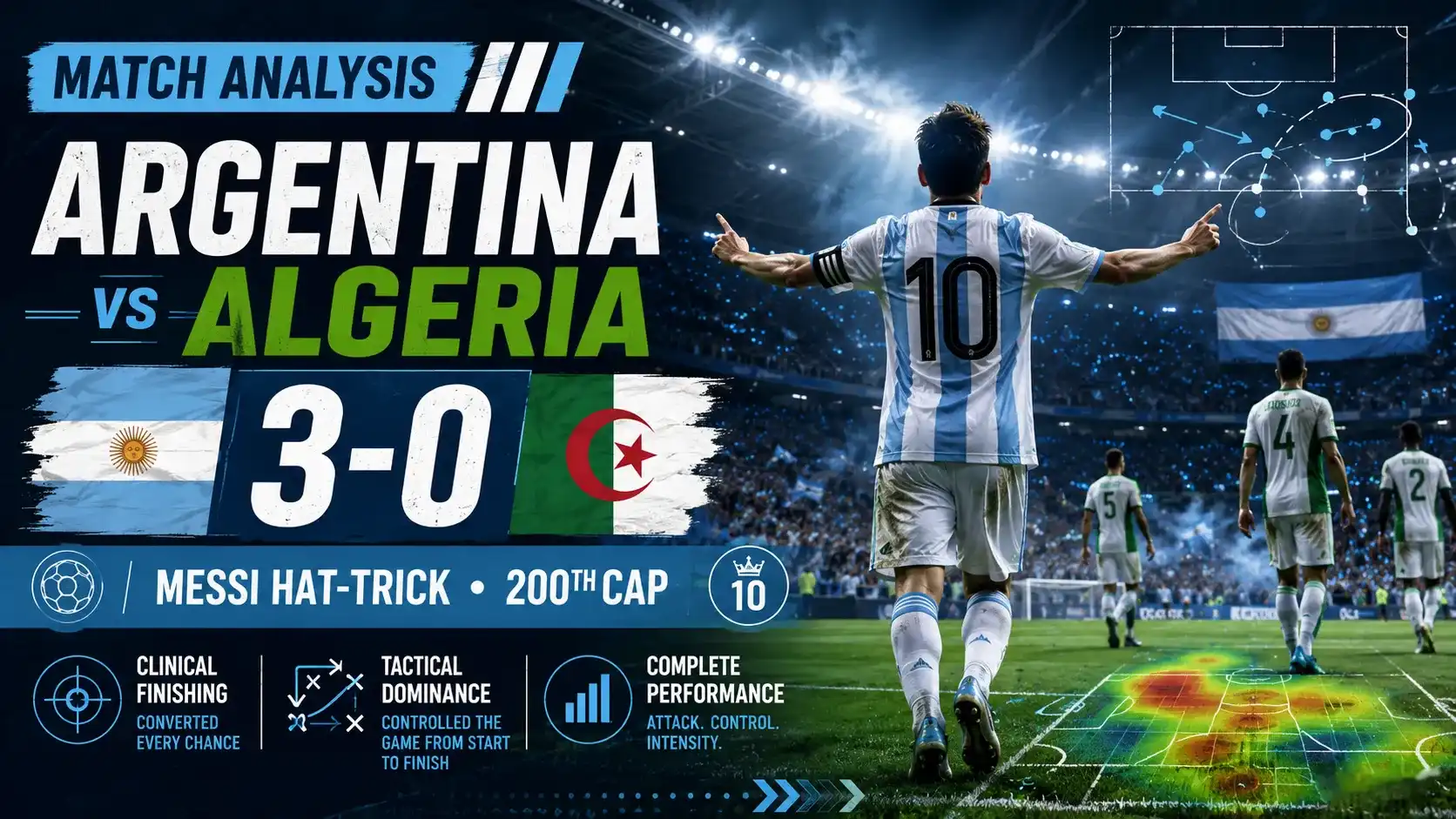
Historic Night in Kansas City: Messi’s 200th Cap and Record-Breaking Hat-Trick
Lionel Messi transformed his 200th international appearance into a historic statement by scoring a hat-trick that secured Argentina’s 3-0 victory over Algeria while making him the first male player to feature at six World Cup tournaments and equaling Miroslav Klose’s record of 16 World Cup goals.
The 200th cap represents two decades of international service spanning World Cups from Germany 2006 through to this 2026 tournament in North America. No male player has previously appeared at six World Cup finals, placing Messi in uncharted territory for longevity at the highest level. The 16 goals match the total accumulated by German striker Miroslav Klose across four tournaments between 2002 and 2014, a benchmark previously considered untouchable given the rare combination of team success and individual scoring required to reach such heights.
The 17th-minute opener demonstrated Messi’s enduring long-range power and De Paul’s creative vision. Rodrigo De Paul collected possession in central midfield and threaded a precise pass to Messi advancing toward the penalty area. Space opened up as Algerian defenders backed off, allowing Messi to drive a powerful low shot beyond goalkeeper Luca Zidane into the bottom corner. The strike initiated the scoring and established the pattern of Argentine control that would define the evening.
Messi’s second goal revealed his predatory anticipation rather than just creative genius. Alexis Mac Allister unleashed a fierce long-range drive that Zidane could only parry into dangerous space near the penalty spot. Messi had continued his run into the box rather than watching the shot, positioning himself perfectly to stroke home the rebound before defenders could react. The 77th-minute completion of the hat-trick showcased close-control mastery, with Messi weaving through multiple Algerian defenders inside the penalty area before calmly slotting the finish that sealed the contest.
Opening-day tournament context immediately frames the Golden Boot race and sparks debate regarding Messi’s role at 38 years old. Kylian Mbappé scored twice for France in their opener, while Erling Haaland matched that tally for Norway, yet Messi’s treble gives him an early advantage in the scoring charts. The performance raises legitimate questions about whether Messi remains the tournament’s most decisive individual force capable of carrying Argentina through difficult moments, or whether this display provides the clearest proof yet that Argentina’s evolved tactical structure finally gives him the perfect platform to conserve energy and maximize impact without bearing the entire creative burden alone.
The physical condition Messi displayed contradicts assumptions that age would diminish his tournament impact. His movement between the lines remained sharp, his first touch eliminated defenders instantly, and his finishing showed no hesitation. Debates about whether he carries Argentina or benefits from structure miss the essential point that this symbiotic relationship represents the culmination of a fifteen-year evolution in Argentine football, where previous generations relied heavily on Messi’s individual dribbling while this squad provides the platform for his finishing intelligence.
Tactical Control: Argentina’s Midfield Dominance and Algeria’s Structural Limitations
Argentina’s midfield trio maintained relentless possession and executed rapid counterpressing to pin Algeria back, while the African side’s defensive disorganization and Riyad Mahrez’s absence from the starting lineup prevented them from challenging Emiliano Martínez consistently despite an energetic opening period that produced a disallowed goal.
Rodrigo De Paul, Alexis Mac Allister and Enzo Fernández formed a compact unit that circulated the ball efficiently and immediately pressed to recover possession whenever Algeria attempted transitions. De Paul operated as the metronome, dictating tempo and triggering pressing traps, while Mac Allister provided vertical thrust through carrying and shooting. Their positioning created central corridors between the lines where Messi could receive the ball without engaging in high-speed vertical runs that would exhaust his 38-year-old legs. Argentina’s defensive line stepped forward confidently to compress space, ensuring that even when Algeria retained the ball, they did so in harmless areas far from Martínez’s goal.
Algeria’s early promise faded due to structural limitations and personnel decisions. An opening goal was correctly ruled out for offside after a swift attacking move, but the subsequent withdrawal of creative energy proved costly. Riyad Mahrez began on the bench, depriving the starting eleven of Premier League experience and incisive passing in final third areas. Defensive lines repeatedly lost track of Messi around the penalty area perimeter, failing to apply pressure quickly enough to prevent his long-range first goal or block his path for the third. Reactions to second balls proved lethargic throughout the defensive unit, particularly for Messi’s second goal where multiple defenders watched the rebound rather than aggressively clearing the danger.
A controversial first-half challenge involving Messi and Aïssa Mandi generated legitimate debate about disciplinary standards without overshadowing Argentina’s tactical superiority. Some observers argued the contact warranted a red card for serious foul play given the intensity and location of the challenge, while others viewed it as a tactical foul deserving only a caution within the normal flow of competitive football. The incident remains a valid discussion point regarding officiating consistency and player safety, though Algeria’s inability to generate sustained pressure after the interval or convert their possession into clear-cut chances suggests the result reflected deeper structural patterns rather than single refereeing decisions.
Emiliano Martínez faced minimal serious danger despite Algeria’s intermittent possession, testament to the protective shield provided by Cristian Romero and Nicolás Otamendi. The defensive pair intercepted crosses confidently and distributed efficiently to restart attacks, ensuring that Algeria’s wide players could not supply their forwards with service in dangerous areas. This defensive stability allowed the midfield to maintain high positions without fear of being exposed on the break, creating the sustained offensive pressure that eventually overwhelmed Algerian resistance.
Group J Consequences and Kenya Viewing Context
Argentina’s three points immediately establish them as Group J leaders heading into their clash with Austria, while Algeria faces a must-win scenario against Jordan to keep their knockout hopes alive, with Kenyan supporters able to track all fixtures through Pulser’s comprehensive World Cup 2026 coverage in East Africa Time.
The result exceeded our pre-match prediction of a 2-0 Argentina victory that had identified midfield control and Algeria’s counterattack as decisive tactical themes. The analysis of Argentine dominance through the center proved accurate, with De Paul, Mac Allister and Fernández restricting Algeria’s transitions as anticipated, though Messi’s individual brilliance expanded the margin to 3-0. The tactical framework allowed Messi to operate primarily as a finisher rather than sole creator, validating the structural approach while acknowledging that few players in history could have converted those chances with such clinical precision.
Group J standings now place Argentina in a commanding position before facing Austria in their second fixture, while Algeria’s path to the round of 32 becomes significantly more complicated following this opening defeat. The North African side must defeat Jordan in their second group match to avoid facing elimination pressure in their final game against Argentina. Readers can check Group J standings and schedule to plan viewing for these critical fixtures, including kickoff times converted to East Africa Time for Kenyan audiences planning their viewing schedules.
Kenyan fans following the tournament should note that all Argentina matches and World Cup 2026 fixtures are available through the Pulser FIFA hub, with complete scheduling details available at the full World Cup 2026 schedule in Kenya Time. Full match details and lineups from the Kansas City Stadium encounter provide additional tactical context for this opening statement in Argentina’s title defense campaign, ensuring East African supporters remain informed throughout the tournament’s progression.
The wider 2026 tournament narrative now positions Argentina as immediate favorites to defend their title, with Messi’s form suggesting they possess the individual brilliance required to overcome knockout-stage pressure. For African football representation, Algeria’s defeat highlights the growing gap between established South American powerhouses and CAF nations struggling to convert domestic talent into cohesive international tournament performances. The Jordan match will reveal whether Algeria can adapt their tactical approach to secure the victory necessary to keep their World Cup ambitions alive beyond the group stage.