
Group Stage vs Knockout Stage: The Fundamental Format Difference at World Cup 2026
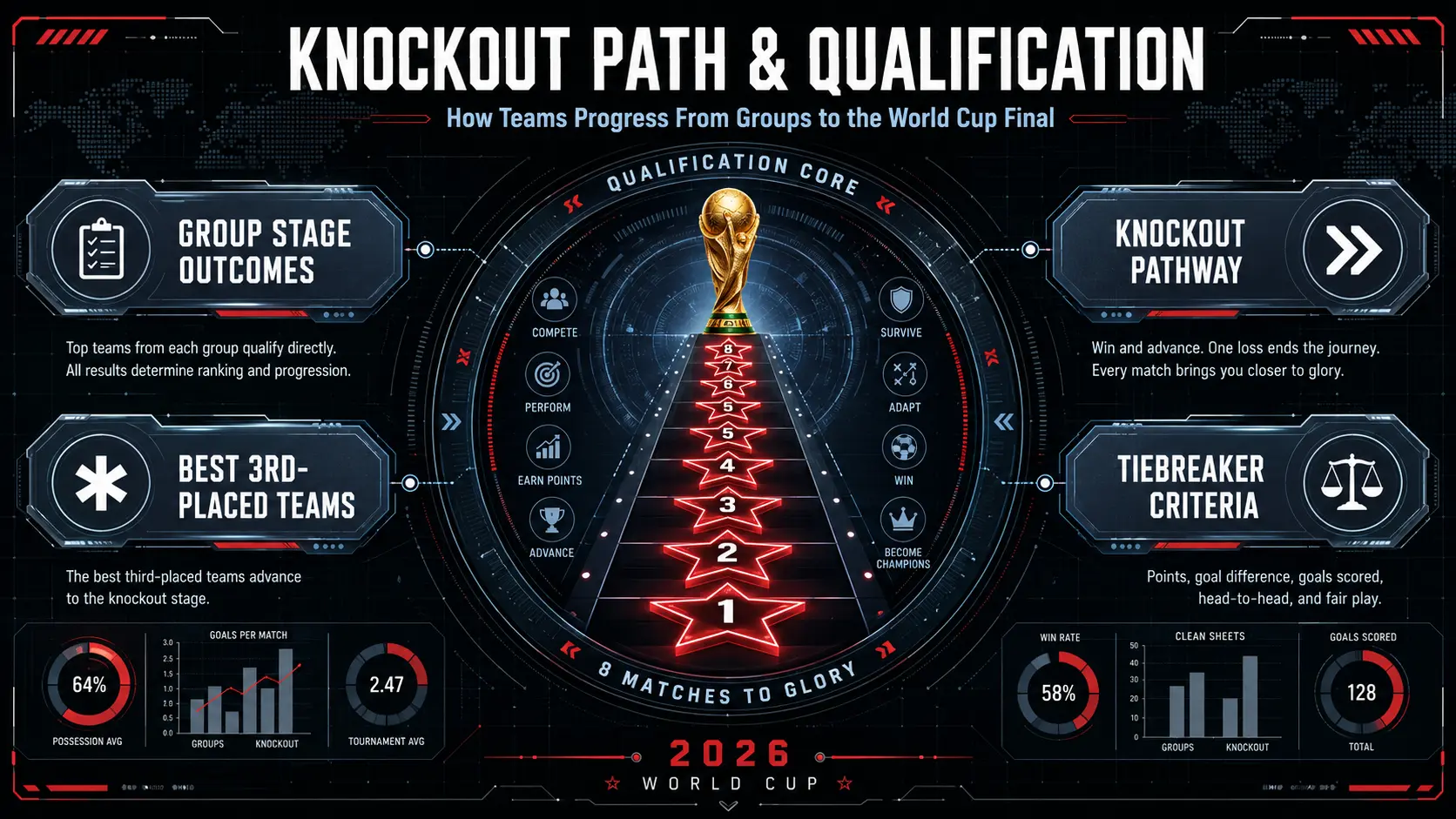
The group stage allows teams to accumulate points across three matches to qualify for the Round of 32, while the knockout stage demands immediate victory with no margin for error. Teams compete in 12 groups of four nations during the opening phase, with each side playing three matches against group opponents to determine final standings. The group and teams schedule page tracks which nations secure the top two positions automatically and which eight best third-placed teams advance to fill the expanded 32-team bracket, creating a new Round of 32 that did not exist in previous 32-team tournaments.
Matches in the knockout phase operate as single-elimination contests starting with the Round of 32, where only the winner progresses to the next round. Defeat means immediate elimination regardless of previous performance, creating high-stakes encounters that contrast sharply with the group phase’s allowance for recovery from individual losses.
Strategic calculations differ significantly between the two formats, as group stage managers can utilize draws tactically or survive a single defeat through point accumulation. Knockout fixtures require attack-minded approaches that prioritize scoring decisive goals within regulation time to avoid the uncertainty of extra time and penalty shootouts, which introduce significant physical and psychological pressure on players.
Points Systems, Tiebreakers, and Match Resolution Rules
Group stage rankings depend on accumulating three points for a win and one for a draw, while knockout matches require definitive resolution through extra time and penalties when tied after 90 minutes. FIFA awards three points for victory and one for stalemates across the 12 groups, with tiebreakers including goal difference and goals scored separating teams level on points. Head-to-head results and fair play points serve as secondary criteria when teams remain tied after standard metrics, ensuring definitive group rankings that determine which third-place teams advance to the knockout phase.
Knockout fixtures cannot end in draws, mandating two 15-minute periods of extra time followed by a penalty shootout if scores remain level. These resolution mechanisms extend broadcast duration significantly for Kenyan viewers following East Africa Time schedules, potentially pushing match conclusions into early morning hours beyond standard 90-minute windows.
The expanded 48-team format creates unique qualification scenarios where third-placed teams advance to a Round of 32, altering tactical approaches compared to previous tournaments. Coaches must calculate whether four points guarantees advancement or whether goal difference might eliminate a third-place finisher, adding mathematical complexity to group stage preparations and final matchday scenarios.
Planning Your Viewing Strategy in Kenya Time
Kenyan fans should monitor live group standings to anticipate knockout fixtures while accounting for extended broadcast windows that accommodate extra time and penalty shootouts. Live group standings available on the group and teams schedule page help identify which teams are likely to advance before the knockout bracket is finalized, allowing supporters to predict potential Round of 32 matchups.
Broadcast schedules require additional time allocation during knockout rounds, as extra time and penalties can add 30 minutes or more to standard match duration. Fans should consult the full World Cup 2026 schedule in Kenya Time to plan viewing sessions that account for these potential extensions in EAT, particularly for late-night fixtures that might conclude in the early morning hours when extra time is required.
Single-match pages provide exact kickoff times for confirmed fixtures from the Round of 32 through to the final once group stage results determine specific pairings. The FIFA hub serves as a central navigation point for all tournament content, connecting readers from group stage analysis to individual knockout match details as the tournament progresses.
FAQ
How many teams qualify from each group for the knockout stage?
The top two teams from each of the 12 groups automatically qualify, joined by the eight best third-placed teams to create a 32-team knockout bracket starting with the Round of 32.
What happens if a knockout match is tied after 90 minutes?
The match proceeds to 30 minutes of extra time split into two halves, and if still tied, a penalty shootout determines the winner who advances to the next round.
Can a team lose a group stage match and still win the World Cup?
Yes, a team can lose one or even two group stage matches and still qualify for the knockout stage, then proceed to win the tournament through the single-elimination rounds.
Reference
Scores & Fixtures | FIFA World Cup 2026™
Standings | FIFA World Cup 2026™
World Cup 2026 groups: How teams qualify and tie-breakers
Procedures and pots | Final Draw | FIFA World Cup 2026