
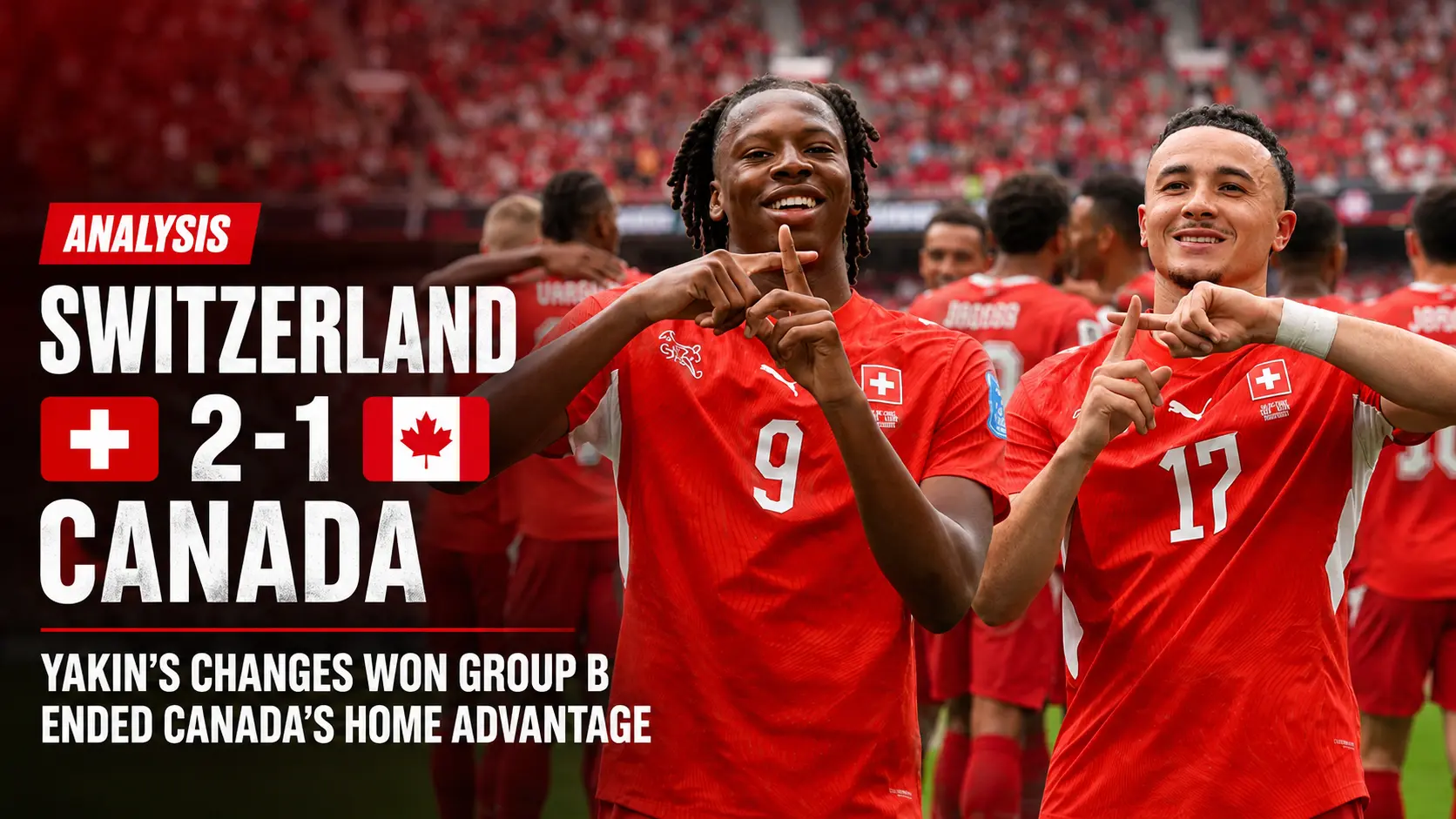
How Yakin Won the Group from the Bench: Switzerland’s Second-Half Transformation
Murat Yakin’s halftime adjustments transformed Switzerland’s attack by prioritising wide channels and half-spaces, allowing Ruben Vargas and Johan Manzambi to find the spaces between Canada’s midfield and defensive lines and score the decisive goals within twenty minutes of the restart. The Swiss coach recognised that Canada’s high block had compressed central areas during the first period, so he instructed his wingers and full-backs to stretch play horizontally and exploit the corridors between the Canadian centre-backs and their covering midfielders.
The tactical shift specifically targeted Canada’s defensive transitions. By moving attackers into wider positions and half-space corridors, Switzerland created overloads that pulled Canadian defenders out of shape. Vargas operated primarily in the left half-space, receiving balls between the lines where Canada’s press had vacated, while Manzambi found similar room on the right to capitalise on the disorganisation caused by the first goal.
Yakin’s management of game tempo proved equally decisive. Rather than engaging directly with Jesse Marsch’s high-energy press, Switzerland slowed possession and invited Canada forward. This strategy exploited the gaps left when Canadian players committed numbers forward chasing an equaliser, ensuring that when Switzerland regained possession, they faced a backpedalling defensive block rather than a set press. The controlled rhythm conserved Swiss energy while forcing Canada into an unsustainable chase.
Canada’s Tactical Gamble: Why Chasing the Win Cost Vancouver Home Advantage
Canada’s aggressive pursuit of victory after falling behind disrupted the defensive structure that had previously secured qualification, forcing Marsch’s side to abandon the draw that would have kept them in Vancouver and instead chase the match unsustainably. The hosts needed only a point to finish top of the group on goal difference, yet the concession of Vargas’s goal triggered an all-out attacking response that left defensive vulnerabilities exposed.
The high-octane pressing system that characterised Marsch’s approach initially disrupted Swiss build-up play in the opening period. However, once Switzerland took the lead, the same intensity became a liability. Canadian forwards and midfielders overcommitted in advanced positions searching for an immediate response, leaving the back four isolated and creating the conditions for Manzambi’s second goal as Swiss attackers found room in the vacated half-spaces.
Substitute Promise David’s volley to reduce the deficit to 2-1 demonstrated the attacking depth available to Canada, yet the goal only reinforced the tactical gamble. The concession of the second Swiss goal while pushing for an equaliser highlighted the strategic miscalculation: Canada risked everything for three points when one would have secured first place and home advantage. The eventual second-place finish forces Canada to surrender their Vancouver base and travel for the Round of 32, despite achieving the primary objective of qualification.
Group B Decided: Knockout Stage Paths for Kenyan Viewers
Switzerland’s seven-point tally and plus-four goal difference confirmed top spot in Group B final standings, with Canada’s four points and plus-five goal difference securing second place, ensuring both nations advance to the Round of 32 but under vastly different logistical circumstances. The Swiss campaign included a 1-1 draw with Qatar and a 4-1 victory over Bosnia, while Canada’s results featured a 1-1 draw with Bosnia and a 6-0 win over Qatar.
Switzerland’s victory secures the team’s position as group winners, granting them the right to remain in Vancouver for their Round of 32 fixture and avoiding travel fatigue. Canada’s second-place finish forces them to leave their home base at BC Place and relocate for their next match, surrendering the support of the Vancouver crowd that had driven their campaign during the group stage despite their impressive goal difference.
Kenyan viewers following the tournament on East Africa Time can track the confirmed Round of 32 fixtures using Pulser’s World Cup 2026 schedule in Kenya Time page. The EAT timezone (UTC+3) remains consistent throughout the tournament without daylight saving time changes, ensuring kick-off times listed on the schedule page are accurate for Nairobi, Mombasa, and Kampala audiences. Further detailed match report and statistics from the BC Place encounter are available for readers seeking specific tactical data.