
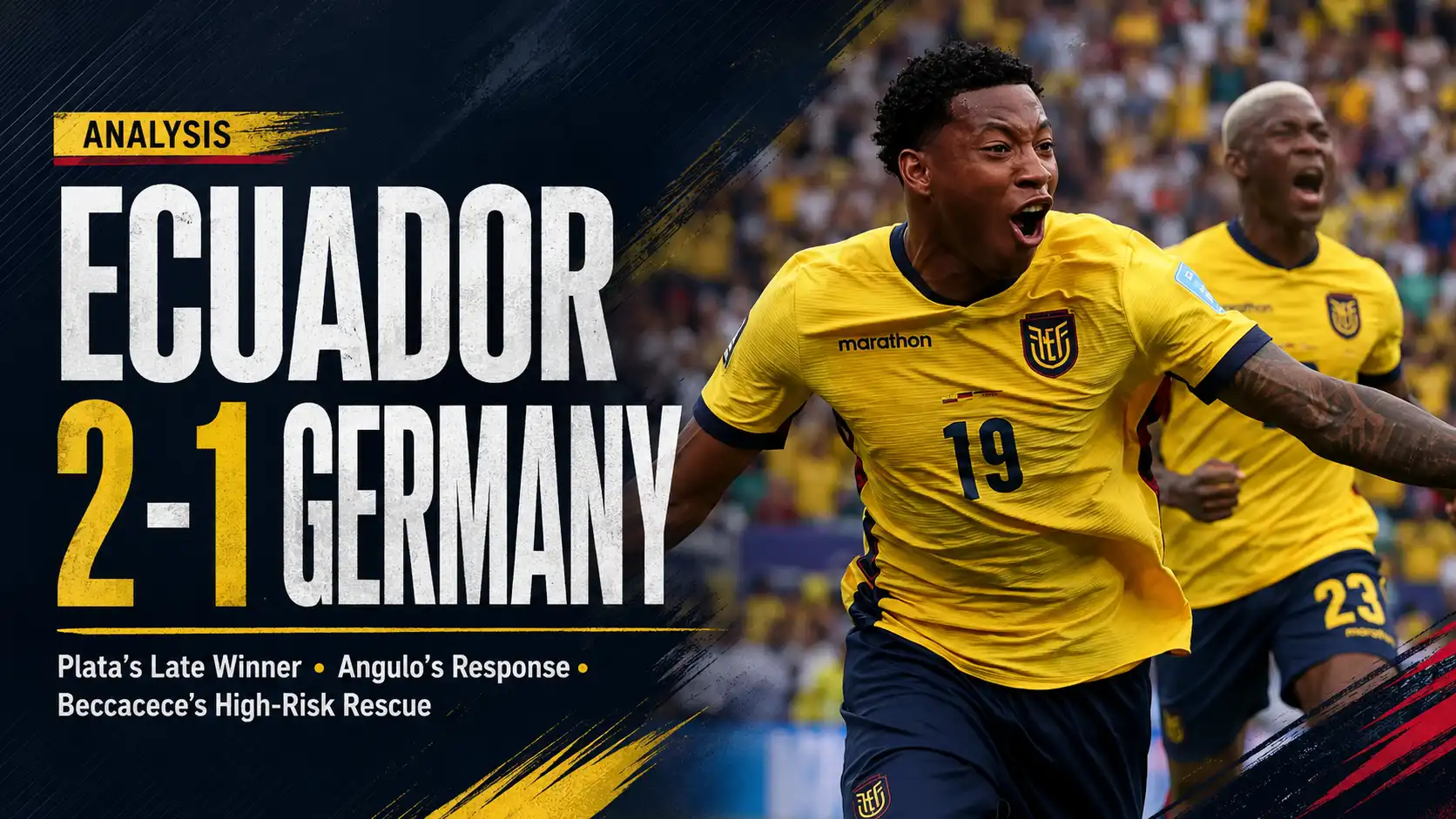
How Ecuador Staged a Dramatic Comeback to Beat Germany 2-1
Ecuador recovered from conceding inside two minutes by implementing Sebastián Beccacece’s aggressive pressing system, securing their place in the knockout stage through Nilson Angulo’s ninth-minute strike and Gonzalo Plata’s 77th-minute finish. Leroy Sané’s early goal for Germany came after a swift attacking move caught the South American defense unprepared, yet Ecuador’s backline reorganised rapidly to prevent the European side from capitalising on the initial momentum. The early concession could have triggered a collapse similar to their previous tournament performances, but instead the defensive structure absorbed the shock and maintained positional discipline.
Angulo’s equaliser in the ninth minute arrived as the decisive turning point that validated Beccacece’s decision to abandon caution. The forward capitalised on a defensive error forced by Ecuador’s renewed intensity, slotting home to cancel out Sané’s opener and immediately shift the psychological momentum toward the South Americans. That early response prevented Germany from establishing the rhythm they had enjoyed in previous victories over Curaçao and Ivory Coast, forcing Julian Nagelsmann’s rotated side into a more contested, transitional contest than they had anticipated.
Plata’s winner in the 77th minute represented the culmination of sustained high-risk pressing that eventually overwhelmed Germany’s experimental backline. The winger exploited transitional spaces created when Ecuador pushed numbers forward, finishing clinically to complete a comeback that seemed improbable after the team entered the match with zero goals from their opening two fixtures against Ivory Coast and Curaçao. That late strike secured four points and a zero goal difference, sufficient for advancement through the expanded 48-team format’s best-third-place calculation.
Tactical Breakdown: Beccacece’s High-Risk Rescue vs Nagelsmann’s Rotation Gamble
Beccacece abandoned the cautious approach that produced scoreless displays against Ivory Coast and Curaçao, instead deploying aggressive vertical pressing designed to disrupt Germany’s build-up play immediately after losing possession. The Argentine coach instructed his midfielders to compress spaces between the lines, forcing Germany’s rotated lineup into hurried clearances rather than the controlled progression that characterised their earlier tournament victories. That tactical shift transformed Ecuador from a passive defensive unit into an active disruptor of the European champions’ rhythm.
Nagelsmann’s decision to rotate his squad exposed vulnerabilities when the experimental Germany lineup lost midfield control once the match became a transitional, end-to-end contest. The second-string midfield pairing struggled to maintain possession against Ecuador’s physical pressing, creating a vacuum in the center of the pitch that allowed the South Americans to attack directly at a makeshift defense. Germany’s usual dominance in possession evaporated as the rotated players failed to replicate the positional stability shown by the first-choice unit in their opening victories.
Germany’s second-string defensive line struggled when confronted with sustained South American physicality, raising significant questions about squad depth before the knockout rounds. Center-backs who had not featured prominently in the tournament’s opening phase found difficulty handling the direct running and aerial pressure applied by Ecuador’s attackers, suggesting that Nagelsmann’s faith in his extended squad may have been misplaced. Those defensive frailties, combined with the loss of midfield control, created the conditions for Ecuador’s late winner and highlighted potential limitations as Germany prepare to face stronger opposition in the Round of 32.
What This Result Means for Group E and the Knockout Stage
Ecuador’s qualification mathematics demonstrate how the expanded 48-team tournament format rewards resilience, as reaching four points with a zero goal difference proved sufficient to advance through the best-third-place calculation. The three points gained against Germany lifted La Tri from the bottom of the standings into contention, rendering their earlier defeats to Ivory Coast and goalless draw with Curaçao irrelevant to their final placement. That progression marks a significant achievement for Beccacece’s side, who recovered from a goalless start to secure knockout football.
Germany’s precarious position despite finishing with six points and a plus-six goal difference reveals the competitive balance of the expanded tournament, with the defeat exposing tactical rigidity and depth concerns before the Round of 32. While the European side had already secured progression after beating Curaçao 7-1 and Ivory Coast 2-1, the manner of this loss against largely reserve opposition suggests vulnerabilities that stronger knockout opponents will seek to exploit. The rotated lineup’s inability to maintain control against Ecuador’s pressing indicates that Nagelsmann may need to rely heavily on his first-choice eleven in the elimination phase.
Kenyan supporters can track both teams’ upcoming fixtures in East Africa Time by consulting Pulser’s knockout stage schedule in Kenya Time, ensuring accurate kick-off times without daylight saving confusion. Ecuador will enter the Round of 32 as a third-place qualifier facing uncertain opposition, while Germany must address the defensive and midfield issues exposed in this defeat before they encounter higher-caliber opposition. For complete Group E standings and qualification scenarios, including final tables and opponent matchups, visit Pulser’s dedicated group page.