
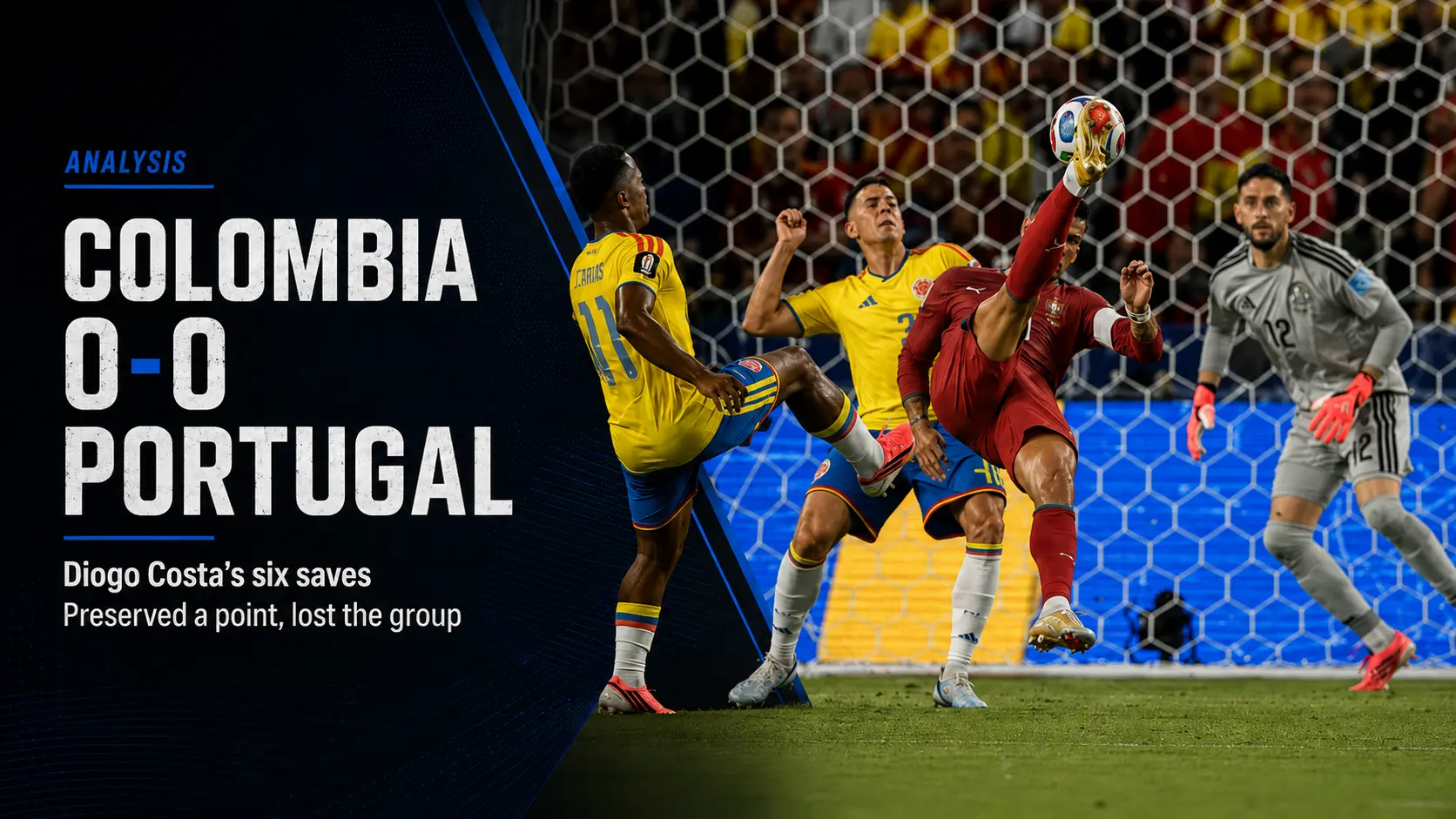
Group K Final Standings: How the 0-0 Draw Decided the Table
Colombia secured first place in Group K with 7 points and a +3 goal difference, earning a favorable Round of 32 draw against Ghana while maintaining their unbeaten tournament record. The Tricolor entered the final matchday knowing that a draw would guarantee top spot, and their defensive organization proved sufficient to nullify Portugal’s attacking threats despite ceding significant possession statistics to their European opponents.
Portugal finished second with 5 points and a +5 goal difference, with Diogo Costa’s six saves preventing defeat but consigning them to a more difficult knockout route against Croatia rather than a theoretically easier tie against a third-place qualifier. Seleção das Quinas controlled the ball for long periods but created few clear chances, managing only one shot on target of real note when Bruno Fernandes forced a major save from Camilo Vargas in the second half.
Key moments included Davinson Sánchez’s late header being ruled out for offside and Diogo Costa’s series of reflex stops that denied Luis Díaz and Jhon Durán on separate occasions. Neither side could break the deadlock despite periods of pressure, with Colombia content to protect their point after the hydration break while Portugal lacked the incision to punish their opponents’ defensive setup. Both teams preserved their unbeaten records through the group phase, though only Colombia benefited from that consistency in terms of final positioning. You can view the complete Group K final standings on Pulser to see how the points table settled after all matches concluded.
Tactical Analysis: Lorenzo’s Energy Against Martínez’s Caution
Néstor Lorenzo’s Colombia dominated the early phases with high pressing and varied attacking movement that repeatedly exposed Portugal’s slow build-up play before fatigue set in after the hydration break. Los Cafeteros varied their approach between direct balls to the wings and quick interchanges through the center, creating three excellent chances in the opening half-hour that required Costa’s intervention to keep the scores level.
Roberto Martínez’s possession-heavy approach showed little risk appetite against quality opposition, lacking the fluency and attacking incision displayed in their 5-0 demolition of Uzbekistan and mirroring their earlier struggles against Uruguay. Portugal completed numerous passes in harmless areas of the pitch but struggled to penetrate Colombia’s compact defensive block, with the full-backs remaining conservative and the midfield pivot reluctant to commit players forward into dangerous positions.
The hydration break at the 30-minute mark marked a significant shift in momentum, with Colombia’s early intensity dropping and Portugal gaining territorial control without translating that dominance into clear-cut opportunities. The central debate for Portugal entering elimination football centers on whether Costa’s shot-stopping heroics represent genuine goalkeeping strength or merely masked structural deficiencies in their ability to control matches against organized defenses. Six saves suggests Colombia created genuine danger, yet Portugal’s inability to impose themselves on a team sitting back after the 60-minute mark raises questions about their tactical flexibility when opponents refuse to engage in open exchanges. Martínez’s decision to maintain shape rather than push for the winner that would have secured top spot illustrates the cautious approach that now leaves his team facing a sterner test in the Round of 32 bracket.
Knockout Pathways and What Kenyan Fans Should Watch Next
Colombia’s first-place finish sets up a Round of 32 clash with Ghana, while Portugal’s second-place positioning forces them into a difficult bracket against Croatia with a potential quarter-final against Spain looming if they advance. The draw against the Africans offers Lorenzo’s side a realistic pathway to the last 16, with the winner of that tie facing either the Netherlands or a third-place qualifier from Group H in more favorable conditions.
Portugal enter single-elimination football with concerning questions about their attacking control, as the failure to impose themselves against Colombia suggests defensive resilience alone may not suffice against Croatia’s technical midfield. A victory against the Vatreni would likely set up a quarter-final with Spain, representing a significantly tougher route than Colombia faces on the opposite side of the draw and placing greater pressure on Cristiano Ronaldo and company to find their scoring touch immediately.
Kenyan supporters can track the evolving bracket and fixture timings in East Africa Time through Pulser’s dedicated World Cup 2026 resources to follow these teams’ progress through the Round of 32 and beyond. The World Cup 2026 schedule in Kenya Time provides exact EAT kickoff times for both matches, ensuring East African fans do not miss the early morning or late-night fixtures as the tournament progresses into the knockout phase. Additional context on the knockout stage structure is available for those planning to follow the remaining matches of the expanded tournament format.