
England Secure Group L and Confirm DR Congo Knockout Tie
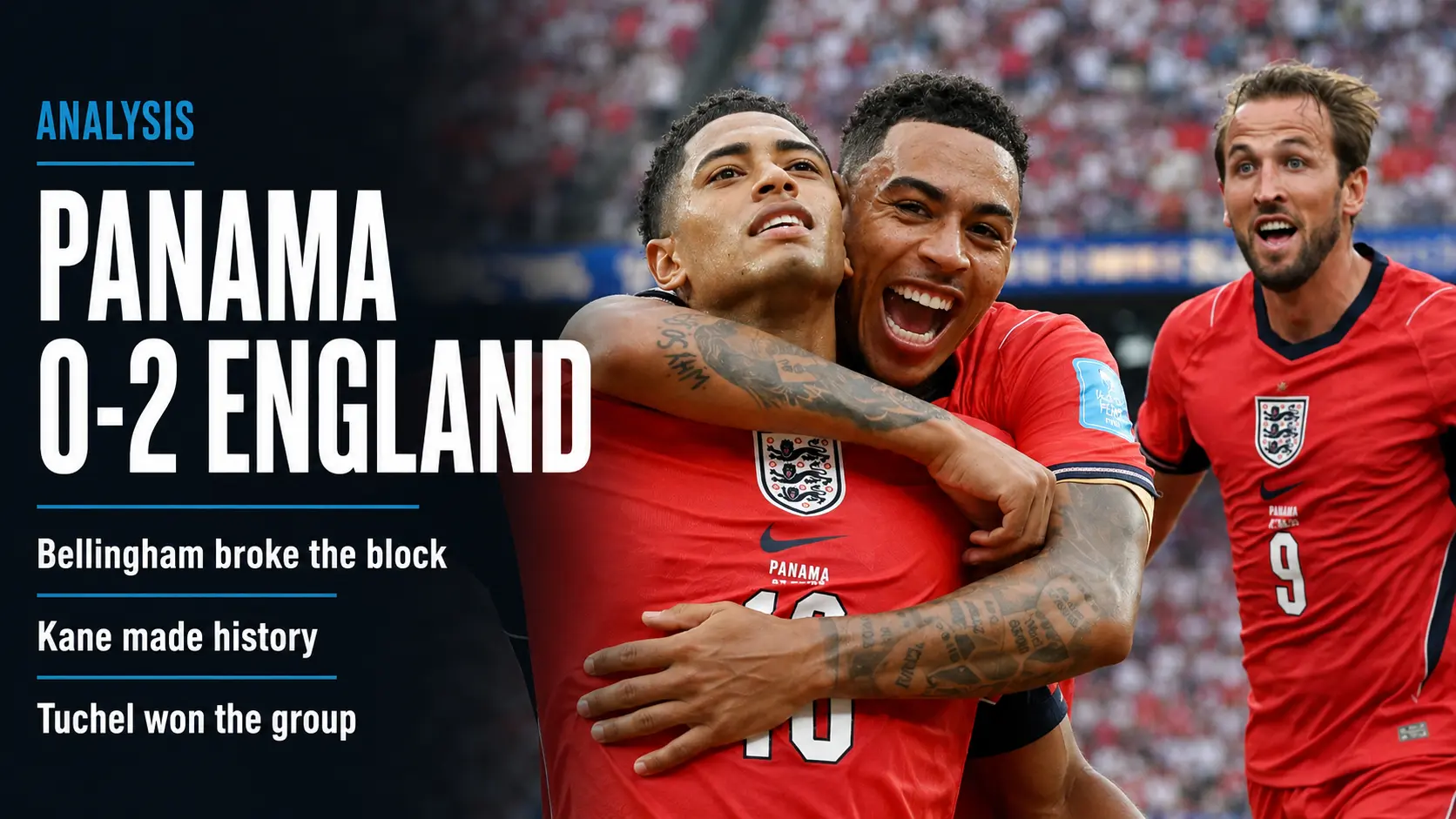
England topped Group L with 7 points after a 2-0 victory over Panama, setting up a Round of 32 clash with DR Congo. Jude Bellingham’s 62nd-minute strike and his assist for Harry Kane’s historic 11th World Cup goal in the 67th minute secured the result. Kane’s finish made him England’s all-time leading scorer in the competition, capping a decisive five-minute spell that settled the contest despite a difficult first hour.
Final Group L standings confirm England as winners with 7 points and a +4 goal difference, following victories over Croatia and Panama plus a draw with Ghana. Panama exit the tournament with zero points and a -4 goal difference, joining the list of eliminated teams despite showing resilience in defensive organisation. England’s seven-point total secured first place ahead of the runners-up, ensuring a theoretically favourable draw in the next phase.
The Round of 32 offers no second chances, marking a significant shift from the safety net of group-stage accumulation. Unlike the opening phase, where a single defeat does not necessarily end the campaign, the knockout stage demands immediate precision, as defensive errors become fatal and tempo management proves decisive against DR Congo.
Tuchel’s Rotation and the Struggle Against Christiansen’s Compact Block
Thomas Tuchel’s five changes disrupted England’s rhythm and contributed to a sluggish first hour against Thomas Christiansen’s well-organised low block. The alterations to the starting eleven disrupted the chemistry built during the opening matches, with new combinations in midfield and attack failing to establish the tempo required to unlock a deep-lying defence. Passes went astray under pressure, and the movement off the ball lacked the sharpness necessary to create overloads in dangerous areas.
Christiansen organised Panama to remain competitive for sixty minutes, deploying a compact low block that denied central penetration and forced England to recycle possession sideways rather than playing through the lines. The Central Americans maintained a narrow shape, congesting the corridors and ensuring the underdogs reached the hour mark with the game still level. This defensive discipline frustrated England’s stars, limiting clear-cut opportunities and highlighting how organised underdogs can trouble elite sides without the ball.
Individual quality eventually superseded tactical struggle, with Bellingham’s direct running and clinical finish providing the incision that structured patterns could not manufacture. Kane’s predatory instinct converted the second goal almost immediately after, capitalising on the space opened by the breakthrough. Those five minutes of elite execution transformed the scoreline but did not reflect a collective solution to the tactical puzzle posed by the opposition.
Round of 32 Readiness: Systemic Solutions or Individual Dependency
Questions remain about whether England’s reliance on individual brilliance against compact defences will suffice in the high-stakes environment of the Round of 32. DR Congo will present a physically demanding challenge in the knockout tie, potentially adopting similar compact tactics to force errors knowing that England struggled against Panama’s block. The knockout environment magnifies every decision, with penalty shootouts looming as a possibility if ninety minutes cannot separate the teams.
Bellingham’s second-half intervention solved the immediate problem against Panama but potentially masked ongoing vulnerabilities that remain unaddressed. While the midfielder’s ability to decide matches is a valuable asset, sustainable tournament success typically requires reliable systems that function when key players face tight marking or fatigue. Structural issues in breaking down low blocks through collective patterns rather than solo dribbling persist as a concern for deeper tournament progression.
Necessary tactical adjustments for Tuchel must focus on generating breakthroughs through coordinated movement and quicker circulation before the knockout tie begins. Solutions might include reverting to a more settled lineup, increasing width to stretch defensive blocks, or delivering early crosses to bypass packed central areas. England cannot depend solely on elite individual moments against DR Congo or subsequent opponents who will study how Christiansen’s approach nearly succeeded for an hour.