
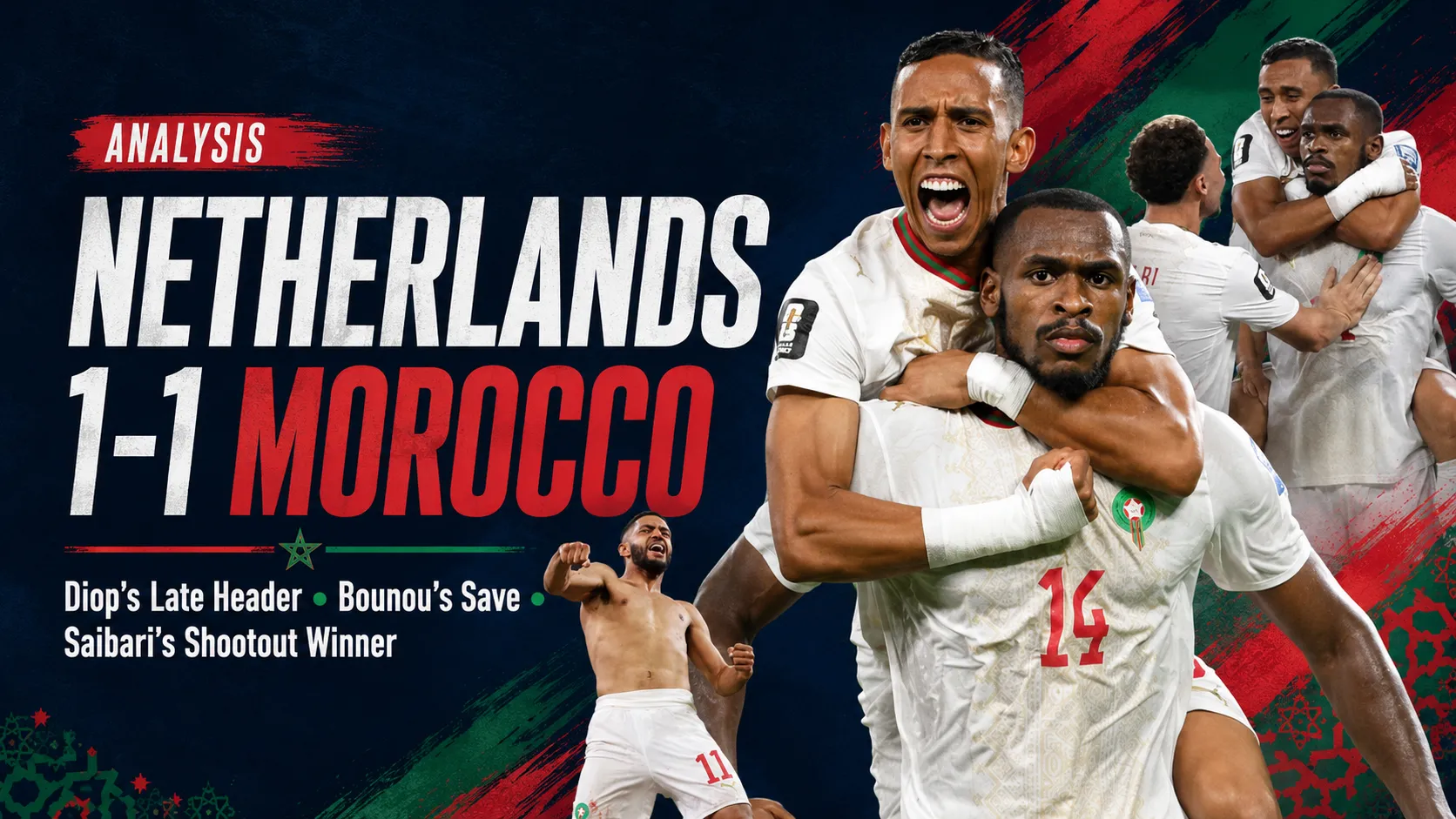
Match Result and Decisive Moments: From Gakpo’s Opener to Saibari’s Winner
The final scoreline confirmed Morocco’s passage to the Round of 16 via a 3-2 penalty shootout victory following a 1-1 stalemate after 120 minutes of intense knockout football. The match, which kicked off at 04:00 EAT on June 30, 2026, concluded the Round of 32 tie that pitted two strong group-stage performers against each other. Dutch celebrations erupted in the 72nd minute when Cody Gakpo broke the deadlock, capitalizing on a period of sustained pressure to put the Group F winners ahead.
Stoppage time delivered the cruel twist that defined the contest. Issa Diop’s powerful header drew Morocco level during the dying moments of regulation, forcing an additional 30 minutes that the Atlas Lions dominated territorially. Achraf Hakimi struck the crossbar during this period of sustained Moroccan pressure, while Bart Verbruggen produced a series of critical saves to keep Dutch hopes alive temporarily. The woodwork and the Dutch goalkeeper combined to prevent a regulation-time winner, pushing the fate of both sides toward the lottery of penalties.
The decisive shootout sequence showcased nerve and goalkeeping excellence. Yassine Bounou’s save from Crysencio Summerville’s penalty provided the crucial advantage, shifting psychological momentum irreversibly toward the North African side. Ismael Saibari subsequently converted the winning spot kick with precision, sealing Morocco’s progression and confirming the Netherlands’ elimination despite their superior group-stage goal difference.
The opening exchanges had suggested a tight contest between two disciplined sides who had conceded minimally during the group phase. Morocco’s early pressing disrupted Dutch attempts to build from the back, while the Netherlands looked to exploit transitions through their pacey forwards. Neither goalkeeper faced sustained examination during the first hour, with both teams prioritizing structural security over attacking risk until the pattern shifted decisively after the 70-minute mark.
Tactical Contrast: Ouahbi’s Relentless Width Against Koeman’s Defensive Retreat
Mohamed Ouahbi’s tactical approach centered on relentless width and midfield aggression, a philosophy that never wavered even after Gakpo’s 72nd-minute opener. Morocco’s full-backs and wingers maintained advanced positions throughout the knockout tie, stretching the Dutch defensive block and creating the crossing opportunities that eventually produced Diop’s stoppage-time equalizer. This refusal to drop into a protective shell represented a calculated gamble that ultimately rewarded proactive football over caution.
Ronald Koeman’s strategy presented a stark contrast, shifting toward a conservative, direct approach immediately following the Netherlands’ goal. The Group F winners, despite boasting a +6 goal difference from their preliminary matches, surrendered initiative and territorial control by retreating into a more defensive posture. Game management prioritizing containment over ball retention invited the sustained Moroccan pressure that characterized the final 20 minutes of regulation time.
Bart Verbruggen’s individual brilliance temporarily masked the structural vulnerabilities created by Koeman’s retreat. The Dutch goalkeeper produced multiple reaction saves during extra time to deny Hakimi and others, preserving the slim advantage for as long as possible. However, the inability to regain possession or establish field position during critical phases exposed the limitations of a purely defensive mindset in knockout football, ultimately contributing to the shootout defeat.
Physical conditioning played a visible role during the additional 30 minutes, as Morocco’s relentless high-tempo approach maintained its intensity while Dutch legs appeared to tire under the cumulative pressure. Substitutions failed to alter the momentum, with fresh Moroccan legs continuing to attack the channels while Dutch replacements focused primarily on defensive reinforcement. The tactical divergence became physically manifest as extra time progressed, with one side attacking and the other absorbing.
Knockout Implications: Morocco’s Path to the Round of 16 and Beyond
Morocco’s advancement sets up a Round of 16 clash with Canada, offering the Atlas Lions a pathway to the quarterfinals while representing a significant fixture for East African audiences tracking the tournament. The matchup pits Africa’s remaining hope against a CONCACAF side that also progressed through determined group-stage performances. Kenyan viewers can anticipate another early morning kickoff, with fixture details available on Pulser’s full tournament schedule in Kenya Time.
Seven-point group records proved irrelevant once the single-elimination phase began, highlighting the ruthless nature of World Cup knockout football. The Netherlands entered the tie as Group F winners with a +6 goal difference, while Morocco arrived as Group C runners-up with +3, yet these accumulated statistics offered no protection against 120 minutes of decisive action. The result serves as a stark reminder that tournament progression depends entirely on execution during the knockout windows, rendering group-stage dominance merely a pathway rather than a shield.
The updated World Cup 2026 knockout bracket now reflects Morocco’s position on the opposite side of the draw from Canada’s previous opponents, mapping out potential quarterfinal pathways for interested fans. Supporters should consult the bracket to understand the broader tournament structure and remaining fixtures, ensuring they remain informed about the Atlas Lions’ journey and the evolving landscape of the competition’s decisive phase.
The upcoming fixture against Canada presents Morocco with a different tactical challenge than the Dutch possession-based approach, requiring adaptation to the physical directness typical of CONCACAF opposition. Preparations will focus on recovering from the 120-minute exertion while analyzing Canadian weaknesses exposed during their own Round of 32 progression. Victory would set up a potential quarterfinal that represents uncharted territory for the Atlas Lions in World Cup history, building upon their 2022 semi-final achievement.