
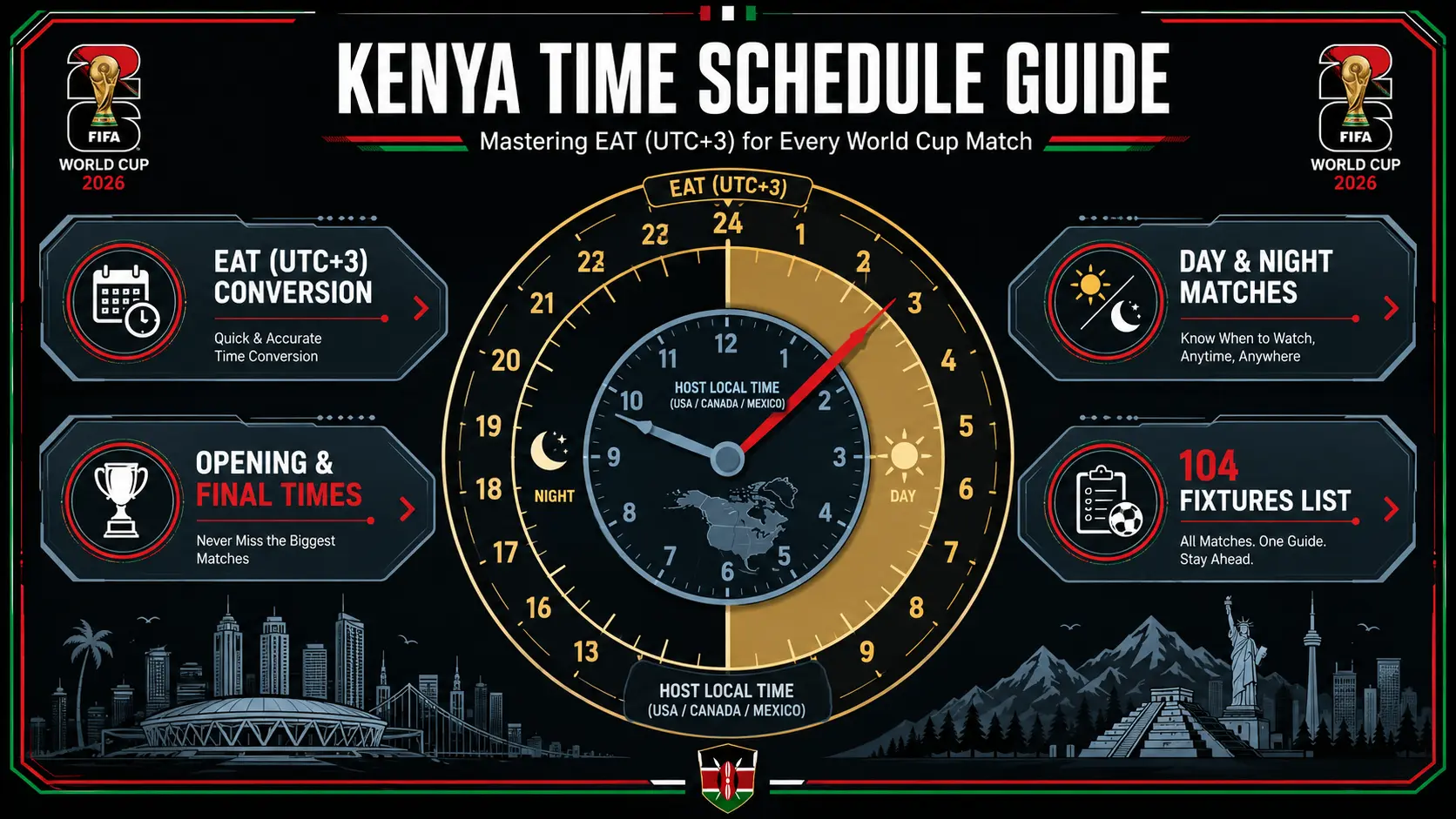
Looking for today’s World Cup matches in Kenya Time? View the full FIFA World Cup 2026 schedule in Kenya Time, including kickoff times, group-stage fixtures and knockout matches in East Africa Time (EAT).
Explore World Cup 2026:
Teams, Groups & Standings
FIFA World Cup Hub
How to Find Today’s World Cup Matches in Kenya Time
World Cup matches take place across Canada, Mexico and the United States, with host cities operating in several different North American time zones. As a result, a match listed under one date in the host country may be played after midnight on the following calendar day in Kenya.
The World Cup 2026 schedule in Kenya Time lists every fixture using East Africa Time, allowing viewers to check which matches are being played today without manually converting from Eastern, Central, Mountain or Pacific Time.
The schedule includes group-stage and knockout fixtures, current match status and links to individual match pages. When the final match of a Kenya matchday has finished, supporters can use the same page to see the next scheduled fixtures and plan ahead for late-night or early-morning kickoffs.
Kenyan viewers should always follow the EAT date shown on the schedule rather than relying only on the host-country date. This is particularly important for matches beginning between midnight and 6:00 AM in Nairobi, Mombasa, Kisumu and the rest of East Africa.
Understanding World Cup 2026 Kickoff Times in Kenya
Kenya uses East Africa Time, or EAT, which remains fixed at UTC+3 throughout the year. The country does not observe daylight saving time, so there is no seasonal clock change for Kenyan viewers during the tournament.
North American host cities generally operate between seven and ten hours behind Kenya during the World Cup. The exact difference depends on the city in which a match is played.
Fixtures held in eastern host cities such as New York, Miami or Toronto usually convert to earlier Kenya times than matches played on the west coast. Evening matches in eastern North America may begin at approximately 2:00 AM, 3:00 AM or 4:00 AM EAT, depending on the confirmed local kickoff.
Evening fixtures in western cities such as Los Angeles or Vancouver can begin at approximately 5:00 AM, 6:00 AM or later in Kenya. Central and Mountain time-zone matches generally fall between the eastern and western viewing windows.
Matches played during the North American morning or early afternoon are usually more convenient for Kenyan audiences because they convert to evening or late-night viewing hours. Evening kickoffs in the host cities are the fixtures most likely to require an overnight viewing session in Kenya.
Because the tournament uses venues across several time zones, viewers should not apply one general time difference to every match. The confirmed EAT time displayed on the Pulser schedule and individual match pages should be treated as the primary reference.
Early Morning World Cup Matches in Kenya
A significant number of World Cup fixtures fall between 12:00 AM and 6:00 AM East Africa Time. These early-morning kickoffs are caused by the time difference between Kenya and the North American host cities, particularly when matches are scheduled during local evening television windows.
Matches beginning at 1:00 AM, 4:00 AM or 5:00 AM in Kenya create a different viewing challenge from afternoon or evening fixtures. Supporters may need to decide which matches justify setting an alarm, changing their sleeping schedule or watching highlights later in the day.
The most important point is to check both the time and the Kenya calendar date. A fixture played on a Friday evening in North America may appear early on Saturday morning in Kenya. Following the host-country date alone can therefore cause viewers to miss a match by an entire day.
Weekend early-morning games are usually easier to follow because viewers have more flexibility after the final whistle. Friday evening matches in North America can become Saturday morning fixtures in Kenya, while Saturday evening games may be shown early on Sunday.
Weekday overnight matches require more planning, especially for supporters with work, school or other morning commitments. Checking the complete schedule in advance allows fans to identify which matches are worth watching live and which can be followed through highlights, reports or replays.
For viewers prioritising only a limited number of overnight fixtures, African national teams, decisive final group matches, major international rivalries and knockout games are usually the strongest options.
Best World Cup 2026 Matches for Kenyan Viewers
The best matches for Kenyan viewers depend on team preference, tournament importance and kickoff time. With 104 fixtures across the expanded competition, most supporters will need to choose which matches deserve their attention rather than attempting to watch every game live.
African National Team Fixtures
Matches involving African countries are likely to generate some of the strongest interest in Kenya and across East Africa. Teams from the continent attract regional support, particularly when they face traditional football powers or enter decisive group and knockout matches.
African team fixtures can also create communal viewing occasions in homes, bars and public fan zones. Interest normally increases when a result affects qualification or when an African nation has an opportunity to reach a historic stage of the tournament.
Major Group-Stage Clashes
Group-stage matches between leading international teams provide some of the tournament’s biggest early storylines. Fixtures involving former champions, highly ranked contenders or teams competing directly for first place can carry knockout-level importance before the elimination rounds begin.
The final round of group matches is particularly important because qualification positions may depend on points, goal difference and results in other groups. Under the expanded format, third-place calculations can also keep more teams in contention until the final group fixture.
The Opening Match
The opening match marks the official beginning of the tournament and remains a major global television event. It combines the first competitive action with the wider ceremony and atmosphere surrounding the start of the World Cup.
Even viewers who do not intend to follow every group-stage match may choose to watch the opener because it establishes the first major storyline of the tournament.
Knockout Matches
The new Round of 32 begins the elimination phase, followed by the Round of 16, quarter-finals, semi-finals and final. Each knockout match must produce a winner, creating greater pressure and a stronger possibility of extra time or penalties.
The quarter-finals and semi-finals are among the clearest must-watch fixtures because they bring together the strongest remaining teams while directly determining the route to the final.
The World Cup Final
The final is the definitive must-watch event for Kenyan football supporters. It determines the world champion and attracts both dedicated fans and viewers who may not have followed every earlier round.
The confirmed Kenya kickoff time and match details will remain available through the full World Cup schedule in EAT as the tournament progresses.
How the 48-Team World Cup Format Works
The 2026 FIFA World Cup expands the tournament from 32 to 48 national teams. The teams are divided into 12 groups, labelled Group A through Group L, with four nations in each group.
Every team plays three group-stage matches. The top two teams in each group qualify automatically for the knockout phase, producing 24 automatic qualifiers.
The eight best third-placed teams also advance, completing the 32-team field for the new Round of 32. From there, the tournament continues through the Round of 16, quarter-finals, semi-finals and final.
The expanded structure increases the total number of matches to 104. It also creates more daily fixtures, additional knockout games and a wider range of Kenya viewing times across the group stage.
For Kenyan supporters, the expanded tournament provides more opportunities to watch African, Asian and developing football nations compete on the global stage. It also makes the group standings more complex because third-place teams must be compared across all 12 groups.
Track World Cup Teams, Groups and Standings
The teams, groups and standings page provides an overview of all 48 teams and the 12 tournament groups.
Standings tables show each team’s position, matches played, wins, draws, losses, goals scored, goals conceded, goal difference and points. These figures become increasingly important as the group stage develops.
Because eight third-placed teams can qualify for the Round of 32, supporters may need to monitor results outside their preferred team’s group. A third-place team’s qualification chances can depend on points and goal difference compared with teams in several other groups.
Group pages also provide context for upcoming fixtures. A match may determine the group winner, automatic qualification, a third-place position or elimination from the tournament.
Fans following a particular country can use the teams and groups page to identify its remaining fixtures, current position and possible route into the knockout bracket.
Use the FIFA World Cup Hub and Individual Match Pages
The FIFA World Cup Hub serves as Pulser’s main tournament dashboard. It connects supporters to current matches, results, analysis, predictions, team information and other World Cup coverage.
Individual match pages provide a more focused view of one fixture. Each page includes the participating teams, confirmed Kenya kickoff time, match status and relevant tournament context.
A practical matchday journey begins with the Kenya Time schedule. Supporters can identify the match they want to follow, open its dedicated page and then check the teams and standings section to understand how the result affects qualification.
The schedule, tournament hub and standings pages perform different roles:
- The Kenya Time schedule provides the complete fixture list and confirmed EAT kickoff times.
- The teams, groups and standings page tracks tournament positions and qualification scenarios.
- The FIFA World Cup Hub provides the wider dashboard for match coverage, results and analysis.
Planning Your World Cup Viewing Schedule in Kenya
Kenyan fans can make the tournament easier to follow by reviewing each matchday in advance. Rather than checking the schedule immediately before kickoff, supporters should identify convenient evening matches, priority overnight fixtures and important weekend games.
Fans following African teams may want to bookmark all of their group-stage fixtures first. Viewers interested mainly in the biggest matches can prioritise major group clashes, final-round group games and the knockout phase.
Weekend fixtures offer the greatest flexibility for matches played during Kenya’s early-morning hours. Weekday games may require a more selective approach, particularly when kickoff falls between 3:00 AM and 6:00 AM.
Using the EAT schedule removes the risk of incorrect manual calculations and ensures that each fixture is followed on the correct Kenya date.
FAQ
What time zone does the 2026 World Cup use in Kenya?
World Cup times for Kenyan viewers are displayed in East Africa Time, or EAT, which is UTC+3. Kenya does not observe daylight saving time.
Where can I find today’s World Cup matches in Kenya Time?
Visit the full FIFA World Cup 2026 schedule in Kenya Time to see today’s fixtures, upcoming matches and confirmed EAT kickoff times.
Why are some World Cup matches played at 4:00 AM or 5:00 AM in Kenya?
North American host cities are between approximately seven and ten hours behind Kenya. Evening matches in the host cities can therefore begin during the early morning in East Africa.
Will every World Cup match be shown early in the morning in Kenya?
No. Matches are scheduled throughout the North American day, producing a mix of Kenya afternoon, evening, late-night and early-morning kickoff times.
How many teams and matches are in the 2026 World Cup?
The tournament features 48 teams and 104 matches. The competition includes 12 groups of four teams and a new Round of 32 knockout phase.
How do teams qualify from the group stage?
The top two teams in every group advance automatically. They are joined by the eight best third-placed teams to form the Round of 32.
Where can I check World Cup groups and standings?
The teams, groups and standings page lists all 12 groups and tracks points, results, goal difference and qualification positions.
Which World Cup matches are most important for Kenyan viewers?
African national team fixtures, major group-stage clashes, decisive final group matches, knockout games, the semi-finals and the final are likely to attract the strongest interest.
What is the difference between the schedule page and the FIFA World Cup Hub?
The schedule page focuses on the full fixture list and Kenya kickoff times. The FIFA World Cup Hub is the main tournament dashboard for matches, results, analysis and wider World Cup coverage.
Reference
- World Cup 2026 | Match schedule, fixtures & stadiums
- Scores & Fixtures | FIFA World Cup 2026™
- FIFA World Cup 2026™ | Fixtures, groups, teams & more