
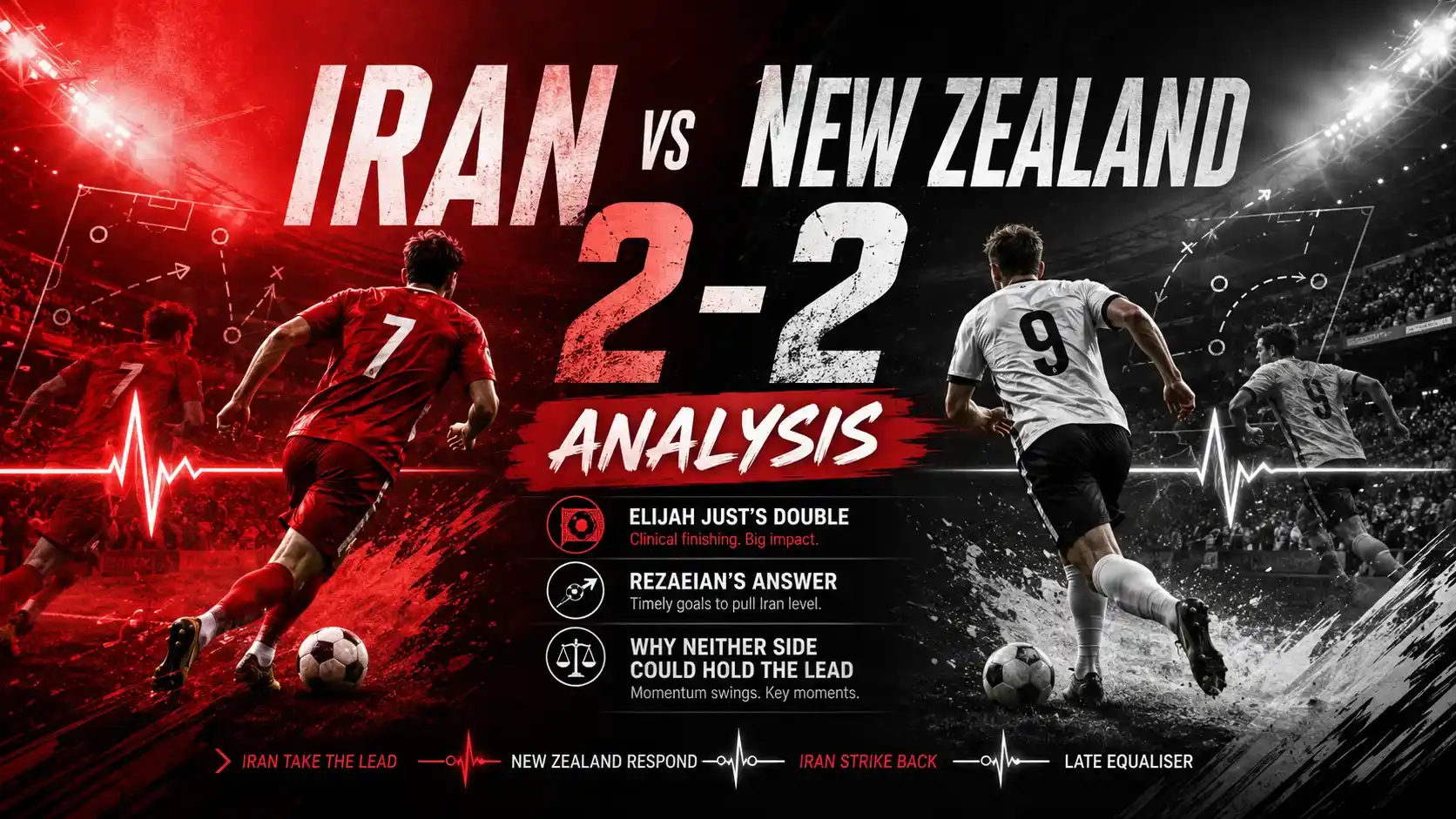
Iran 2-2 New Zealand: Result Summary and Goal Timeline
The match finished 2-2 at Los Angeles Stadium, with New Zealand taking the lead twice through Elijah Just in the 7th and 55th minutes, only for Iran to equalize through Ramin Rezaeian in the 32nd minute and Mohammad Mohebi in the 64th minute. Mehdi Taremi struck the post during Iran’s attempt to respond to the opening goal, while Ali Nemati had a goal correctly disallowed for offside shortly before half-time. Full match details and statistics show how the result left both teams searching for defensive answers.
Chris Wood was instrumental for New Zealand, providing the assist for both Just goals by controlling long balls inside the penalty area and supplying his strike partner. The target-man partnership demonstrated its effectiveness against Iran’s backline, with Wood’s physical presence allowing him to shield possession and lay the ball into Just’s path for both finishes.
Iran’s goals came from different sources of pressure, with Rezaeian reacting first to a loose ball after Shahriar Moghanloo’s blocked effort for the first equalizer, and later delivering the precise cross for Mohebi’s headed second equalizer. These moments showcased Iran’s ability to create through quick combinations and wide deliveries, though they could not translate this pressure into a lead.
Why Neither Side Could Hold the Lead: Tactical Breakdown
New Zealand’s direct approach repeatedly exposed Iran’s defensive frailties, particularly their inability to control second balls and track runners arriving around the center-forward, allowing Wood to consistently bring Just into dangerous positions that led to both goals. Iran’s defensive organization appeared vulnerable whenever the ball was played long into the penalty area, with New Zealand regaining the lead just seven minutes after Iran’s first equalizer.
Ramin Rezaeian’s advanced positioning from right-back created Iran’s attacking threat but also contributed to defensive instability, as his penalty-area presence for the first goal and overlapping cross for the second left spaces behind him that New Zealand exploited to restore their lead. The dual nature of his performance—scoring and assisting while leaving defensive gaps—encapsulated the open, transitional nature of the contest.
Despite Iran’s superior shot volume with 17 total attempts to New Zealand’s 14, New Zealand’s eight shots on target compared to Iran’s four illustrates that total attempts alone did not determine the result. New Zealand generated more efficient and accurate attacking moments through their focused direct play, while Iran’s higher volume included speculative efforts that failed to test the goalkeeper.
Group G Context and What’s Next for Both Teams
The draw leaves all four Group G teams level on one point after Belgium and Egypt also drew 1-1, creating a wide-open group where Iran and New Zealand’s next fixtures against Belgium and Egypt respectively will be crucial for qualification hopes. Group G standings and fixtures confirm that neither team can afford defeat in their second matches if they hope to reach the Round of 32.
Iran coach Amir Ghalenoei and captain Mehdi Taremi cited difficult travel, visa, and recovery conditions including a requirement to return to their Mexico base shortly after the match, providing context for their physical preparation though not serving as a proven excuse for the tactical deficiencies observed on the pitch. These statements represent Iran’s explanation for their circumstances rather than objective reasons for every physical or organizational shortcoming during the 90 minutes.
For Kenyan and East African viewers following the tournament in EAT (UTC+3), Iran face Belgium next while New Zealand meet Egypt, with both matches carrying significant weight in determining which two teams will advance from the group to the Round of 32. Complete World Cup 2026 schedule in Kenya Time helps local fans plan their viewing for these decisive second-round fixtures. Pulser’s FIFA hub provides ongoing coverage of the tournament.