
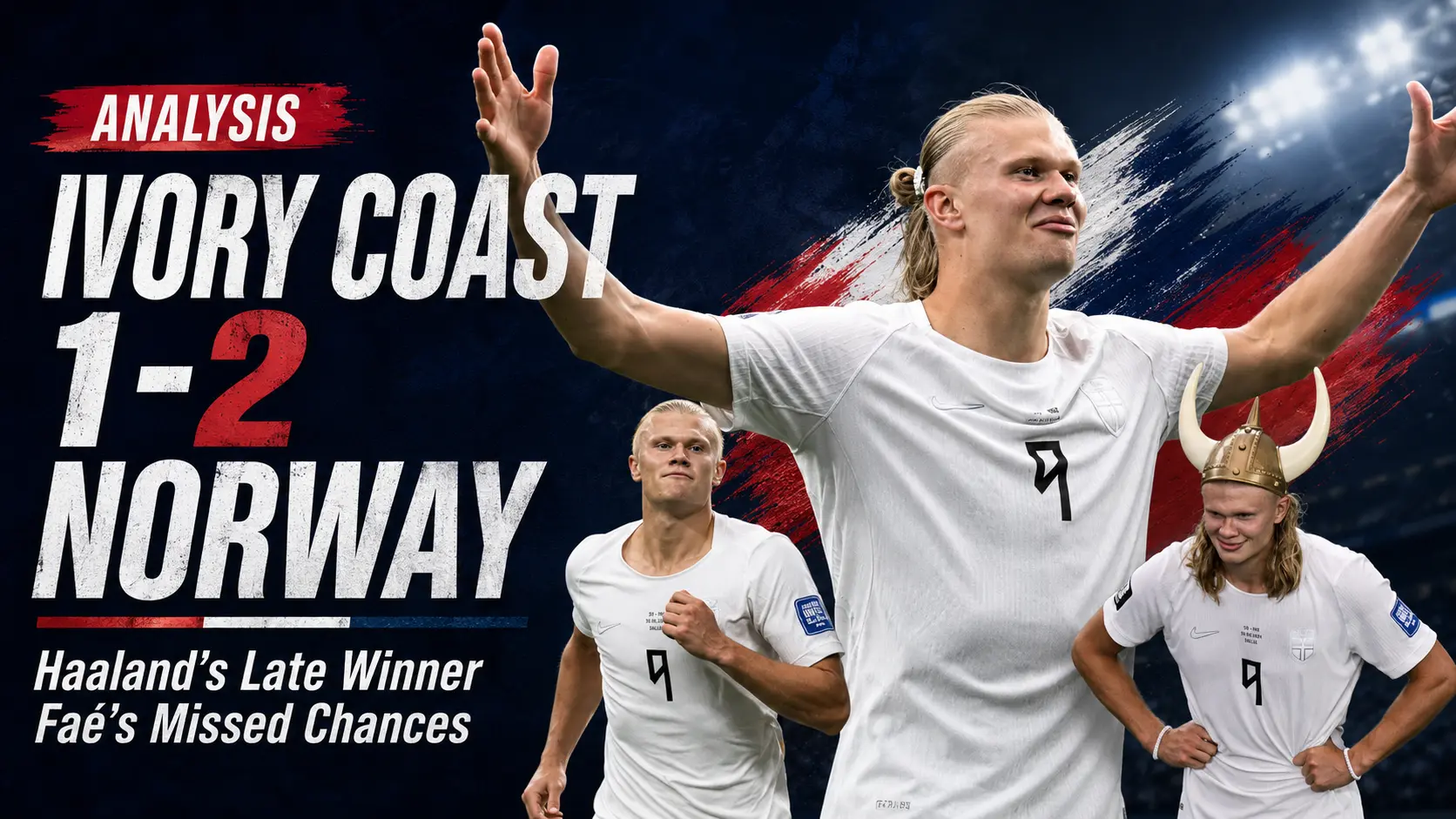
Match Result and Decisive Moments: How Norway Broke Ivory Coast Hearts
Norway defeated Ivory Coast 2-1 in a tense Round-of-32 encounter at the 2026 FIFA World Cup, with Erling Haaland’s 86th-minute strike sealing the Norwegians’ passage to face Brazil after the Elephants had fought back from a first-half deficit. Antonio Nusa had given Norway the lead before halftime, but Manchester United winger Amad Diallo levelled the contest in the 74th minute, setting up a dramatic finale that ultimately favoured the European side’s clinical edge.
Ivory Coast entered the knockout phase as Group E runners-up, having secured six points and a plus-two goal difference through victories over Ecuador and Curaçao during an impressive group-stage debut for many of Faé’s young players. Norway arrived as Group I runners-up with an identical six-point haul but a narrower plus-one goal difference, having recovered from a heavy 4-1 defeat to France by defeating Iraq and Senegal to secure their place in the bracket.
Nusa’s opening goal established Norway’s control of the scoreboard despite the Scandinavians ceding large portions of possession to their African opponents, who pressed aggressively for an equaliser throughout the second half. The RB Leipzig winger’s finish rewarded a swift transitional move that highlighted the danger Norway posed even when defending deep against Ivory Coast’s sustained attacks.
Diallo’s equaliser in the 74th minute temporarily shifted momentum entirely toward the Elephants, with the Manchester United forward capitalizing on space created by Ivory Coast’s width-focused attacking system to spark celebrations among the travelling supporters. However, the goal also exposed Norway’s vulnerability to sustained pressure, forcing Solbakken’s side to regroup quickly as the match entered its decisive final phase.
Haaland’s winner four minutes from time punished Ivory Coast’s inability to reset defensively after their equaliser, with the Manchester City striker demonstrating the ruthless efficiency that separates tournament contenders from emerging sides. The strike ended Ivory Coast’s maiden knockout appearance in the expanded 48-team format, sending the West Africans home despite a performance that merited at least extra time based on territorial dominance.
Tactical Battle: Solbakken’s Restoration vs Faé’s Fearless Youth
Solbakken’s decision to restore Norway’s strongest lineup proved pivotal, as the manager abandoned the heavy rotation that contributed to the 4-1 group-stage collapse against France in favor of his established core. The restored XI maintained structural integrity during Ivory Coast’s best periods, ensuring that Norway remained dangerous on the counter even while absorbing pressure for extended stretches of the second half.
Faé’s tactical approach relied on fearless youth and attacking width, with the Elephants employing a high-pressing system designed to create turnovers in advanced positions and exploit the flanks through rapid combinations. The strategy generated numerous crossing opportunities and half-chances, particularly during the quarter-hour following halftime, but poor final touches and rushed decision-making in the penalty area prevented Ivory Coast from converting territorial superiority into goals.
Norway’s game management distinguished the victors from the eliminated, as the Scandinavian side demonstrated the composure to weather Ivory Coast’s post-equaliser momentum without committing reckless numbers forward. Solbakken’s players maintained their shape and defensive discipline, whereas the Elephants’ youthful exuberance led to overcommitment in attack during the final ten minutes, leaving spaces that Haaland exploited for the decisive finish.
Differing experience levels became evident during the closing stages, with Norway’s settled squad controlling tempo and possession intelligently to see out the result, while Ivory Coast’s players appeared uncertain whether to press for a winner or protect the draw. This tactical ambiguity proved costly, as the defensive lapse that allowed Haaland to break free stemmed directly from the Elephants’ disorganized transition after losing possession in Norway’s half.
Road Ahead: Norway’s Brazil Test and Ivory Coast’s Tournament Legacy
Norway’s reward for the hard-fought victory is a Round-of-16 appointment with Brazil, a fixture that presents a formidable examination of Solbakken’s tactical acumen and his squad’s ability to compete against tournament favourites. The Scandinavians must improve their possession control and defensive transitions significantly if they hope to trouble the Seleção, though the restoration of their strongest lineup suggests they will at least field their most competitive available personnel.
Ivory Coast’s exit marks the end of a promising campaign for Faé’s development-focused squad, which secured six points from their group stage matches and pushed a seasoned Norwegian side to the brink despite this being many players’ first World Cup appearance. The tournament revealed both the depth of young talent available to Ivorian football—particularly in wide areas—and the critical need for development in game management and clinical finishing against high-level opposition.
The Elephants’ inability to close out tight contests against European opposition highlights a developmental gap that must be addressed before future AFCON and World Cup cycles, though the aggressive, front-foot approach suggests a clear identity that could yield success with added maturity. Fans seeking to follow Norway’s progress against Brazil can consult Pulser’s full match report and timeline for lineups from this fixture, while the Round of 32 bracket contextualizes the victory within the wider knockout tree.
Kenyan viewers planning to watch the Norway-Brazil showdown should note that kickoffs continue at 20:00 EAT for evening fixtures, with Pulser’s Round of 16 schedule in Kenya Time providing exact dates and venues. Those interested in the group-stage paths that brought these teams together can review the standings from Group E and Group I for complete context on how Ivory Coast and Norway navigated the opening phase.