
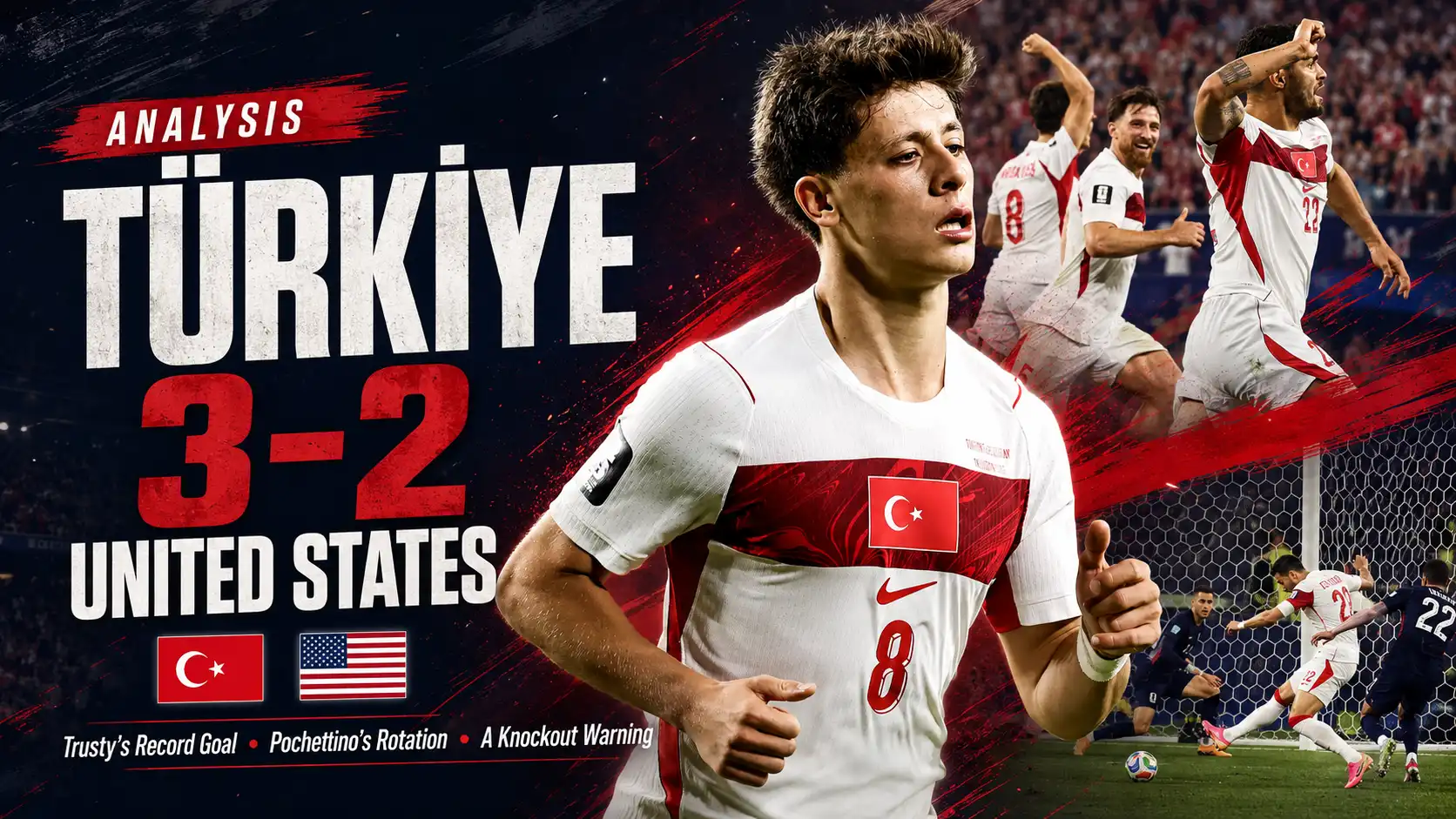
Match Breakdown: How Türkiye Recovered from Trusty’s Record Opener
Türkiye recovered from Auston Trusty’s record-breaking opener by finally converting their attacking volume into goals through improved movement and clinical finishing in the final third. Auston Trusty gave the United States an early lead by scoring the tournament’s record-breaking 173rd goal, capping the highest-scoring FIFA World Cup in history before the knockout stage had even begun. The strike represented a historic moment for the tournament, surpassing previous scoring records and demonstrating the attacking intent that has characterized the expanded 48-team format across North American venues.
Vincenzo Montella’s side finally converted their attacking volume into goals after drawing blanks against Australia and Paraguay, demonstrating improved finishing and movement in the final third to score three unanswered goals. Turkish attackers found spaces between the lines that had previously been unavailable, exploiting the experimental American back line with combinations that reflected growing chemistry despite earlier group-stage disappointments. The three-goal haul validated Montella’s tactical adjustments and provided a measure of redemption for a side that had dominated possession in previous matches without finding the net.
The rotated US defensive structure struggled to maintain the compactness shown in earlier 4-1 and 2-0 victories, allowing Turkey to exploit spaces that had been sealed off when the full-strength press was active. Full match details and statistics reveal how the experimental back line failed to coordinate its positioning, leaving channels open for Turkish runners that would have been closed by the first-choice unit. Defensive transitions, in particular, exposed the gap between starting-caliber players and their replacements, suggesting that the squad depth Pochettino tested against a motivated opponent possessed limitations when pressed into extended action.
Pochettino’s Rotation Gamble: Protecting Stars vs. Maintaining Rhythm
Pochettino’s rotation gamble sacrificed defensive control and pressing coordination, exposing fragility in the squad structure when multiple key personnel were withdrawn simultaneously. Christian Pulisic began on the bench alongside several regular starters as Mauricio Pochettino prioritized managing yellow-card accumulation and fitness concerns over maintaining momentum in a dead rubber fixture. The decision reflected the realities of a compressed tournament schedule in the 48-team format, where accumulation risks and recovery cycles demand squad management even when perfectionist coaches prefer continuity.
The heavily rotated XI lost the defensive control and high-pressing coordination that defined the USMNT’s opening wins, suggesting the squad’s structure becomes fragile when key personnel are withdrawn simultaneously. Without the regular starting back line and midfield pivot, the press lacked the synchronization required to trap opponents in their own half, forcing the team into reactive positions that consumed energy and created openings. Group D standings and qualification scenarios confirm that the result did not damage the United States’ position, yet the performance raised troubling questions about whether the tactical system is personnel-dependent rather than robust enough to function with squad rotation.
Tactical discipline disintegrated against sustained Turkish pressure, raising questions about whether this defeat represents merely a harmless consequence of necessary squad management in the expanded format or evidence that the US lacks comparable depth to maintain structure against motivated opponents. The 48-team World Cup demands rotation across seven potential matches for finalists, meaning Pochettino cannot rely exclusively on his strongest eleven throughout the knockout phase. If the second-unit players cannot replicate the pressing triggers and defensive compactness of the starters, the United States risks exhaustion or suspension crises derailing their campaign when they face higher-quality opposition in the Round of 32.
Group D Final Table and Round of 32 Implications
The United States finished top of Group D with 6 points and a +4 goal difference despite the 3-2 defeat, while Turkey exited the tournament with 3 points and a -2 goal difference that proved insufficient for the best-third-place calculation. The Group D standings show the USA ahead of the second-placed team on goal difference accumulated during their opening 4-1 and 2-0 victories, confirming that the final match operated as a dead rubber for Pochettino’s side. Turkey’s elimination despite their final-day victory illustrates the cruel mathematics of the 12-group format, where three points and a negative goal difference rarely suffice for progression as one of the best third-placed teams.
The 48-team format with 12 groups and a Round of 32 meant this result did not alter the group winner, but still serves as a concentration warning ahead of knockout football where errors are fatal. Round of 32 schedule in Kenya Time reveals that the United States will face their next opponent in a single-elimination fixture where defensive lapses like those seen against Turkey result in immediate elimination rather than merely damaging group-stage arithmetic. Kenyan fans planning to watch the knockout phase should note that the expanded format has already produced record goal totals, but knockout matches typically favor organized defensive structures over the open exchanges seen in dead rubber group games.
Restoring the first-choice back line becomes Pochettino’s immediate priority before the Round of 32, alongside re-establishing the high press and ensuring squad rotation does not compromise defensive transitions against higher-quality opposition. The FIFA World Cup hub provides updated squad news and injury reports that will determine whether the protected starters return refreshed or carrying knocks from training. Defensive transitions, in particular, require urgent attention, as the Round of 32 opponents will possess the pace and tactical intelligence to exploit the gaps that Turkey exposed, making the difference between a deep run and an early exit.