
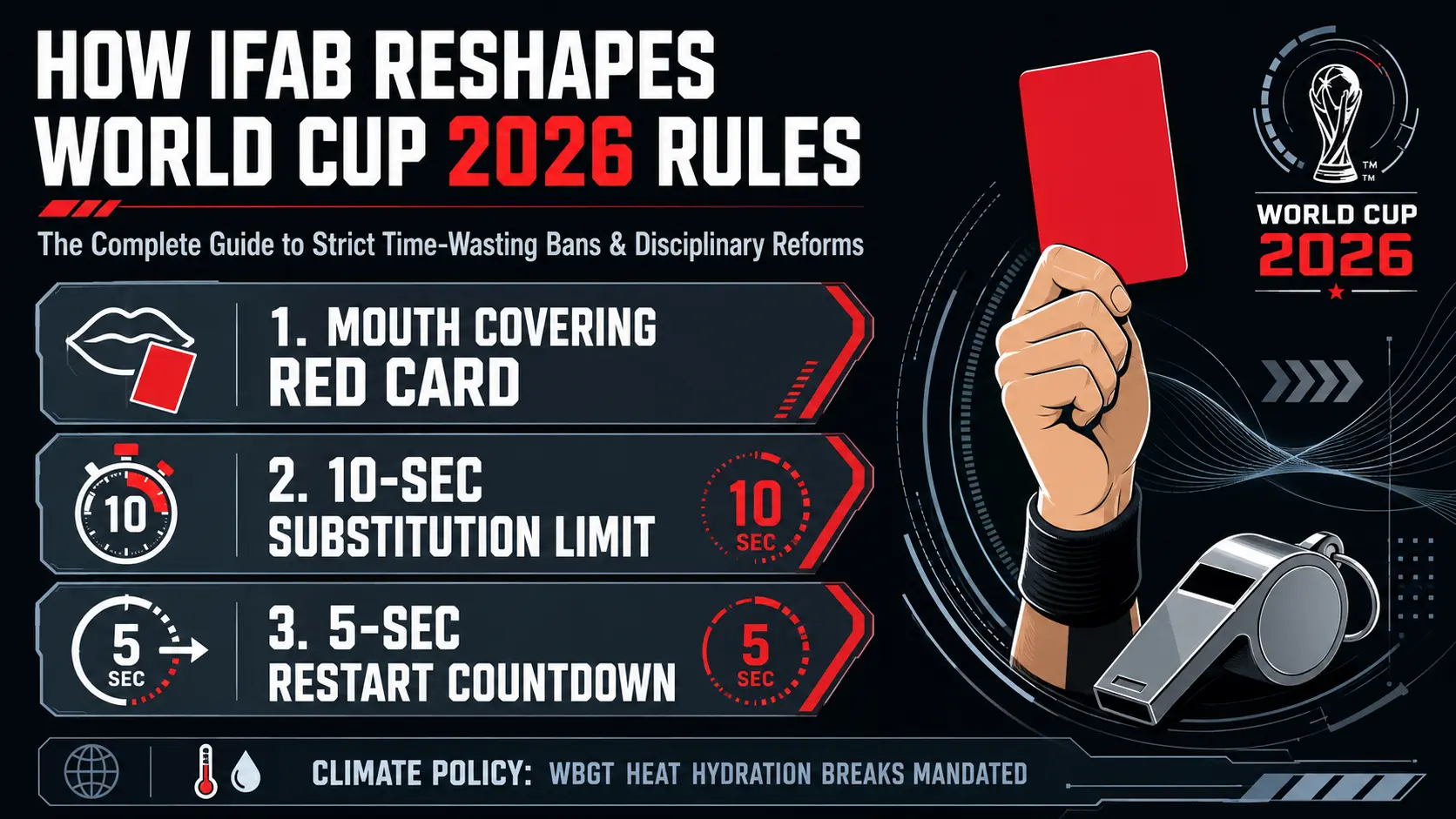
IFAB (International Football Association Board) has officially established a comprehensive overhaul of world cup 2026 rules to resolve critical pain points regarding match pacing, on-field unsporting delays, and player physical welfare. As the tournament transitions into an unprecedented 48-team expansion, maintaining athletic standards across 104 matches presents a significant challenge for officials. This detailed guide breaks down every landmark regulatory change greenlit for the tournament, ranging from the strict 10-second substitution limit to the innovative 5-second restart countdowns designed to eliminate late-game stalling. Additionally, we analyze how the newly expanded VAR protocols correct disciplinary errors such as mistaken player identity on the pitch. Beyond on-field play, this resource details how the competitive bracket is restructured under the best third-placed teams criteria and explores the vital health measures, like WBGT cooling pauses, implemented to protect participants from extreme summer heatwaves. Supporters, coaches, and athletes will find the essential insights needed to adapt to this modernized sporting framework.
👉 Official Recommendation: Visit the FIFA Official Tournament Hub to explore the latest official news, complete match schedules, participating team rosters, and updated group standings!
How does IFAB reshape world cup 2026 rules to eliminate time-wasting?
The IFAB (International Football Association Board) has officially authorized the updated world cup 2026 rules to eliminate on-field time-wasting. This governing body worked closely with FIFA Chief Refereeing Officer Pierluigi Collina to craft these dynamic modifications. They target excessive match delays and unsporting behavior to ensure a faster, cleaner spectacle. By modernizing these parameters, soccer’s lawmakers aim to preserve the active playing time and elevate the athletic standards expected at the highest level of international football.
Strict mouth covering bans trigger instant red cards
Mouth covering by players during on-field confrontations triggers a direct red card under the updated IFAB code. This strict ban was codified following a controversial altercation in February 2026 between SL Benfica’s Gianluca Prestianni and Real Madrid’s Vinicius Junior, where hidden verbal abuse raised massive concerns. By forbidding players from hiding their lips behind hands, arms, or jerseys during heated disputes, the rule eliminates the cover used for racial or discriminatory abuse. Referees now possess immediate authority to dismiss any individual violating this boundary, enhancing behavioral accountability across the pitch.
New ten second substitution rules penalize slow exits
The new substitution protocol imposes a strict 10-second limit for exiting players to maintain game momentum. This operational mandate requires the substituted athlete to exit the pitch at the nearest boundary line within the designated timeframe. If the player fails to leave the playing surface in time, the incoming substitute is forced to wait on the sidelines for a mandatory one-minute delay period. During this penalty minute, the offending team must compete with only ten players, heavily discouraging deliberate stalling tactics during late-game transitions.
Referee five second count downs accelerate match restarts
Referee five-second countdowns on throw-ins and goal kicks prevent teams from deliberately delaying restarts. When an official raises an arm to signal the countdown, the executing player must put the ball back into play within five seconds. If a throw-in exceeds this strict limit, possession immediately reverses to the opposing side. For delayed goal kicks, the penalty is even more severe, as the referee will award an immediate corner kick to the attacking team, completely removing the tactical advantage of slow defensive resets.
Will the massive 48-team expansion restructure the tournament knockout path?
The historic 48-team expansion forces the IFAB (International Football Association Board) to adapt the world cup 2026 rules for a larger competitive pool. This unprecedented scale means the total number of tournament fixtures will spike from 64 to 104 matches. Its administrative framework must support a balanced competitive path that preserves physical integrity. Consequently, the governing body has restructured the advancement mechanics to handle the massive influx of competing nations without compromising sporting quality.
Why twelve groups of four trigger a historic round of 32
A restructured bracket featuring twelve groups of four teams introduces an extra Round of 32 knockout stage. This structural change replaces the traditional format, ensuring that every participating country plays at least three high-stakes matches. To transition smoothly into the knockouts, the top two teams from each group, along with the eight best third-placed teams, will advance to this newly created round. Under these updated parameters, the path to the championship now requires a grueling eight-match run, intensifying the physiological demands placed on elite athletes.
How best third-placed teams criteria resolve group ties
Best third-placed teams criteria serve as the primary mechanism to resolve qualification ties among identical group records. This complex tie-breaker system utilizes a rigid three-step audit that evaluates overall group points, goal differences, and goals scored. If multiple squads remain level, officials will consult the Team Conduct Score, which penalizes yellow and red card accumulation, before defaulting to the latest FIFA/Coca-Cola World Rankings.
To ensure transparency, the fair play point deductions are strictly calculated as follows:
| Disciplinary Action | Fair Play Point Deduction |
|---|---|
| Yellow Card | -1 point |
| Indirect Red Card (Second Yellow Card) | -3 points |
| Direct Red Card | -4 points |
| Yellow Card followed by Direct Red Card | -5 points |
Can advanced VAR and SAOT systems eliminate officiating delay?
Technological integration championed by the IFAB (International Football Association Board) establishes modernized world cup 2026 rules to minimize human error. These digital officiating assets operate continuously to streamline match flow and support the referee’s on-field decisions. By deploying cutting-edge tracking cameras and artificial intelligence, the tournament aims to deliver near-instantaneous accuracy. This technical infrastructure reduces the lengthy interruptions that historically frustrated spectators and disrupted team strategies.
Expanded video assistant referee duties correct mistaken identity
Expanded Video Assistant Referee protocols empower officials to reverse obvious errors regarding mistaken player identity. The video booth now possesses broader intervention capabilities designed to keep play moving without compromising sporting justice. This system actively reviews critical incidents to rectify misapplied discipline before matches resume.
The primary responsibilities under the expanded video officiating protocols include:
- Correcting second yellow card errors that lead to direct red cards.
- Identifying cases of mistaken identity during disciplinary actions.
- Rectifying obvious errors in awarding corner kicks before the play restarts.
Semi-Automated Offside Technology secures instant decisions
Semi-Automated Offside Technology is a specialized tracking system designed to generate instantaneous offside lines. This specialized configuration utilizes tracking cameras and a sensor embedded directly inside the match ball to determine player positions. It calculates spatial data in real time, transmitting immediate alerts to the video officiating booth to verify offsides within seconds. By automating the geometry of close calls, this advanced platform minimizes prolonged video reviews, ensuring that tight decisions are settled without halting the match’s natural rhythm.
How do extreme WBGT heat limits and stadium security impact fans?
Extreme environmental conditions compel the IFAB (International Football Association Board) and regional coordinators to tighten stadium safety and world cup 2026 rules. This collaborative network must manage the physical hazards of a summer tournament spanning Canada, Mexico, and the United States. They enforce strict regional ordinances alongside climate protocols to protect thousands of traveling supporters. These protective measures establish a secure, organized environment that keeps focus entirely on the pitch.
Mandatory hydration breaks mitigate extreme summer heatwaves
Wet Bulb Globe Temperature levels exceeding 28 degrees Celsius trigger mandatory cooling pauses for player safety. This atmospheric measurement accounts for humidity, wind speed, and direct sunlight to evaluate thermal stress on the human body. When the threshold is breached, referees will halt play around the 22nd minute of each half for a mandatory three-minute hydration break. These pauses allow players to lower their core body temperatures, preventing severe heat-related illnesses during extreme summer conditions.
Strict water bottle bans clash with fan health demands
Stadium safety requirements dictate that reusable water bottles are strictly prohibited under the active FIFA Stadium Code. This safety protocol bans hard metal flasks and insulated thermoses to prevent them from being used as dangerous projectiles. To balance this safety measure with public health concerns during high-temperature matches, the organizing committee permits spectators to bring a single, empty, transparent plastic bottle of up to one liter. Fans can fill these containers at dedicated water stations located throughout the stadium concourses.
No drone zones impose steep federal penalties near venues
Unlawful drone activity around sports venues triggers heavy penalties enforced by local and federal aviation authorities. The Federal Aviation Administration has designated all active tournament stadiums as strict “No Drone Zones” to prevent aerial collisions and security breaches. Violators operating unauthorized unmanned aircraft face civil fines of up to $75,000 and criminal penalties reaching $100,000, along with potential federal prosecution and the confiscation of their equipment. These severe enforcement guidelines secure the airspace, ensuring that match play proceeds without external disruption.
Green sustainability rules restrict team transit routes
Green sustainability rules impose strict limits on regional transit to lower carbon footprints across host nations. This environmental policy restricts participating squads to localized clusters during the initial group stages, preventing excessive long-haul flights. Security experts, including former safety coordinators like Andrew Giuliani, recognize that managing multi-jurisdictional logistics requires balancing travel efficiency with rigorous crowd safety. By enforcing these environmental regulations, organizers minimize the carbon impact of a 48-team event while optimizing regional safety protocols.
FAQ
What are the new rules for the World Cup 2026?
The newly introduced world cup 2026 rules represent the most extensive campaign by the IFAB (International Football Association Board) to curb delays and ensure behavioral discipline. These policies focus heavily on eliminating time-wasting and discrimination. They introduce immediate red cards for mouth-covering during arguments, enforce strict 10-second limits for exiting players during substitutions, and implement referee-controlled 5-second countdowns for throw-ins and goal kicks.
Is the 6 second rule for goalkeeper still applying?
The traditional six-second rule for goalkeepers is undergoing structural testing and revision under modern IFAB directives. While the classical restriction historically limited the time a goalkeeper could hold the ball in their hands, enforcement was notoriously inconsistent. In current competitive frameworks, referees are trailing an eight-second restriction where officials physically count down the final seconds. If a goalkeeper violates this temporal boundary, possession is transferred to the opposing side via an immediate corner kick or a throw-in, replacing the previous indirect free-kick penalty.
What’s the hardest position in soccer?
The position of goalkeeper along with high-coverage central midfield roles are widely considered the most physically demanding positions under the 2026 climate guidelines. Players occupying these zones must manage extreme physical exertion across the expanded 8-match tournament schedule. Midfielders must sustain continuous high-intensity running across massive pitches, while goalkeepers must maintain micro-second focus under the physical duress of extreme summer heat exceeding 28 degrees Celsius on the WBGT index.
What is the rule 12 in FIFA?
FIFA Rule 12 constitutes the formal section of soccer’s laws addressing fouls, misconduct, and on-field disciplinary sanctions. This specific law serves as the legal foundation that referees use to issue yellow and red cards. For the 2026 campaign, the regulation has been amended to categorize any deliberate attempt to cover one’s mouth during player confrontations as a dismissible red card offense, directly combating hidden offensive or discriminatory behavior.
Is the drop kick still legal?
The goalkeeper drop kick remains completely legal under the current Laws of the Game. This specific distribution technique allows goalkeepers to punt the ball immediately after letting it fall from their hands before it touches the ground. While the mechanics of the drop kick itself have not been outlawed, keepers must execute this release quickly to avoid violating the updated goalkeeper possession time limits enforced by match officials.
References
- World Cup 2026 groups, qualification rules & tie-breakers explained (FIFA Official Website)