
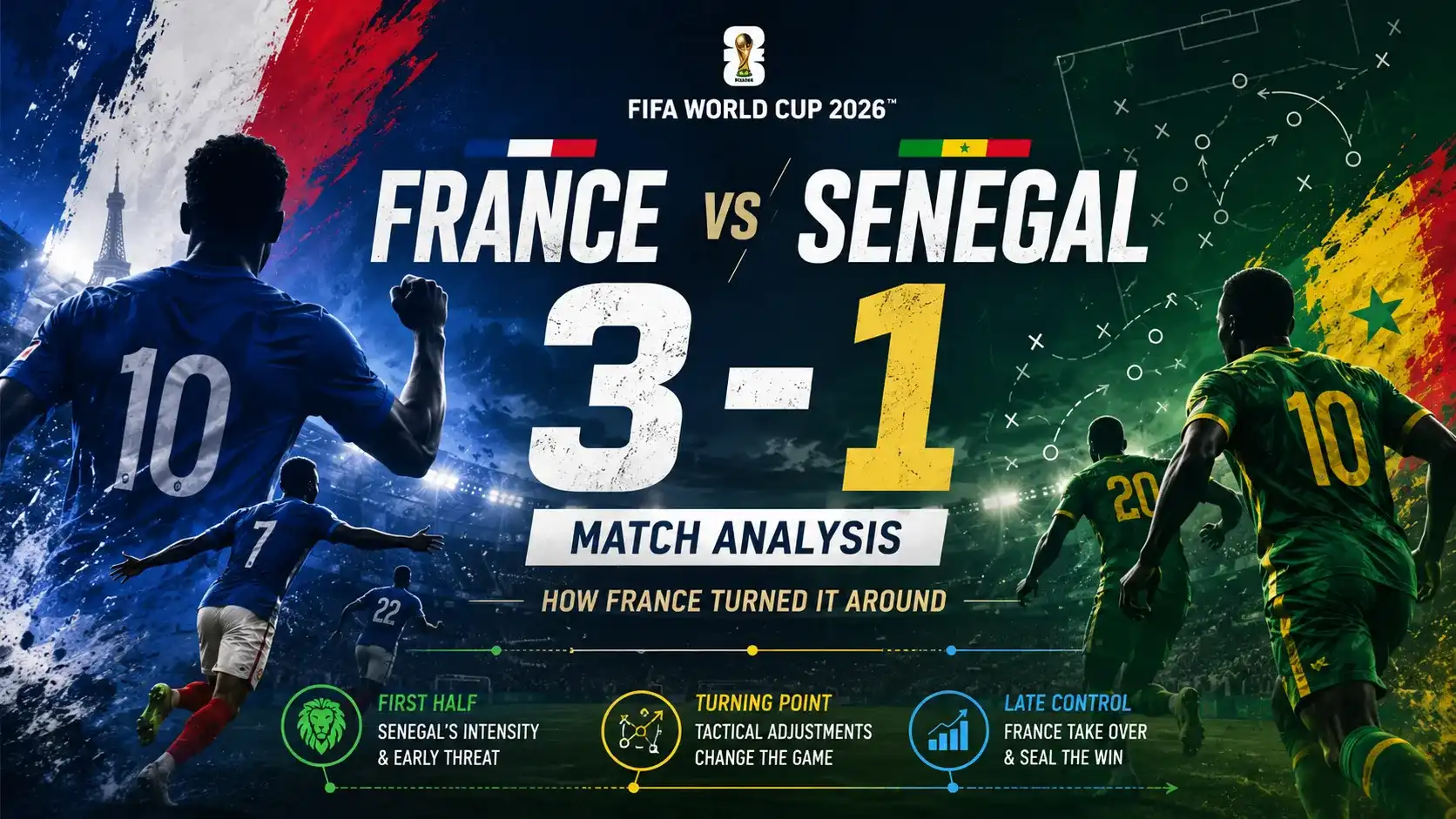
How the Match Unfolded: Senegal’s Early Dominance and France’s Second-Half Response
Senegal’s aggressive transition play and superior athleticism controlled the opening 45 minutes, creating the match’s most dangerous opportunities through Nicolas Jackson, Sadio Mané, and Ismaila Sarr before tactical adjustments shifted momentum toward France after halftime.
Jackson’s blistering pace exposed France’s high defensive line during a rapid counterattack midway through the first half, with the Chelsea striker’s powerful drive striking the post after beating Jules Koundé for speed. That near-miss epitomized Senegal’s early superiority, as Aliou Cissé’s side repeatedly regained possession and attacked with numbers before France could reorganize their defensive shape. Sadio Mané’s experience and close control provided the creative hub for these transitions, drawing fouls and creating space for overlapping runs from the wing-backs that stretched France’s back four.
France’s midfield appeared sluggish and disconnected during these opening exchanges, with Aurélien Tchouaméni and Warren Zaïre-Emery struggling to protect the space between the defensive line and the midfield block. Kylian Mbappé found himself isolated against Senegal’s compact defensive unit, unable to receive possession in dangerous areas between the lines and resorting to hopeful runs behind the defense that the Senegalese back three consistently tracked. The reigning world champions managed only speculative efforts from distance during the first half-hour, while Senegal’s direct approach generated three clear-cut opportunities that should have produced at least one goal.
The Teranga Lions’ physical intensity and coordinated pressing forced France into uncharacteristic errors, with misplaced passes in dangerous areas gifting possession to Senegal’s forwards in advanced positions. Ismaila Sarr’s close-range miss from Mané’s inviting cross shortly before halftime represented the clearest indication that Senegal’s dominance deserved tangible reward, with the Watford winger failing to convert from six yards after excellent build-up play down the French right. That squandered opportunity would haunt the African champions as the match progressed, providing France with a reprieve they capitalized upon after the interval.
France’s tactical fortunes changed significantly early in the second half when Michael Olise began drifting into central spaces between Senegal’s midfield and defensive lines, abandoning the wide positions where Nampalys Mendy and the Senegalese wing-backs had neutralized his first-half influence. The Crystal Palace winger’s intelligent movement created overloads in the half-spaces that Senegal’s back three struggled to manage, allowing France to attack through the middle rather than relying solely on predictable wide possession or direct passes over the top. Olise’s assist for Mbappé’s opener exemplified this positional shift, with the midfielder receiving possession between the lines and threading a precise pass that split the Senegalese defense.
Mbappé’s Historic Brace and France’s Bench Impact
Kylian Mbappé’s second-half brace transformed a personally frustrating evening into a historic milestone, with the France captain scoring in the 66th minute and again during stoppage time to become Les Bleus’ all-time leading scorer with 58 goals while extending his World Cup finals tally to 14 strikes.
The opening goal arrived following Olise’s incisive pass into the penalty area, with Mbappé demonstrating his characteristic composure to control the ball and fire past Edouard Mendy into the bottom corner. That finish broke the deadlock after an hour of mounting French pressure and visibly relieved tension within the French camp, allowing the forward to play with greater freedom during the closing stages. Mbappé’s second strike, a thunderous long-range effort struck with minimal backlift during second-half added time, sealed the victory emphatically and officially moved him past Olivier Giroud’s previous record of 57 international goals for France. The brace also elevated Mbappé to 14 World Cup goals, placing him among the tournament’s most prolific scorers and cementing his status as the defining player of his generation on football’s biggest stage.
Bradley Barcola’s immediate impact from the substitute’s bench proved equally significant for Didier Deschamps’ tactical approach, with the Paris Saint-Germain winger scoring France’s second goal shortly after replacing Ousmane Dembélé. Barcola’s energetic running and direct dribbling stretched a tiring Senegalese defense, creating the space for his precise finish that effectively decided the contest before Mbappé’s late record-breaker. The substitute’s contribution highlighted the extraordinary attacking depth available to France throughout this tournament, with Deschamps able to call upon match-winners from his replacements bench even when his starting forwards struggled to break down organized opposition.
The contrast between Mbappé’s subdued first half and his clinical second period illustrated the striker’s maturity and mental resilience. During the opening 45 minutes, the captain misplaced several routine passes and appeared frustrated by Senegal’s physical marking, leading to uncharacteristic decisions in possession that disrupted French attacking rhythm. However, the 27-year-old maintained his concentration and positioning discipline, ensuring he remained available to convert the high-quality chances that finally arrived once Olise’s tactical adjustments created space between Senegal’s defensive lines. This ability to influence matches even when not at peak performance levels separates elite forwards from merely good ones, suggesting Mbappé’s record-breaking evening may represent just the beginning of his impact at this tournament.
The final 3-1 margin aligned broadly with our pre-match France vs Senegal prediction, which forecast a narrow 2-1 French victory while correctly identifying Senegal’s counterattacking threat as the primary danger to Les Bleus. The tactical preview warned specifically about Jackson’s pace and Mané’s creativity on the break, concerns validated by Senegal’s first-half dominance and clear-cut chances. While France’s late efficiency produced a wider final margin than predicted, the fundamental analysis regarding the match’s competitive nature and Senegal’s ability to trouble the world champions proved accurate, suggesting the African side will remain dangerous opponents for any team in this competition.
Senegal’s Missed Opportunities and Group I Consequences
Senegal’s profligacy in front of goal during their first-half dominance proved more decisive than France’s second-half quality in determining the 3-1 outcome, with Nicolas Jackson and Ismaila Sarr squandering clear chances that would have fundamentally altered the match trajectory before France seized control.
Jackson’s thunderous strike against the woodwork following a blistering counterattack and Sarr’s failure to convert from close range after Mané’s inviting cross represented high-value opportunities that separated potential victory from eventual defeat. Ibrahim Mbaye’s consolation goal in the closing minutes offered brief hope of an unlikely comeback before Mbappé immediately restored the two-goal cushion with his record-breaking strike. A final stoppage-time goalmouth scramble that forced Mike Maignan into a crucial goal-line clearance further demonstrated Senegal’s persistent threat even when trailing, underscoring how the African champions’ performance deserved greater reward than the final scoreline suggested.
The 3-1 result raises legitimate questions about whether the scoreline flatters France given Senegal’s control of key periods and dangerous attacking transitions throughout the first hour. Aliou Cissé’s side demonstrated sufficient tactical organization and individual quality to trouble any opponent in this tournament, with their pressing structure and transition speed causing significant problems for a French side considered among the favorites for the title. Senegal’s defensive compactness limited Mbappé’s influence for extended periods, while their midfield battle against established French stars suggested they possess the necessary components to recover from this setback and challenge strongly for qualification from Group I standings and fixtures.
France’s three points provide crucial momentum and relieve immediate pressure ahead of their remaining group matches, placing them at the top of the table after the opening round of fixtures. However, the difficulty encountered against Senegal serves as a warning that their path through this tournament will require significant improvements in defensive transitions and midfield compactness. For Senegal, the focus must shift immediately to their upcoming fixture against Norway, a match that now carries must-win implications if they hope to progress beyond the group stage. The full match details and Kenya kick-off time confirm this result opens Group I with a statement French victory, though Senegal’s performance suggests they retain the necessary quality to recover and potentially secure second place, provided they convert future opportunities with greater precision than they managed against the reigning world champions.