
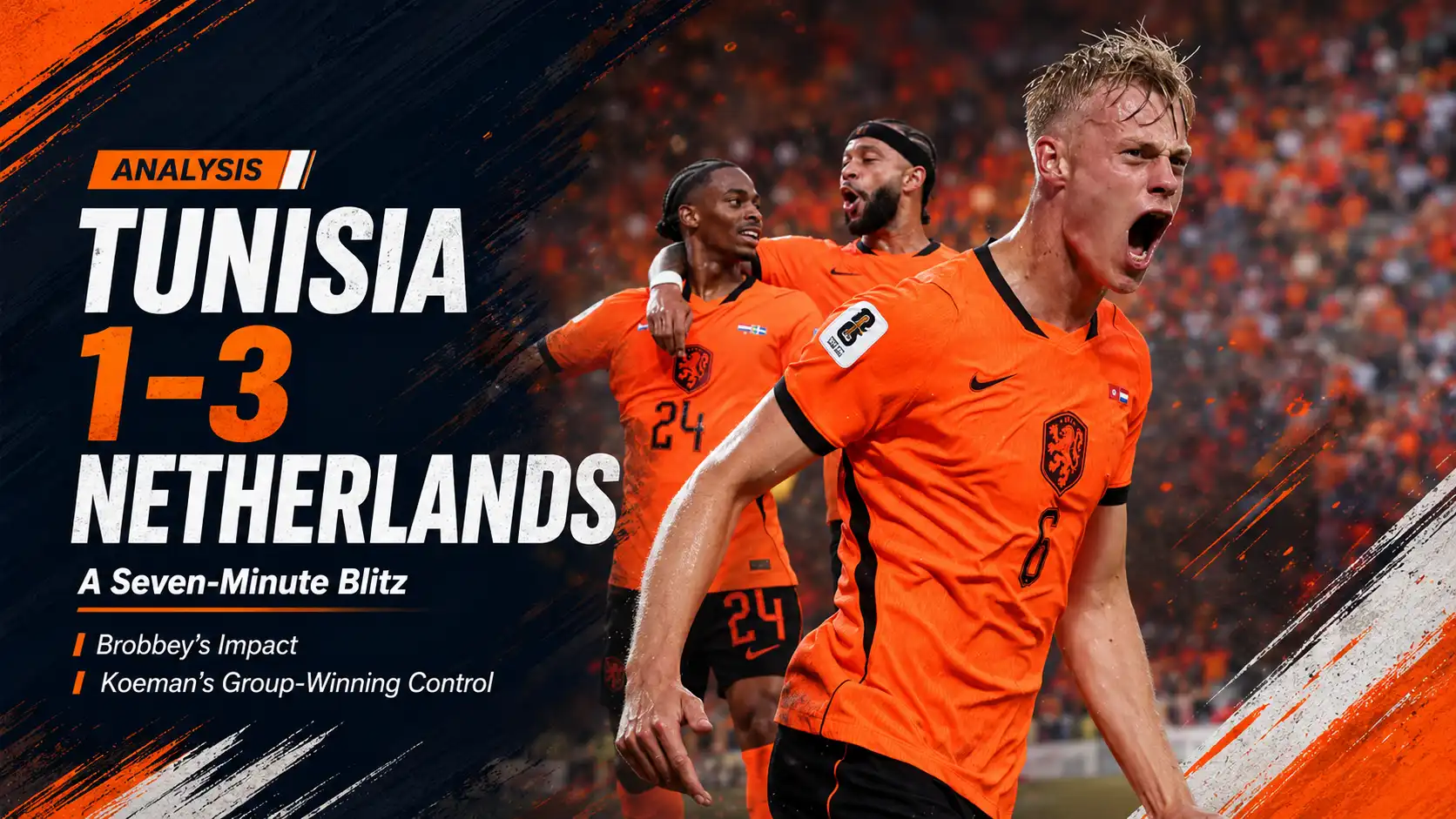
The Seven-Minute Blitz: How Netherlands Broke Tunisia Before Half-Time
The Netherlands destroyed Tunisian resistance inside seven first-half minutes through an unfortunate Ellyes Skhiri own goal and Brian Brobbey’s clinical finish. Pressure from Dutch vertical running forced the Tunisia captain into deflecting the ball into his own net, opening the scoring against the run of play and shattering North African confidence. Brobbey capitalized immediately on the resulting disorganization, slotting home from close range to double the advantage before Tunisian defenders could regroup.
Jan Paul van Hecke’s second-half header from a set-piece ultimately killed any lingering Tunisian momentum after Hazem Mastouri had briefly offered hope with a well-taken consolation goal. Mastouri’s strike came against the flow of play, rewarding a rare moment of Tunisian attacking intent, but van Hecke’s aerial dominance from a corner restored the two-goal margin within minutes. The detailed match report and timeline captures how these three goals unfolded in a match that effectively ended as a contest before halftime.
The final 3-1 scoreline confirmed the Netherlands finished with 7 points and a +6 goal difference after drawing 2-2 with Japan and beating Sweden 5-1. Tunisia ended their campaign with zero points, a -10 goal difference, and 12 goals conceded across three matches following earlier 5-1 and 4-0 defeats. These statistics reflect a defensive collapse that started from the opening whistle of the tournament and never stabilized, even after a mid-tournament coaching change attempted to stem the bleeding.
Koeman’s Tactical Mastery: Rotation, Verticality and Midfield Control
Ronald Koeman rotated his squad effectively while maintaining structural discipline and high-tempo vertical attacks throughout the 90 minutes. Fresh legs introduced into the starting lineup maintained the pressing intensity and shape that characterized the Dutch opening wins, preventing Tunisia from finding rhythm even when possession statistics briefly favored the North Africans. Rotation risks often destabilize teams in knockout qualification scenarios, yet Koeman’s system proved robust enough to absorb personnel changes without losing geometric balance.
Dutch attackers exploited space behind Tunisia’s high defensive line through direct channel passes that bypassed the midfield press. Tunisia’s back four, already reeling from the full Group F standings and results showing their previous heavy defeats, struggled to cope with the pace of Dutch wingers making diagonal runs into the final third. Verticality dominated the Oranje approach, with midfielders instructed to look forward immediately upon winning possession rather than recycling possession sideways.
Brian Brobbey’s physical impact and predatory movement sparked debate about whether he should start ahead of other options in the knockout stages against Morocco. His close-range finish demonstrated excellent positional awareness, though questions remain whether this performance against a fragile Tunisian defense truly tests his readiness for sterner opposition. Koeman faces a selection dilemma: reward Brobbey’s goals or revert to more experienced strikers who might better handle Morocco’s organized backline.
Tournament Fallout: Morocco Awaits, Tunisia Departs
The Netherlands advance to face Morocco in the Round of 32 as Group F winners, while Tunisia exit after conceding 12 goals across three comprehensive defeats. The expanded 48-team format offers no reprieve for the bottom-placed side, with Tunisia’s -10 goal difference and zero points representing one of the tournament’s poorest group stage returns. Defensive instability plagued the Carthage Eagles from their opening 5-1 thrashing through to this final 3-1 loss, with a mid-tournament coaching change failing to address systemic organizational issues.
Koeman must now adjust his tactical approach for the Morocco matchup, recognizing that the defensive vulnerabilities exposed by Tunisia’s high line will not transfer to a well-drilled Moroccan side. Moroccan defenders will likely sit deeper, forcing the Netherlands to break down compact blocks rather than exploiting space in behind. Tactical flexibility becomes essential as the Oranje transition from group-stage dominance against weaker opposition to knockout football against fellow qualifiers.
Kenyan fans can track the Netherlands versus Morocco fixture using the World Cup 2026 schedule in Kenya Time (EAT UTC+3) to catch kickoff times without timezone confusion. Pulser will continue providing match updates, analysis, and standings as the tournament progresses through the knockout rounds. Tunisia’s early departure leaves North African representation focused on Morocco, setting up a potentially explosive Round of 32 clash with continental bragging rights at stake.