
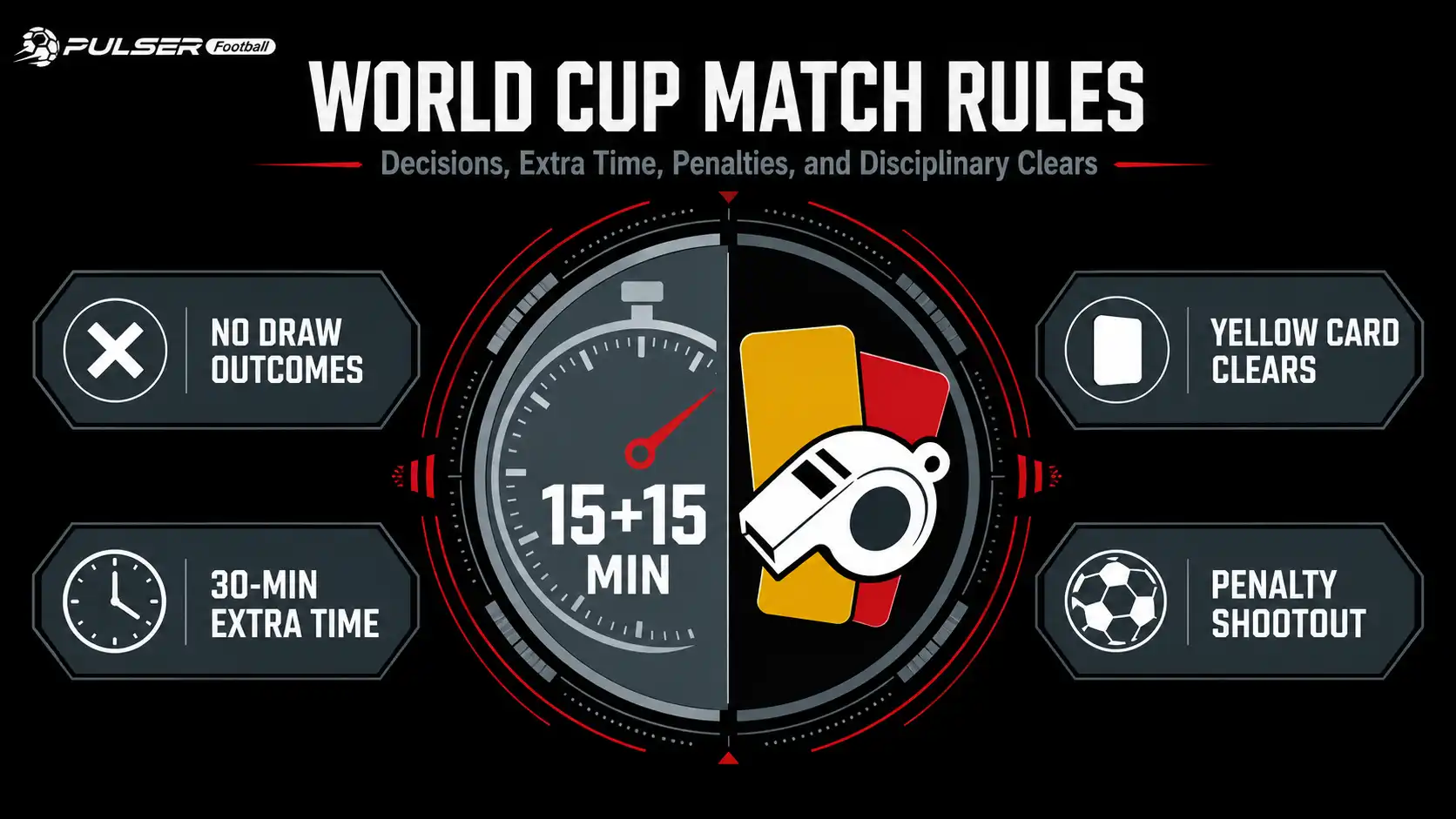
Can a World Cup Knockout Match End in a Draw? The Definitive Answer
Knockout matches at the FIFA World Cup cannot end in draws because the tournament structure requires one team to advance and the other to be eliminated. Group stage fixtures permit drawn results where both teams receive one point toward their group standings, allowing multiple paths to qualification, but knockout football operates under single-elimination rules that demand a definitive winner by the end of the scheduled proceedings. The bracket format leaves no room for shared outcomes, as each round must halve the remaining field until only one champion remains.
Level scores after 90 minutes of normal time do not conclude the contest or send both teams through. Referees immediately trigger a mandatory tie-breaking sequence when the final whistle blows with the sides tied, signaling the start of additional playing periods. Players remain on the pitch rather than heading to the dressing rooms, maintaining match readiness while coaches make tactical adjustments for the extended play.
Football’s governing bodies mandate a specific two-stage resolution process for every knockout fixture to ensure fairness and finality. First, contestants play two 15-minute periods of extra time totaling 30 additional minutes of continuous play. A penalty shootout follows if the deadlock persists after 120 minutes of cumulative play to determine which nation progresses to the next round. Readers seeking the complete bracket progression and format details for the expanded tournament should consult the World Cup 2026 knockout stage guide.
Extra Time and Penalties: How Winners Are Decided in Knockout Football
Extra time begins immediately when the referee blows the final whistle at 90 minutes with the scores level. Players contest two distinct 15-minute periods totaling 30 additional minutes of play, with teams switching ends between halves as they would at halftime in normal matches. The full extra time duration is completed regardless of whether either side scores during these periods, ensuring both teams receive the full opportunity to win in open play before resorting to the penalty spot.
A brief interval separates the two extra time periods, allowing squads to hydrate, receive tactical instructions from coaching staff, and make substitutions if they have not exhausted their allocation. Play continues until the 120th minute expires, at which point the match terminates immediately if one team holds a lead over the other. Sudden death applies during these final moments, meaning a late goal ends the contest without waiting for the full period to elapse, provided the trailing side cannot equalize before time expires.
Penalty shootouts commence when the score remains tied after the full 120 minutes of open play. Each team nominates five players to take alternating kicks from the penalty mark, with the order decided by coin toss. Sudden death rounds follow if the scores remain level after these initial ten attempts, with players continuing in rotation until one team scores and the other misses, creating the necessary advantage to declare a winner.
Official match records maintain a crucial distinction between the scoreline and the shootout outcome for statistical purposes. The final result recorded in tournament statistics and history books reflects the score at the end of extra time, typically displayed as a draw such as 1-1 or 2-2. Penalty shootout successes determine only the advancing team for bracket progression purposes and do not alter the official match score or count toward goal difference or player goal tallies.
World Cup 2026 Knockout Stage: What Kenyan Fans Need to Know
The 2026 FIFA World Cup introduces an expanded knockout format featuring 48 teams and a new Round of 32 phase. A total of 56 knockout matches will be played under single-elimination rules from the Round of 32 through to the final, representing a significant increase from the 32-team era. Every fixture in this expanded bracket requires a winner, meaning East African viewers will witness potentially more extra time and penalty shootout scenarios than in any previous World Cup edition as the field narrows from 32 survivors to one champion.
Timezone considerations present unique viewing challenges for football supporters in Kenya and East Africa during the 2026 tournament. Matches hosted across Canada, Mexico, and the United States will air at various hours in East Africa Time (EAT, UTC+3), often during late night or early morning hours depending on the specific North American venue and local kickoff scheduling. Fans should prepare for kickoffs occurring well past midnight and potentially approaching dawn for certain knockout fixtures, particularly those held on the United States West Coast, requiring strategic planning for work and sleep schedules.
Pulser provides dedicated resources to help Kenyan supporters track the knockout bracket progression through every potential tie-breaking scenario including extra time and penalties. The Full World Cup 2026 schedule in Kenya Time offers specific kickoff times converted to EAT for planning viewing parties and setting reminders. The FIFA World Cup 2026 teams and groups page helps readers understand how nations progress from the initial group stage into the new Round of 32 format before reaching the traditional Round of 16. Real-time updates on the Pulser FIFA hub ensure fans never miss which teams advance via dramatic late goals, extra time winners, or tension-filled penalty shootouts.
FAQ
Can a World Cup knockout match end in a draw after extra time?
No. If the score remains level after 120 minutes of play, a penalty shootout is held to determine the winner. The match cannot conclude without a decided outcome and an advancing team.
Do penalty shootout goals count in the final match result?
No. The official match scoreline records the score at the end of extra time. While the penalty shootout decides which team advances, the kicks are not added to the official match score.
What happens if a Round of 32 match is tied in the 2026 World Cup?
The match proceeds to two 15-minute periods of extra time. If still tied, a penalty shootout determines which team advances to the Round of 16. This applies to all knockout stages including the final.
Reference
- FIFA World Cup 26™ Regulations
- Law 10 — Determining the Outcome of a Match
- Law 7 — The Duration of the Match