
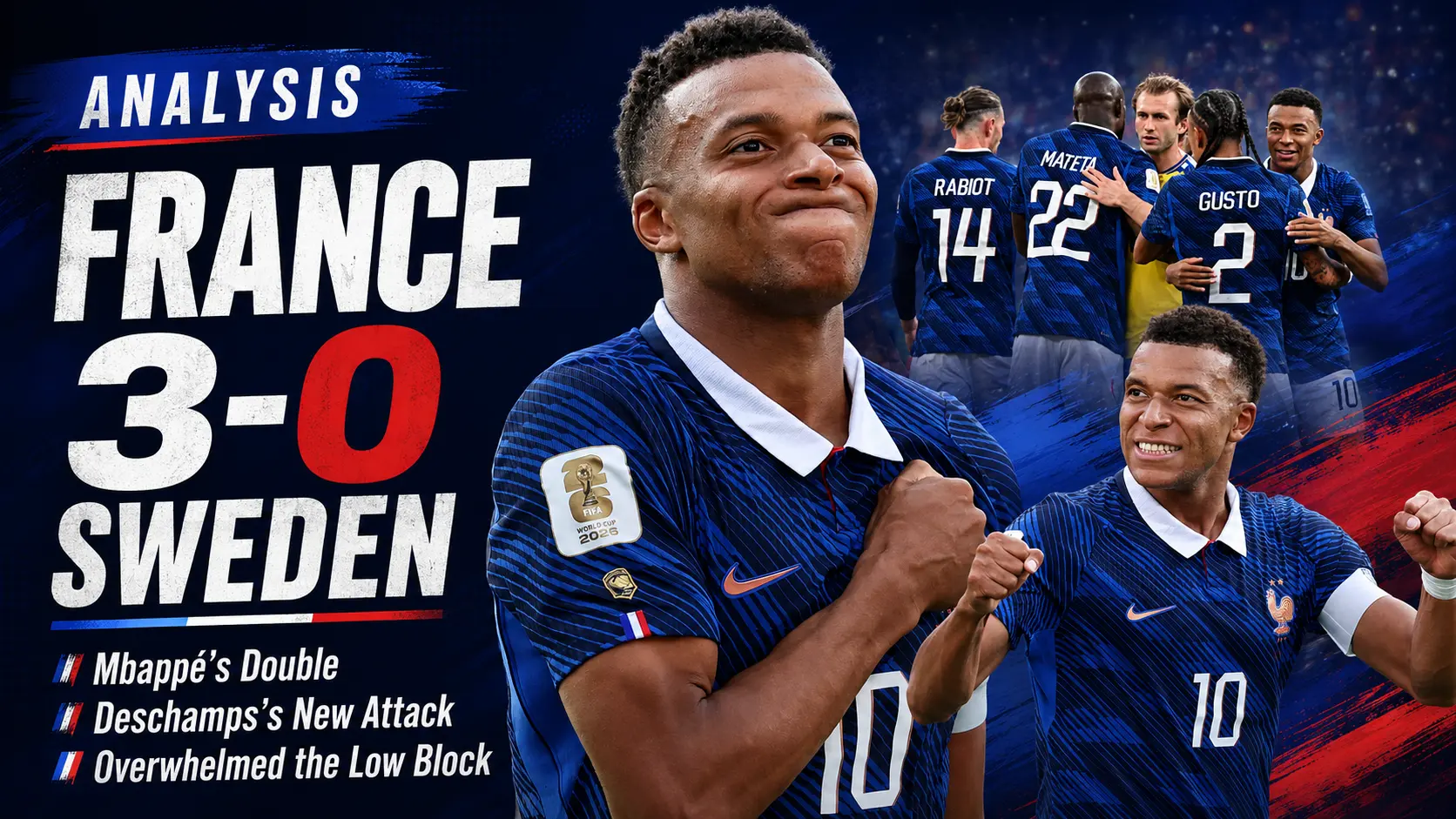
How France Dismantled Sweden’s Low Block After a Cagey Opening Phase
Kylian Mbappé’s intelligent movement into the half-spaces between Sweden’s center-backs and full-backs provided the primary weapon against Graham Potter’s organized defensive structure. The France captain timed his runs to exploit the brief moments when Sweden’s back line stepped up, creating the separation necessary for Michael Olise’s through balls. Mbappé’s first goal demonstrated this relationship perfectly, as he received the ball in the left channel before cutting inside to finish clinically, while his second showcased his ability to punish defensive blocks that had already conceded mental and physical ground after the initial breakthrough, with Ousmane Dembélé providing the assist after a quick exchange that highlighted their growing on-field chemistry.
Michael Olise’s deployment as a central creative hub rather than a traditional wide midfielder allowed France to access dangerous areas between Sweden’s defensive and midfield lines. The Bayern Munich playmaker’s technical security under pressure meant Sweden’s attempts to congest the wide areas proved futile, as France simply accelerated through the center. Olise’s assist for the opening goal originated from a half-turn in central midfield, threading a weighted pass that bypassed three Swedish defenders and arrived at Mbappé’s feet precisely as the defensive line attempted to step up, demonstrating the timing required to break a compact low block that had previously frustrated France during the opening twenty minutes of cautious probing.
Bradley Barcola’s impact as the third attacker completed the systematic dismantling of Sweden’s defensive shape by providing vertical stretching that prevented Potter’s back line from compressing into a narrow, central block. The trio of Mbappé, Dembélé, and Barcola created a rotational threat that moved Swedish defenders horizontally across the pitch, generating the fatigue and lapses in concentration that characterize organized defenses facing sustained pressure against technically superior opponents who refuse to force play through congested channels. Barcola’s third goal resulted directly from this dynamic, as Sweden’s inability to simultaneously account for Dembélé’s width and Barcola’s diagonal runs into the box left space for a simple finish that sealed the contest.
Deschamps’s Tactical Evolution: Genuine Transformation or Opportunistic Exploitation?
Didier Deschamps’s decision to field a high defensive line and implement coordinated pressing triggers marked a significant departure from the conservative, reactive double-pivot systems that characterized France’s 2022 World Cup triumph and their tendency to protect leads by sitting deep against inferior opposition. Les Bleus dominated territorial possession against Sweden, maintaining sustained pressure in the opposition half rather than retreating into defensive structures after taking the lead. This structural aggression suggests a philosophical shift toward proactive control, though the true measure of this evolution will come against opponents capable of exploiting the space behind France’s advanced full-backs.
Mbappé, Olise, and Dembélé formed a fluid attacking triangle that consistently overloaded Sweden’s right flank before switching play to exploit the resulting gaps. Dembélé’s hugging of the touchline pinned Swedish defenders wide, while Olise’s inward drift created numerical superiority in central corridors that Mbappé exploited with his diagonal runs. The constant interchanging of positions prevented Sweden’s organized 4-4-1-1 block from establishing a clear reference point for their defensive assignments, leading to the confusion that produced France’s first two goals and prevented Sweden from establishing any attacking rhythm through sustained possession.
Graham Potter’s tactical approach ultimately facilitated France’s dominance by offering minimal counterattacking threat beyond isolated long balls aimed at a lone striker isolated against Dayot Upamecano and Ibrahima Konaté, who dealt comfortably with aerial threats due to the lack of supporting runners from midfield. Sweden’s decision to remain deep and reactive without implementing a press-resistant outlet or coordinated counter-pressing meant France faced negligible transitional risk when losing possession high up the pitch. Whether this 3-0 victory proves Deschamps has transformed France into genuine attack-first title favorites remains uncertain, as future opponents like Paraguay will likely pose greater questions about France’s defensive spacing and ability to handle aggressive midfield pressing.
Road to the Quarterfinals: France’s Round of 16 Date with Paraguay
Les Bleus will advance to face Paraguay in the Round of 16 carrying the significant advantages of a perfect four-win record and key players rested after an early multi-goal lead allowed Deschamps to make strategic substitutions. The momentum accumulated through dominant group stage performances, including the 4-1 victory over Norway that secured top spot in Group I with nine points and a formidable plus-eight goal difference, provides psychological reinforcement for a squad navigating the high-stakes single-elimination phase. France’s progression through the Round of 32 bracket positions them favorably for a deep run, provided they maintain the tactical discipline shown against Sweden.
Paraguay will present a fundamentally different challenge than Sweden’s passive low block, likely offering more aggressive transitional play and physical midfield pressing that tests France’s ability to play through the center. South American opposition traditionally emphasizes winning second balls and quick vertical transitions, meaning Deschamps must adjust his defensive spacing and pressing triggers to prevent his high line from becoming a liability against pacey wingers who will look to exploit the channels behind Theo Hernández and Jules Koundé. The technical quality of Paraguay’s midfield will demand greater defensive contributions from France’s attacking trio than were required against Sweden’s isolated long-ball strategy.
Supporters in Kenya and East Africa should consult the World Cup 2026 schedule in Kenya Time to confirm kickoff times in EAT for the upcoming knockout fixtures, as single-elimination matches often shift to primetime North American slots that translate to early morning or late night viewing in Nairobi, with France’s match against Paraguay likely requiring Kenyan fans to adjust their schedules accordingly. Understanding the best third-place standings context clarifies how Sweden’s qualification path differed from Paraguay’s more demanding route, highlighting the escalating difficulty France faces as they pursue a quarterfinal berth. Deschamps’s ability to adapt his newfound attacking aggression against proactively defensive South American opposition will determine whether this campaign ends in glory or early elimination.