
Match Result and Decisive Moments in Kansas City
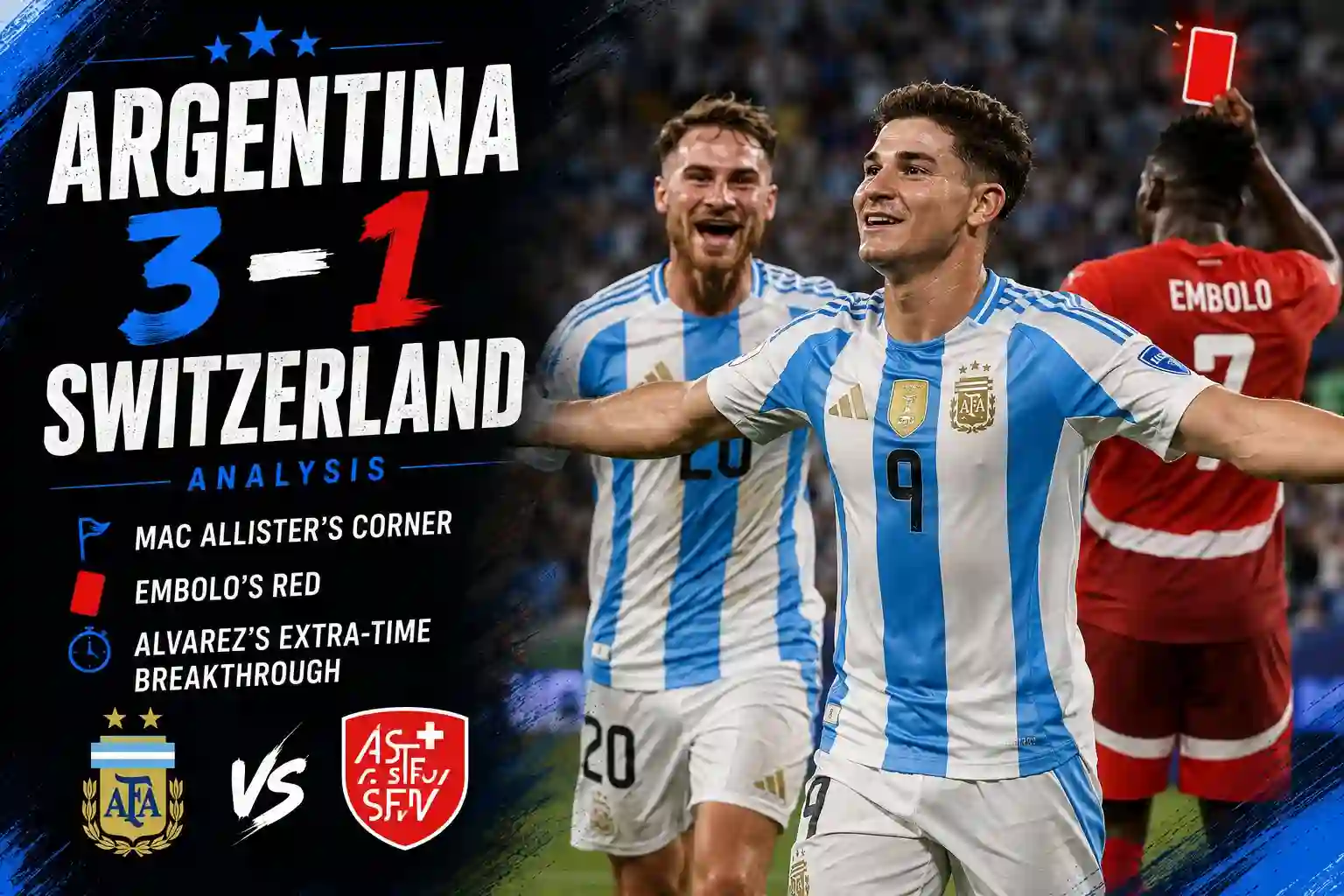
Argentina secured a 3-1 extra-time victory over Switzerland to book a semi-final date with England, surviving a second-half scare before capitalising on Breel Embolo’s controversial 72nd-minute dismissal to find late breakthroughs through Julián Álvarez and Lautaro Martínez. Mac Allister’s precise tenth-minute header gave the defending champions an early advantage, attacking the near post from a Messi corner that exploited Swiss marking vulnerabilities in the opening exchanges. The Liverpool midfielder’s timing provided a lead that held through a first half where Switzerland struggled to break down the compact defensive block.
Dan Ndoye converted a 67th-minute equaliser to reward sustained Swiss attacking intent after the interval, capping a period where Granit Xhaka and Remo Freuler began controlling midfield spaces. The Swiss pressure forced Emiliano Martínez into several saves as Murat Yakin’s side exposed Argentina’s vulnerability to quick transitions, shifting the match’s momentum until the 72nd-minute red card incident eliminated Embolo for simulation following a VAR-related mistaken-identity sequence.
Thirty minutes of extra time became necessary as Swiss defensive organisation initially resisted Argentine advances despite the numerical disadvantage. Julián Álvarez broke the deadlock in the 112th minute with a stunning long-range strike from outside the penalty area, capitalising on space created by relentless pressing against the depleted back line. Lautaro Martínez added the decisive third goal in the 121st minute, tapping home a rebound to ensure Argentina avoided penalties and secured progression.
Tactical Structures and the Red Card Turning Point
Lionel Scaloni deployed a flexible 4-3-1-2 system that transitioned into a 4-4-2 defensive block, relying heavily on Messi’s set-piece mastery and Mac Allister’s aerial timing rather than sustained open-play dominance, with Álvarez’s relentless pressing creating turnovers but the midfield struggling to control possession against Switzerland’s compact shape. Scaloni’s approach prioritized vertical passing through Messi’s creative positioning while accepting periods without the ball, trusting the defensive line to absorb pressure before releasing quick counters through the forward pairing.
Murat Yakin’s 4-2-3-1 structure, anchored by Xhaka and Freuler with Ndoye and Embolo providing vertical threat, grew increasingly effective after halftime as Switzerland forced Martínez into several saves, exposing Argentina’s vulnerability to quick transitions before the numerical disadvantage disrupted their rhythm. Swiss full-backs pushed higher to stretch the pitch, creating overloads that generated the 67th-minute equaliser and maintained pressure until the red card forced a tactical retreat.
The 72nd-minute dismissal of Embolo proved the definitive tactical inflection point, forcing Switzerland into a 10-man defensive shell that nullified their counter-attacking threat while allowing Argentina to increase territorial pressure. Yakin reorganized his remaining players into a 4-4-1 formation, but the loss of Embolo’s hold-up play isolated the remaining attackers and invited sustained Argentine possession that eventually cracked the resistance through moments of individual quality rather than systematic disassembly.
Champion Survival and England Semi-Final Warning Signs
Argentina’s 3-1 victory reinforced the ‘suffering champion’ mentality that defined their Round of 16 escape against Egypt, where Scaloni’s side also required late heroics after conceding momentum, suggesting a resilience forged from high-pressure elimination contexts rather than comfortable dominance. The defending champions fell behind against Egypt before recovering to win 3-2, establishing a pattern of surviving difficult knockout scenarios that reappeared against the Swiss and raised questions about their ability to dominate elite opposition for full ninety-minute periods.
Switzerland’s second-half performance and Argentina’s reliance on set pieces, crowd energy, and the man advantage expose vulnerabilities that semi-final opponents England will seek to exploit, particularly regarding defensive transitions, midfield physicality, and the accumulated fatigue of consecutive extra-time matches. England’s analysts will study how Ndoye and Embolo found space between the lines and how Xhaka’s distribution controlled periods of the match, recognizing that Argentina’s midfield press can be bypassed by quick vertical passing.
Kenya and East African fans tracking the defending champions’ progress can monitor the upcoming semi-final fixture and recovery timeline through Pulser’s 2026 FIFA World Cup schedule in Kenya Time, ensuring they catch the England clash at the correct East Africa Time. Scaloni must now address the tactical gaps that Switzerland highlighted before facing the Three Lions, particularly the need for greater midfield control and faster defensive transitions, while managing the physical toll of 120-minute matches on key veterans. Comprehensive coverage of the knockout bracket, group standings and tournament teams remains available through the FIFA World Cup 2026 hub as Argentina attempts to maintain their title defense against European opposition.