
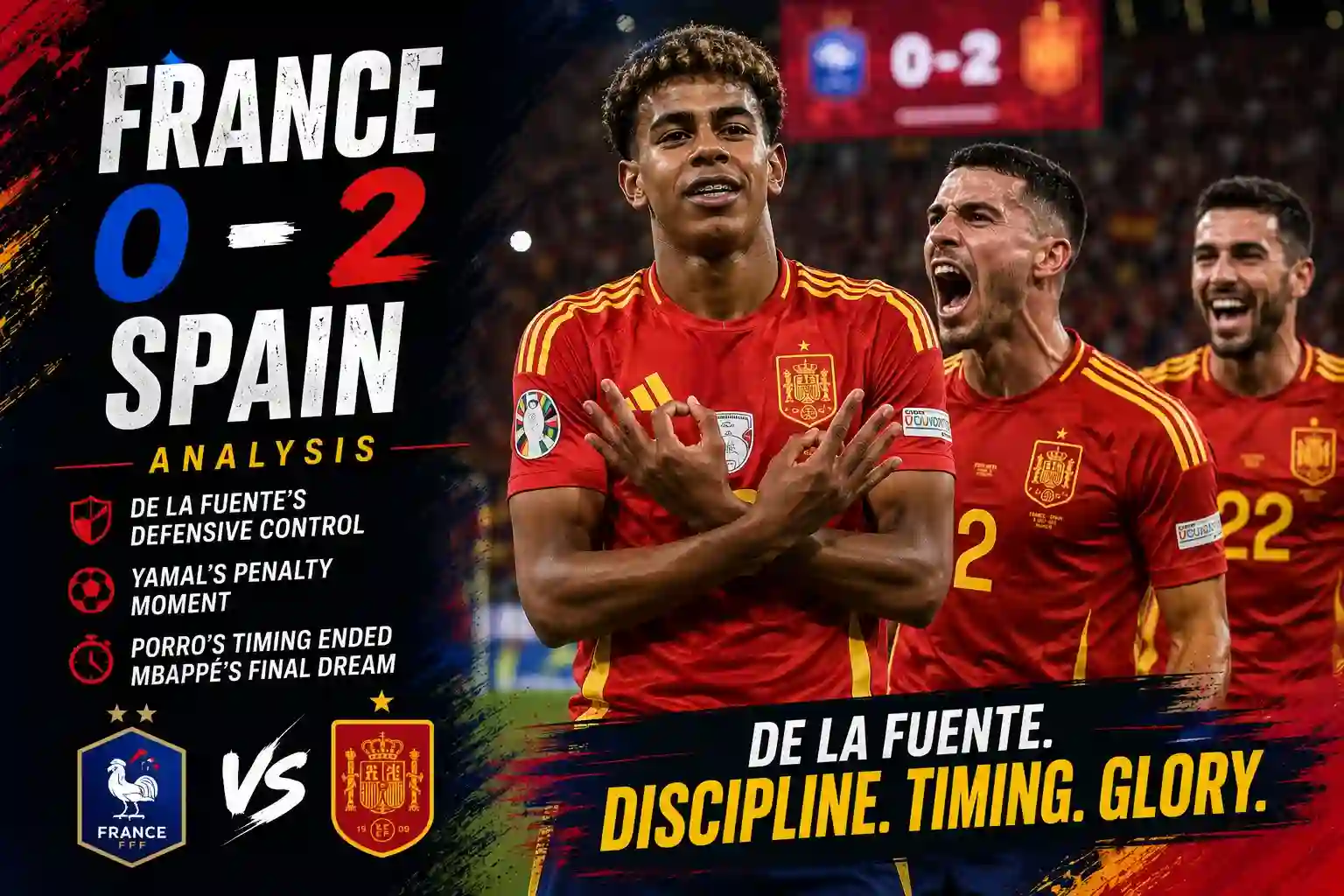
How Spain Beat France 2-0: Key Moments and Tactical Execution in the 2026 World Cup Semi-Final
Spain secured victory through early authority from a penalty conversion, a decisive second goal from full-back depth, and defensive discipline that consistently nullified France’s elite attackers.
Mikel Oyarzabal’s 22nd-minute penalty conversion established immediate Spanish control and forced France to chase the game early. Lamine Yamal’s incisive movement into the penalty area created the defensive error that produced the spot-kick opportunity, demonstrating the teenager’s ability to influence high-stakes matches even without finding the scoresheet himself. The early lead allowed Spain to implement their possession-based strategy without pressure, forcing Didier Deschamps’ side to take tactical risks they had successfully avoided in previous rounds.
Pedro Porro’s perfectly-timed second-half strike after intelligent combination play with Dani Olmo demonstrated Spain’s ability to exploit space behind France’s pressing defense. The goal originated from Spain’s patient build-up, with Olmo operating effectively between the lines to draw defenders and release Porro at the optimal moment. This second goal eliminated any realistic French comeback hopes and validated de la Fuente’s decision to trust attacking full-backs within a structured system.
Spain’s compact defensive block and disciplined positional structure successfully limited Kylian Mbappé, Ousmane Dembélé and Michael Olise to isolated wide areas throughout the contest. Spanish defenders prevented the French attackers from receiving possession in dangerous central zones between the lines, forcing them to collect the ball in positions from which they could not directly threaten the goal. This defensive organization contrasted sharply with France’s previous tournament performances, where transition moments had generated numerous high-quality chances.
De La Fuente vs Deschamps: Why Spain’s Possession Structure Overcame France’s Transition Game
Spain’s possession structure overcame France’s transition game through superior midfield control, tactical flexibility that closed passing lanes, and disciplined positioning that prevented the quick vertical counters upon which Deschamps’ system depends.
Luis de la Fuente’s coaching philosophy of structured possession, wide rotations, aggressive yet controlled pressing and trust in young technical players provided the foundation for Spanish dominance. The system demands technical security under pressure and rewards intelligent movement between defensive lines, qualities embodied by Yamal and Olmo throughout the semi-final. Didier Deschamps’ pragmatic approach relying on defensive balance, transition power and elite individual attacking quality encountered its limits against an opponent unwilling to cede midfield territory or commit numbers forward recklessly.
Midfield dominance through Rodri and Fabian Ruiz dictated tempo and rhythm, calmly circulating possession through France’s disorganized pressing structure and preventing the French midfield from establishing any consistent control or momentum. The Spanish pair maintained positional discipline while progressing the ball, ensuring that even when France attempted to press, they found no clear targets or passing lanes to exploit for counter-attacks. This control starved Mbappé and his attacking partners of the turnover opportunities they require to maximize their pace and finishing abilities.
Spain’s tactical flexibility within their 4-3-3 shape effectively closed central passing lanes, forced France’s attackers to drop deep or drift wide to find the ball, and eliminated the quick vertical transitions that Deschamps’ system depends upon for success. When France attempted to build through the center, Spanish midfielders and defenders compressed the available space, while wide players tracked back diligently to support their full-backs. This collective defensive effort meant that France’s previous success against Morocco, built upon exploiting space in transition, could not be replicated against an opponent maintaining compact shape throughout all phases of play.
Road to the Final: Context for Kenya Viewers and the 2026 World Conclusion
Spain’s progression to the final reflects consistent tactical execution demonstrated in their previous knockout rounds, while France’s elimination exposed fundamental vulnerabilities against organized possession-based opposition that Kenyan viewers should recognize as a recurring tournament theme.
Continuity with Spain’s previous knockout victory over Belgium demonstrated consistent compact defending and technical midfield control that has characterized their entire tournament run. De la Fuente’s approach has proven adaptable against various opponents, maintaining defensive solidarity while allowing creative players the freedom to unlock organized defenses. This sustained success validates the Spanish federation’s trust in de la Fuente’s methodology and suggests further tactical evolution as they prepare for the final challenge.
France’s successful tactical execution against Morocco could not be replicated against Spain due to broken pressing spacing, inability to generate turnovers in advanced positions, and failure to exploit the transition moments that previously fueled their attack. Against Morocco, France found space to release their pace merchants behind defensive lines; against Spain, those spaces remained closed, and French midfielders found themselves running toward their own goal rather than advancing into attacking areas. This tactical limitation highlighted the difference between defeating reactive opponents and solving proactive possession systems.
Kenyan football supporters planning to watch the final can access the complete 2026 FIFA World Cup schedule in Kenya Time through Pulser’s dedicated resources, ensuring accurate EAT (UTC+3) timings without daylight saving adjustments. The final promises to showcase whether Spain’s possession mastery can overcome their remaining opponent’s challenge, concluding a tournament that has highlighted the tactical diversity among the world’s best teams. Additional context on participating nations and competition structure remains available through the Pulser FIFA World Cup hub.