
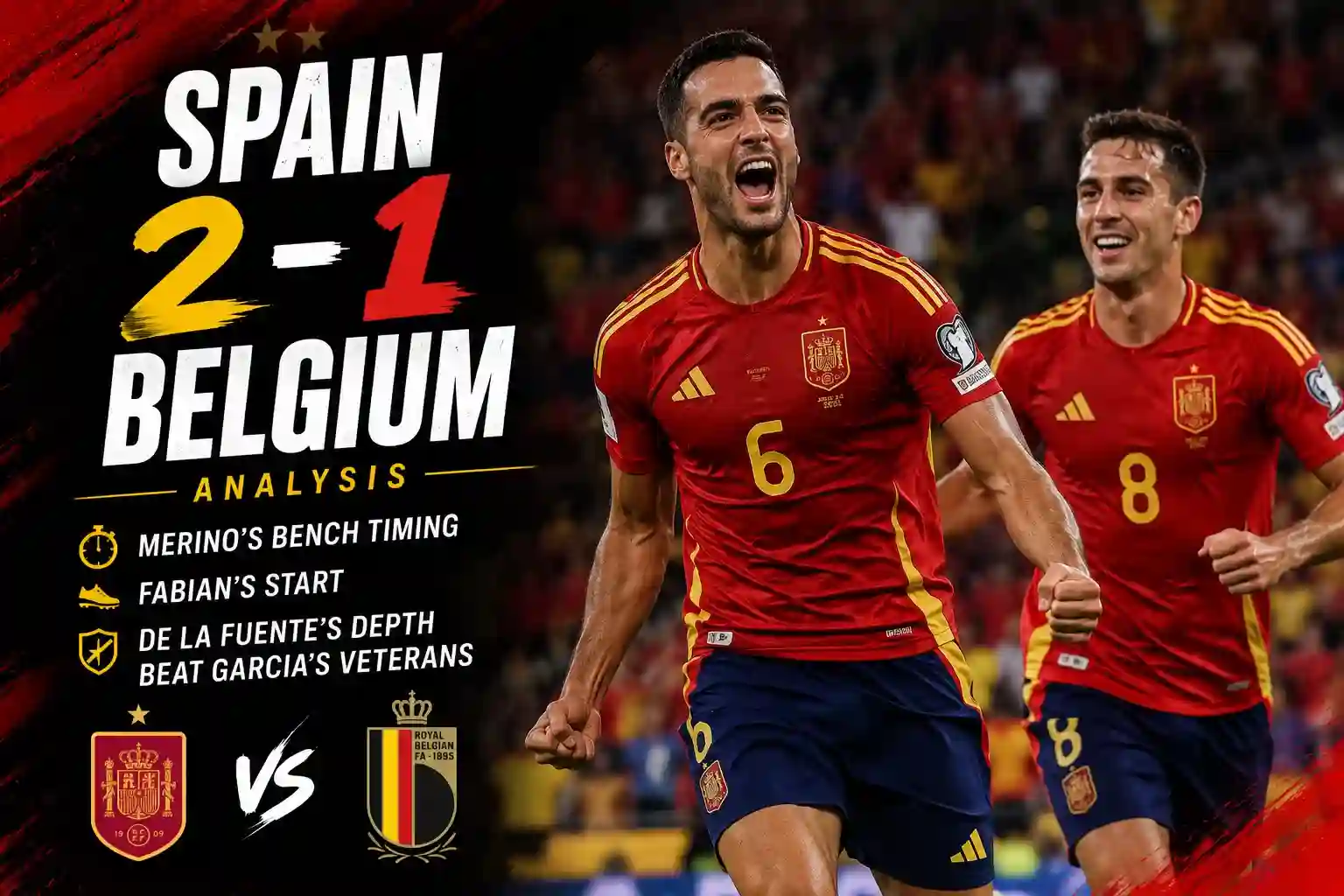
How Spain Secured the 2-1 Victory: Fabian’s Start and Merino’s Decisive Finish
Luis de la Fuente’s decision to bench Pedri and start Fabian Ruiz provided the vertical passing lanes and aggressive box timing necessary to unlock Belgium’s veteran defensive block. The Paris Saint-Germain midfielder rewarded this tactical trust by scoring the opening goal, demonstrating the forward momentum and spatial awareness that Spain needed to settle early nerves against a compact Belgian setup that had previously limited the United States to sporadic chances.
Mikel Merino entered the match not as a defensive stabilizer but as a calculated late runner in attacking midfield spaces, positioning himself to capitalize on goalkeeper errors. The Real Sociedad midfielder struck in the 88th minute when substitute goalkeeper Senne Lammens spilled Pau Cubarsí’s low shot, slotting home the rebound to secure progression and replicate his late winner against Portugal in the previous round.
The 2-1 final scoreline at Inglewood confirmed Spain’s place in the semi-finals against France, continuing a knockout pattern where territorial possession eventually converts to decisive goals under elimination pressure. Comprehensive coverage of the knockout stage continues on the Pulser FIFA World Cup hub, where fans can track all quarter-final results and semi-final build-up.
Tactical Systems Under Pressure: De la Fuente’s Role Clarity vs Garcia’s Disrupted Veterans
Spain operated primarily in a 4-2-3-1 formation that shifted into a possession-heavy 4-3-3, with Dani Olmo and Lamine Yamal stretching Belgium horizontally across the width of the pitch. This structure created the necessary channels for Fabian’s forward passing while maintaining midfield control despite Belgium’s attempts to sit deep and absorb pressure through a compact defensive block.
Belgium’s tactical plans destabilized when Thibaut Courtois left the match through injury, forcing substitute goalkeeper Senne Lammens to face intensifying Spanish pressure without the organizational command of the veteran defensive core. Rudi Garcia’s side, which had looked cohesive while eliminating the United States 4-1 with Charles De Ketelaere’s double in the FIFA World Cup 2026 teams and group standings knockout phase, became increasingly reactive as the match progressed.
De la Fuente demonstrated superior depth management by deploying substitutes with specific, predefined roles rather than simply fresh legs, while Garcia’s reliance on experienced players including Romelu Lukaku and Charles De Ketelaere grew less effective as Spain’s late pressure overwhelmed Belgium’s static defensive block. The contrast in bench timing proved decisive as De la Fuente’s substitutions maintained tactical coherence while Belgium’s veteran core lost structural integrity.
Semi-Final Consequences: Can Spain’s Late-Game Mastery Survive Against France?
Match-winning goals in the 88th minute against Portugal and Belgium highlight a concerning reliance on late drama rather than decisive early control, raising tactical questions about whether De la Fuente’s squad possesses the cutting edge to put away organized opponents within regulation time. The pattern indicates territorial possession that generates chances but fails to convert into early goals, creating unnecessary vulnerability in knockout football against opponents who grow stronger as matches progress.
The semi-final matchup against France demands that Spain capitalize on the width provided by Olmo and Yamal during the first 90 minutes, as France’s defensive organization will likely withstand the late-pressure approach that succeeded against Belgium and Portugal. De la Fuente must adjust his timing to ensure his midfield creators find decisive passes earlier in the match, rather than relying on substitute impact to break organized defensive blocks.
East African fans tracking the tournament in EAT (UTC+3) can monitor Spain’s semi-final progression and remaining World Cup fixtures through the complete 2026 FIFA World Cup schedule in Kenya Time (EAT UTC+3), ensuring they do not miss kickoff times adjusted for Kenya’s non-daylight-saving time zone.
FAQ
Who scored the goals in Spain’s 2-1 victory over Belgium in the 2026 World Cup quarter-final?
Fabian Ruiz opened the scoring for Spain after being selected ahead of Pedri in the starting lineup, while Mikel Merino scored the decisive 88th-minute winner after substitute goalkeeper Senne Lammens spilled a low shot from Pau Cubarsí.
How did Thibaut Courtois’s injury affect Belgium’s performance against Spain?
The Belgian goalkeeper’s forced departure disrupted Rudi Garcia’s tactical plans, requiring substitute Senne Lammens to face Spain’s intensifying second-half pressure without the organizational command of Belgium’s veteran defensive core, ultimately leading to the decisive error for Spain’s winning goal.
When and where can Kenya fans watch Spain’s semi-final match against France?
East African fans can find exact kickoff times in EAT (UTC+3) for Spain’s semi-final against France and all remaining matches through Pulser’s dedicated schedule pages, with all times adjusted for Kenya’s non-daylight-saving time zone.