
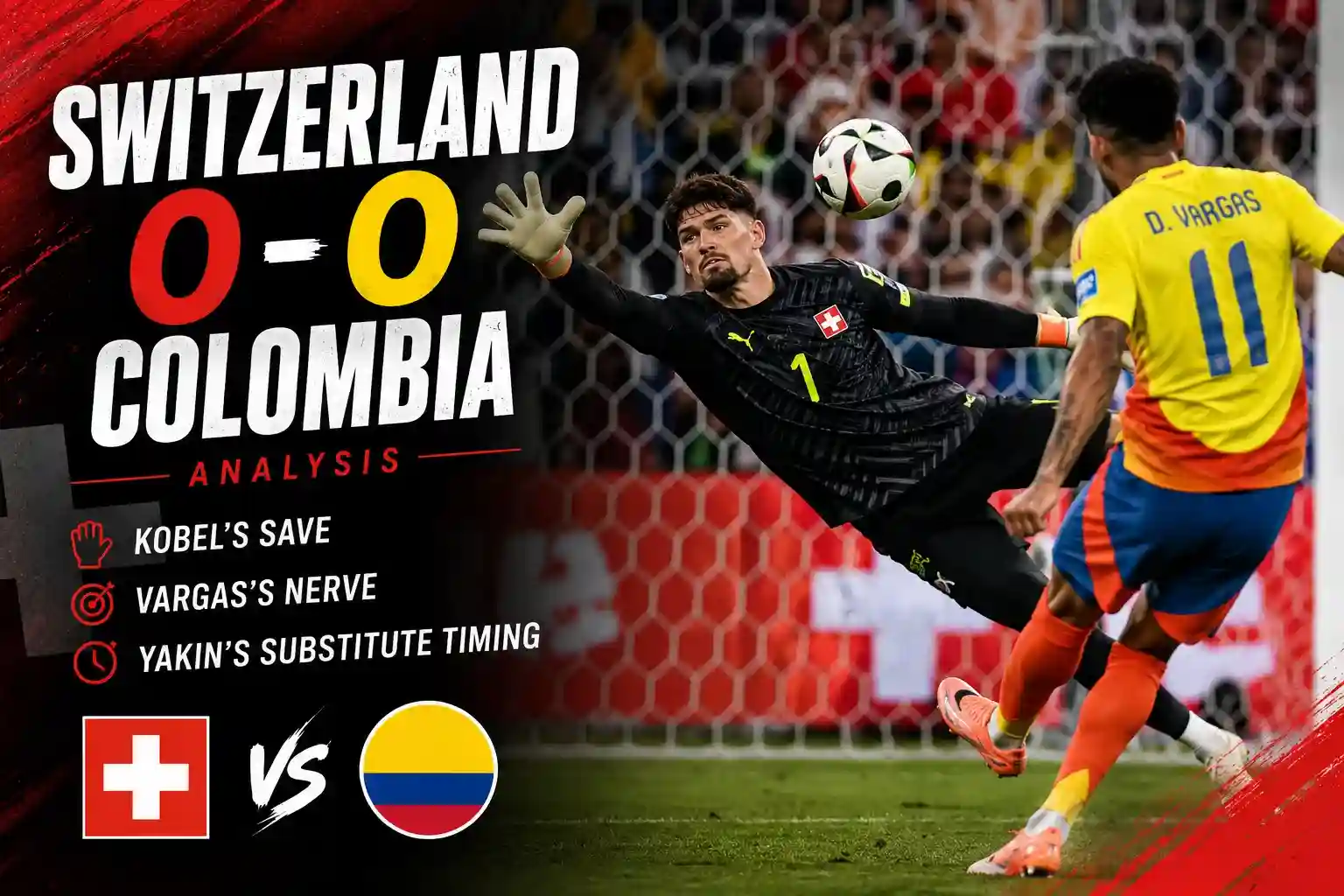
How Switzerland Won the Shootout: Kobel’s Save and Vargas’s Decisive Nerve
The penalty shootout hinged on two critical moments during the five-round sequence in Vancouver. Davinson Sánchez struck the crossbar with Colombia’s second attempt, handing Switzerland an immediate psychological advantage that grew when Gregor Kobel dived correctly to deny Cucho Hernández’s low drive later in the proceedings. These failures allowed the European side to maintain composure as substitute Ruben Vargas stepped forward to roll home the decisive spot-kick, sealing a 4-3 shootout victory that reflected the fine margins defining knockout football at this elite level.
Murat Yakin’s decision-making during the final minutes of extra time proved decisive for the psychological advantage Switzerland carried into the lottery. The manager introduced Cedric Itten, Zeki Amdouni and Ruben Vargas specifically during the additional thirty minutes to ensure cold, fresh legs would take penalties rather than exhausted starters who had battled through two hours of intense Round-of-16 football. Vargas’s successful conversion validated this calculated gamble, as the substitute displayed none of the fatigue that often betrays players in high-pressure sudden-death situations.
The victory carries significant historical weight for Swiss football, ending a 72-year quarter-final drought dating back to the 1954 tournament they hosted. Players celebrated the achievement with visible relief on the Vancouver pitch, knowing they had navigated the high-pressure elimination format that has undone Swiss sides in previous tournaments. Their reward is a quarter-final appointment with Argentina, a fixture that will test whether Yakin’s methodical approach can withstand South American attacking quality.
Tactical Stalemate: Yakin’s 4-2-3-1 Discipline vs Colombia’s Profligate Pressure
Switzerland’s defensive organization provided the foundation for their progression, with Gregor Kobel protected by the central defensive pairing of Manuel Akanji and Nico Elvedi. The double pivot of Granit Xhaka and Remo Freuler controlled the central rhythm, denying Colombia space between the lines and forcing Néstor Lorenzo’s creative players to operate in wider, less dangerous areas away from goal. Breel Embolo served as the attacking reference point up front, though his primary role involved holding up play to relieve defensive pressure rather than generating sustained attacking threat.
Colombia deployed fluid 4-4-1-1 and 4-3-3 variations that relied heavily on the creativity of Luis Díaz, James Rodríguez and Jhon Arias to generate offensive momentum through the wings and half-spaces. Luis Suárez led the line with intelligent movement and pressing, yet the South Americans could not translate their territorial dominance into clear-cut finishes during the 120 minutes of play. The final third lacked the clinical edge required at this stage of the competition, with several promising attacking positions breaking down against Switzerland’s compact defensive block or failing to test Kobel with sufficient conviction.
The tactical contrast highlighted two distinct knockout mentalities competing in Vancouver. Yakin accepted the risk of a penalty lottery by maintaining a patient, risk-averse structure that prioritized defensive solidity over attacking ambition throughout the two hours. Colombia, despite possessing superior attacking intent and longer periods of control, failed to apply the ruthless final touch necessary to avoid the shootout, repeating a familiar tournament narrative for sides that dominate possession without finding the net.
Quarter-Final Bound: What Switzerland vs Argentina Means for East Africa
Switzerland’s upcoming clash with Argentina presents a significant tactical examination of whether Yakin’s defensive structure can contain elite South American attacking quality over ninety minutes without the safety net of a 0-0 draw. The Swiss back line and midfield pivot will face significantly more precise finishing and movement than Colombia managed, requiring disciplined positioning, rapid defensive transitions and perhaps a more proactive approach to avoid conceding early. Kenyan viewers planning to follow this quarter-final should consult the full World Cup 2026 schedule in Kenya Time to confirm exact kick-off times in EAT (UTC+3) and avoid missing the opening whistle.
East African audiences can track the tournament’s progress through Pulser’s FIFA World Cup hub, which provides ongoing coverage, bracket updates and analysis tailored for the region. The World Cup teams and groups page offers additional context on how Switzerland advanced from Group B and Colombia topped Group K before this elimination showdown. These resources ensure fans do not miss the scheduling details for the remaining knockout fixtures.
Colombia’s elimination sparked immediate frustration within their camp, with veteran striker Radamel Falcao offering pointed criticism of the team’s failure to convert their group-stage momentum into knockout success. The side exited despite collecting seven points and a plus-three goal difference during an unbeaten Group K campaign that included a victory over Ghana, while Switzerland had arrived in Vancouver following a 2-0 defeat of Algeria that confirmed their seven-point finish in Group B. Such statistics underline the cruel nature of World Cup knockout football, where a single evening of profligacy can erase the momentum built across three previous matches.