
FIFA has made the world cup referees 2026 list more important than ever because the tournament has expanded to 48 teams, 104 matches and the largest group of match officials in World Cup history. For fans in Kenya and across Africa, this guide explains who the appointed referees are, how assistant referees and video match officials fit into the system, and why CAF representation matters inside the global Team One structure. The article also breaks down how FIFA selects elite match officials through long-term monitoring, seminars, fitness checks and decision-making assessments led by its refereeing leadership. Beyond the names, the 2026 tournament introduces major officiating changes, including advanced semi-automated offside technology, updated VAR review rules and new IFAB controls on goalkeeper delays, substitutions and restarts. Because Omar Abdulkadir Artan’s reported US entry denial affected the latest roster context, this guide also separates the official FIFA appointment list from real-time availability updates.
Need a wider rules breakdown? Read our World Cup 2026 Match Rules, Officials & Awards Guide for VAR, referee decisions, awards and match rules.
How FIFA Built the World Cup Referees 2026 List
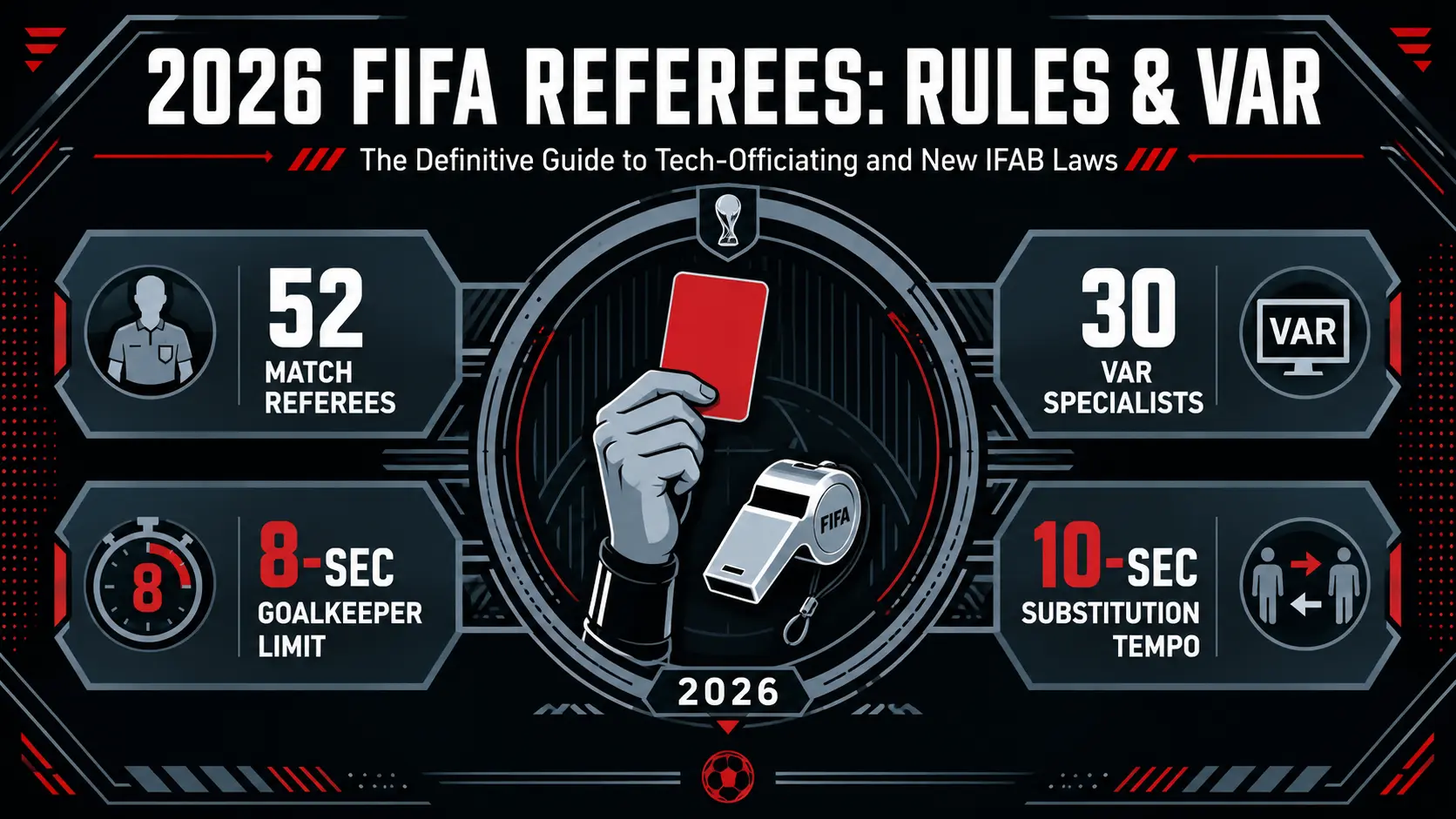
FIFA built the world cup referees 2026 list as the largest match-official operation in World Cup history. The organisation selected 52 referees, 88 assistant referees and 30 video match officials for a tournament expanded to 48 teams and 104 matches. For fans in Kenya, the key point is simple: this is not only a list of whistle-blowers on the pitch, but a complete refereeing system designed for the biggest World Cup ever staged.
The official appointment also shows how much the tournament has changed. A 48-team format creates more group matches, more knockout paths, more travel pressure and more VAR workload, so the refereeing team has to be deeper than in Qatar 2022. Canada, Mexico and the United States also create a broader host-country map, but this article will only mention that logistics angle where it affects referee planning because stadium and host-city details belong in a separate venue guide.
FIFA Appointed Its Largest Team One Ever
FIFA Team One is the official concept that brings referees, assistant referees and video match officials into one unified World Cup refereeing group. This structure matters because the tournament does not rely on individual referees working alone; it depends on teams that must apply the Laws of the Game consistently from the opening match to the final.
The group gathered in Miami for pre-tournament preparation, while video match officials were also connected to the International Broadcast Centre in Dallas. This split shows how modern World Cup refereeing now extends beyond the field of play. The pitch team manages live control, while the video team supports reviewable incidents from a highly technical environment.
Why 48 Teams Changed Referee Planning
The 2026 FIFA World Cup expansion changed referee planning because 48 teams and 104 matches create more decision-making pressure than any previous edition. This increase affects appointment depth, recovery windows, VAR staffing and consistency across matches.
The larger format means FIFA needs enough elite officials to rotate assignments without overloading the same people too early. It also means that a controversial decision in one group-stage match can affect more teams, more qualification scenarios and more fan debate. For African audiences following CAF teams, this scale makes referee consistency especially important because group-stage margins can be very thin.
Latest Roster Note on Omar Artan
Omar Abdulkadir Artan became a major 2026 World Cup referee list update after reports said the Somali referee was denied entry to the United States. This situation matters because Artan appeared on the official FIFA appointment list, but later reporting said he would not be able to train or officiate at the tournament.
The key distinction is that this issue relates to host-country entry procedures, not FIFA’s original selection standard. The official list remains the primary reference for appointments, but readers should treat Artan’s status as a reminder that final tournament availability can still change before or during the event.
World Cup Referee List by Role and Confederation
FIFA organises the world cup referees 2026 list by role, country and confederation, not just by famous referee names. The most useful way to read the list is to separate match referees, assistant referees and video match officials before comparing representation across UEFA, CONMEBOL, CONCACAF, AFC, CAF and OFC.
This structure helps readers avoid a common mistake. Many fans say “World Cup referees” when they actually mean all FIFA World Cup match officials. In practice, a single match depends on the referee, assistant referees, fourth official, VAR, AVAR and other support officials working within one coordinated decision-making chain.
| Role | Official 2026 Count | Main Responsibility |
|---|---|---|
| Referees | 52 | Control the match, manage discipline and make final on-field decisions. |
| Assistant Referees | 88 | Support offside, touchline decisions, goal-line situations and referee communication. |
| Video Match Officials | 30 | Operate VAR processes and help review clear and obvious errors in reviewable situations. |
Referees Assistant Referees and VAR Officials
FIFA World Cup match officials include three different role groups that should not be treated as the same job. The referee leads the match on the pitch, assistant referees support the touchline and offside picture, and video match officials manage VAR checks from the video operation environment.
This division is important for readers who want to understand match controversies. A penalty decision may begin with the referee’s live view, but VAR can recommend a review only if the incident falls within the protocol. An offside situation may involve assistant referees, semi-automated technology and video officials before the final decision is communicated.
UEFA CONMEBOL and CONCACAF Officials
UEFA, CONMEBOL and CONCACAF officials form a major part of the 2026 World Cup refereeing structure. These confederations bring officials from high-profile domestic leagues, continental tournaments and previous FIFA competitions.
Their role is especially visible because many global stars play in European and South American competitions. However, FIFA’s appointment model does not simply reward league popularity. It evaluates consistency, fitness, teamwork and international performance over time.
CAF AFC and OFC Representation
CAF, AFC and OFC representation gives the World Cup referee list a wider global balance. This matters for Kenya-based readers because CAF officials are part of the same African football ecosystem that shapes AFCON, World Cup qualifying and continental club competitions.
The African referee story is not just symbolic. It affects how fans across the continent see fairness, representation and trust in major tournaments. When CAF officials work at the World Cup, their appointments show that FIFA’s referee pathway extends beyond Europe and South America.
How FIFA Selects World Cup Match Officials
FIFA selects world cup referees 2026 through long-term monitoring, not through a last-minute invitation list. FIFA monitors match officials across domestic leagues, confederation competitions, FIFA tournaments, seminars, fitness tests and medical checks before the final appointment stage.
This selection logic is one of the most important parts of the article. A referee does not reach the World Cup only because of reputation. The official has to show that decision-making, communication, teamwork and physical condition can survive the speed and pressure of elite international football.
FIFA Tracks Performances After Qatar 2022
FIFA began tracking the 2026 World Cup referee candidate pool after Qatar 2022. This long window allowed the organisation to compare performances across different competitions, match speeds and pressure levels.
The process also reduces the risk of selecting officials based on one good tournament or one strong domestic season. Instead, the monitoring system looks for repeated reliability. That approach is important because a World Cup referee must be trusted in matches involving different football cultures, playing styles and levels of emotional pressure.
Seminars Test Fitness and Decision Making
FIFA refereeing seminars test fitness, theory, decision-making and practical match scenarios before officials reach the World Cup. These sessions are closer to national-team preparation than classroom lectures.
The training normally combines physical work, video analysis, law interpretation and simulated incidents. This matters because the hardest decisions are rarely simple. A referee may need to judge contact, intent, speed, tactical impact and VAR protocol within seconds while players and fans react immediately.
Collina Defines Elite Referee Readiness
Pierluigi Collina defines elite referee readiness through physical condition, mental strength and decision-making consistency. His influence matters because the FIFA Referees Committee sets the tone for how officials prepare for the tournament.
This standard explains why referees are now treated almost like athletes. They need stamina, recovery planning, communication discipline and emotional control. A referee who understands the Laws of the Game but cannot manage pressure may still struggle at World Cup level.
Female Referees in the 2026 World Cup
FIFA includes female match officials in the world cup referees 2026 conversation as part of a longer World Cup officiating shift that became highly visible in Qatar 2022. The key point is that 2026 continues a milestone, rather than creating the first one.
Female referees should not be framed only as a diversity headline. They are part of the same Team One performance structure, the same preparation standards and the same pressure environment as other appointed officials. That framing is stronger for SEO and more accurate for readers.
Qatar 2022 Created the First Breakthrough
Qatar 2022 created the first major breakthrough for female match officials at a men’s FIFA World Cup. That tournament appointed women referees and women assistant referees for the first time in the competition’s history.
The breakthrough matters because it changed the baseline for future appointments. In 2026, the more accurate angle is continuity. Female officials are now part of the World Cup refereeing pathway, not an isolated experiment.
Tori Penso and Katia Itzel Garcia Matter
Tori Penso and Katia Itzel Garcia matter because individual referee names help readers connect the wider diversity story to real match officials. These names also give the article stronger entity depth than a generic discussion of gender equality.
The better editorial approach is to connect individual officials to role, confederation and tournament context. That makes the section useful for searchers who want names, but it also avoids reducing the topic to biography alone.
Team One Shows Broader Referee Diversity
FIFA Team One shows broader referee diversity through its mix of confederations, countries, roles and gender representation. This diversity supports the idea that World Cup refereeing is now a global talent system.
The system still depends on performance first. Representation matters, but World Cup appointment requires elite match control, fitness, law knowledge and teamwork. That balance is the right way to explain female referees without overstating or underplaying their role.
How World Cup VAR 2026 Will Work
FIFA will use world cup referees 2026 with VAR and advanced semi-automated offside technology to speed up specific review processes while keeping referees central to final decisions. The core message for fans is that technology supports the referee, but technology does not replace the referee.
This section is important because many World Cup controversies start with a misunderstanding of what VAR can and cannot do. VAR does not review every foul, every throw-in or every minor contact. It focuses on defined categories such as goals, penalties, direct red cards, mistaken identity and specific updated situations under the latest protocol.
SAOT Speeds Up Clear Offside Calls
Semi-Automated Offside Technology is a system that uses player-tracking data and 3D positioning to support faster offside decisions. Its main function is to help identify clear positional offside situations more quickly than a fully manual line-drawing process.
The important limitation is that SAOT does not decide every offside question by itself. Positional offside can be automated more efficiently, but interference with an opponent, deliberate play and match-context judgement still require human interpretation. That is where the referee and VAR team remain essential.
VAR Still Handles Judgement Based Incidents
VAR still handles judgement based incidents within the limits of the protocol. This means the video team can support the referee on reviewable match-changing decisions, but it cannot turn the game into a constant replay review.
The distinction matters for fans watching from Kenya because TV replays can make every incident look reviewable. A contact foul in midfield, a small shirt pull or a disputed throw-in may be frustrating, but VAR can only intervene when the competition rules and protocol allow it.
AI Supports Referees Without Replacing Them
AI-supported referee technology helps FIFA improve analysis, offside visuals and referee-view footage without removing human authority from the match. The main function of these tools is to improve speed, clarity and communication.
This is where the 2026 World Cup becomes different from earlier editions. AI-enabled 3D player avatars can improve offside presentation, while stabilised referee-view footage can help fans and analysts understand what the official saw. The referee still has to manage players, control emotion and apply the Laws of the Game in real time.
New IFAB Rules Referees Will Enforce in 2026
FIFA will apply the world cup referees 2026 framework under updated IFAB law changes that focus on match flow, time-wasting and clearer VAR intervention. These changes are likely to shape some of the most debated moments of the tournament.
The most important numbers are easy to remember: eight seconds for goalkeeper control, five seconds for visible countdowns, ten seconds for substitution exits and one minute for certain off-field injury treatment situations. Fans should still check the latest IFAB Laws of the Game before and during the tournament because law wording and competition implementation can be updated.
- Goalkeeper delay can lead to a corner kick after the eight-second limit.
- Throw-ins and goal kicks can involve visible five-second referee countdowns.
- Substituted players are expected to leave the field within ten seconds.
- Some injured players may need to leave the field for one minute after treatment.
- VAR can support more clearly incorrect match-changing decisions under the updated protocol.
Goalkeepers Face an Eight Second Countdown
The goalkeeper eight-second rule gives referees a clearer tool against time-wasting when a goalkeeper controls the ball with the hands or arms. The referee uses a visible five-second countdown near the end of the limit, and an offence can result in a corner kick to the opposing team.
This is a major change from the older six-second idea that was rarely enforced and led to an indirect free kick. The new sanction is easier for fans to understand and more dangerous for the defending team. That makes goalkeeper delay one of the most important rules to watch in 2026.
Substitutions and Restarts Get Faster Controls
Substitution and restart controls give referees more authority to protect match tempo in 2026. The ten-second substitution exit expectation is designed to stop players from slowly walking across the pitch to waste time.
Throw-ins and goal kicks also become more structured through countdown logic. This does not mean every restart will feel rushed. It means referees have a clearer way to act when a team delays the restart after being ready to play.
VAR Can Review More Clear Errors
The updated VAR protocol can allow review support for more clearly incorrect referee errors in specific situations. These include clearly incorrect second-yellow red cards, mistaken identity and certain clearly incorrect corner-kick decisions when the correction can be made immediately.
This does not make VAR unlimited. The review still has to fit the protocol and the timing of the restart. For fans, the safest rule is this: VAR may correct some obvious match-changing mistakes, but it will not re-referee every normal football argument.
How 2026 Refereeing Differs From 2018 and 2022
FIFA made the world cup referees 2026 operation different from 2018 and 2022 by combining a bigger tournament, a larger official pool, advanced offside technology and updated IFAB rules. The difference is not only the number of referees; it is the full operating model.
Russia 2018 introduced VAR as a major World Cup baseline, Qatar 2022 expanded the video-official structure and broke new ground for female match officials, and 2026 adds the scale of a 48-team tournament. This progression helps readers understand why the 2026 referee list feels more technical and larger than previous editions.
| World Cup | Refereeing Context | Key Difference |
|---|---|---|
| Russia 2018 | 36 referees and 63 assistant referees were appointed before VAR candidates were finalised. | VAR became a World Cup baseline. |
| Qatar 2022 | 36 referees, 69 assistant referees and 24 video match officials were appointed. | Female match officials appeared for the first time in men’s World Cup history. |
| World Cup 2026 | 52 referees, 88 assistant referees and 30 video match officials were appointed. | The tournament adds larger scale, advanced SAOT and new IFAB controls. |
Russia 2018 Made VAR the Baseline
Russia 2018 made VAR a World Cup baseline by bringing video review into the men’s tournament at full global scale. That edition changed how fans, teams and referees understood match-changing incidents.
The legacy of 2018 is visible in every later tournament. Referees now work with the expectation that certain major decisions can be checked. Fans also expect replay evidence, even when the protocol does not allow intervention.
Qatar 2022 Expanded Video Match Officials
Qatar 2022 expanded the World Cup video match official structure with 24 VMOs and a more established VAR process. That tournament also gave female match officials their first men’s World Cup appointments.
The 2022 edition matters because it sits between the VAR launch era and the 2026 technology-heavy era. It proved that video officiating was no longer a trial. It was already a permanent part of World Cup match control.
World Cup 2026 Adds Scale and Technology
World Cup 2026 adds scale and technology by increasing the number of teams, matches and appointed officials while using advanced semi-automated offside support. This combination creates a more complex refereeing environment than 2018 or 2022.
The three-host-country format also adds practical pressure, but host-city distance, stadium conditions and travel planning should be handled in a dedicated 2026 World Cup stadiums guide. In this article, the key point is that the larger tournament format helps explain why FIFA needed a larger Team One.
World Cup Referee Pay and Common Fan Questions
FIFA has not used the world cup referees 2026 appointment announcements to publish a complete official pay table for referees, assistant referees and video match officials. That lack of public detail is why referee pay should be explained carefully.
Fans often want a simple number, but World Cup referee compensation can involve different role categories, tournament fees, match fees and later-stage bonuses. Media estimates can be useful for context, but they should not be presented as an official FIFA salary table unless FIFA publishes one directly.
FIFA Has Not Published a Full Pay Table
FIFA has not published a full 2026 World Cup referee pay table in the official match-official appointment materials. This means any article discussing pay must separate confirmed appointment data from estimated compensation data.
The safest editorial wording is to say that FIFA has confirmed the appointed officials, but not a complete public salary structure in the same documents. This protects the article from overstating unofficial numbers and makes the content more trustworthy.
Media Estimates Need Careful Context
Media estimates need careful context because referee earnings can depend on role, match appointments and progression through the tournament. A referee selected for later knockout rounds may not be paid or bonused in the same way as an official who only works group-stage assignments.
The better approach is to explain the possible structure rather than pretend every official earns the same amount. Referees, assistant referees and VAR specialists may have different compensation models, and exact figures should be updated only when supported by reliable reporting or direct FIFA disclosure.
Controversial Calls Depend on IFAB and VAR Rules
Controversial referee calls depend on IFAB rules, VAR protocol and the referee’s live judgement. This is the most useful framework for fans who want to understand arguments about penalties, red cards, offside, goalkeeper delay and corner-kick reviews.
The referee remains the central authority, but the video team can intervene when the protocol allows it. That means some decisions will be reviewed, while others will stay with the on-field team even if fans disagree after seeing replays.
FAQ
FIFA World Cup referee questions usually combine official-list searches, VAR confusion, pay curiosity and historical controversy. The answers below focus on the 2026 FIFA World Cup context while separating confirmed information from estimates or older cases.
Who are the referees for the World Cup?
The referees for the 2026 FIFA World Cup are part of FIFA’s official list of appointed match officials. The full appointment includes 52 referees, 88 assistant referees and 30 video match officials from all six confederations.
The official FIFA PDF is the best source for names, countries and roles. For matchday assignments, fans should also check FIFA’s individual match pages because being appointed to the tournament does not mean working every match.
Why was Omar Artan denied entry to the USA?
Omar Abdulkadir Artan was reportedly denied entry to the United States before the 2026 FIFA World Cup referee preparation period. Reports said the Somali referee would not be able to train or officiate at the tournament after the entry denial.
The important point is that immigration decisions are handled by the host-country authorities, not by the FIFA referee selection panel. Artan’s case should therefore be treated as a roster availability update, not as evidence that FIFA changed its original referee evaluation.
How much do referees get paid in the World Cup?
World Cup referees are paid through tournament compensation structures, but FIFA has not published a complete official 2026 pay table in the referee appointment materials. That means exact figures should be treated carefully unless they come from FIFA or highly reliable reporting.
Media reports may discuss estimated fees or bonuses, but those figures can vary by role and match assignment. The safest answer is that referees, assistant referees and video match officials may not all receive the same compensation, and official confirmation should be checked before quoting a fixed number.
Which referee got banned for match fixing?
Joseph Lamptey is one of the most cited football referee cases linked to match manipulation in a World Cup qualifying context. FIFA banned the Ghanaian referee for life after the South Africa vs Senegal 2018 World Cup qualifier case.
This historical case should not be confused with the 2026 World Cup referee list. Lamptey is useful background for understanding why FIFA treats referee integrity seriously, but the case is separate from the appointed 2026 match officials.
Are there any English referees at the World Cup 2026?
English match officials are represented at the 2026 FIFA World Cup through the official appointment list. Michael Oliver and Anthony Taylor were selected as match referees, with assistant referees and VAR representation also included from the English officiating system.
For readers checking England specifically, the cleanest way to read the list is by role: match referees first, assistant referee teams second and video match officials third. This avoids mixing on-field referees with VAR specialists.
To continue planning your tournament experience, visit our FIFA 2026 navigation hub for schedules, groups, standings, team lists, news, and other essential World Cup resources.
References
- Match officials appointed for FIFA World Cup 2026™ (FIFA / Inside FIFA)
- FIFA World Cup 2026™ — List of appointed FIFA Match Officials (FIFA Digital Hub)
- FIFA President welcomes Team One at training camp in Miami (FIFA / Inside FIFA)
- Elite European referees gather for final seminar ahead of FIFA World Cup 2026™ (FIFA / Inside FIFA)
- FIFA World Cup 2026 preparation continues for AFC, CAF and OFC elite referees (FIFA / Inside FIFA)
- Elite Concacaf and CONMEBOL referees undergo meticulous preparation for FIFA World Cup 2026™ (FIFA / Inside FIFA)
- “No stone unturned”: Referees undergo meticulous preparation for FIFA World Cup 2026™ (FIFA / Inside FIFA)
- Regulations on the Nomination and Appointment of FIFA International Match Officials (FIFA Digital Hub)
- Refereeing (FIFA / Inside FIFA)
- The IFAB introduces further measures to improve match flow and player behaviour (The IFAB)
- Law changes (The IFAB)
- The IFAB tackles time-wasting by goalkeepers (The IFAB)
- Faster offside decisions, more stable referee body cams and more analysis opportunities for teams (FIFA / Inside FIFA)
- FIFA and Lenovo unveil multiple AI-powered innovations ahead of FIFA World Cup 2026™ (FIFA / Inside FIFA)
- 36 referees, 69 assistant referees and 24 video match officials appointed for FIFA World Cup Qatar 2022™ (FIFA / Inside FIFA)
- 36 referees and 63 assistant referees appointed as Russia 2018 Match Officials (FIFA / Inside FIFA)