
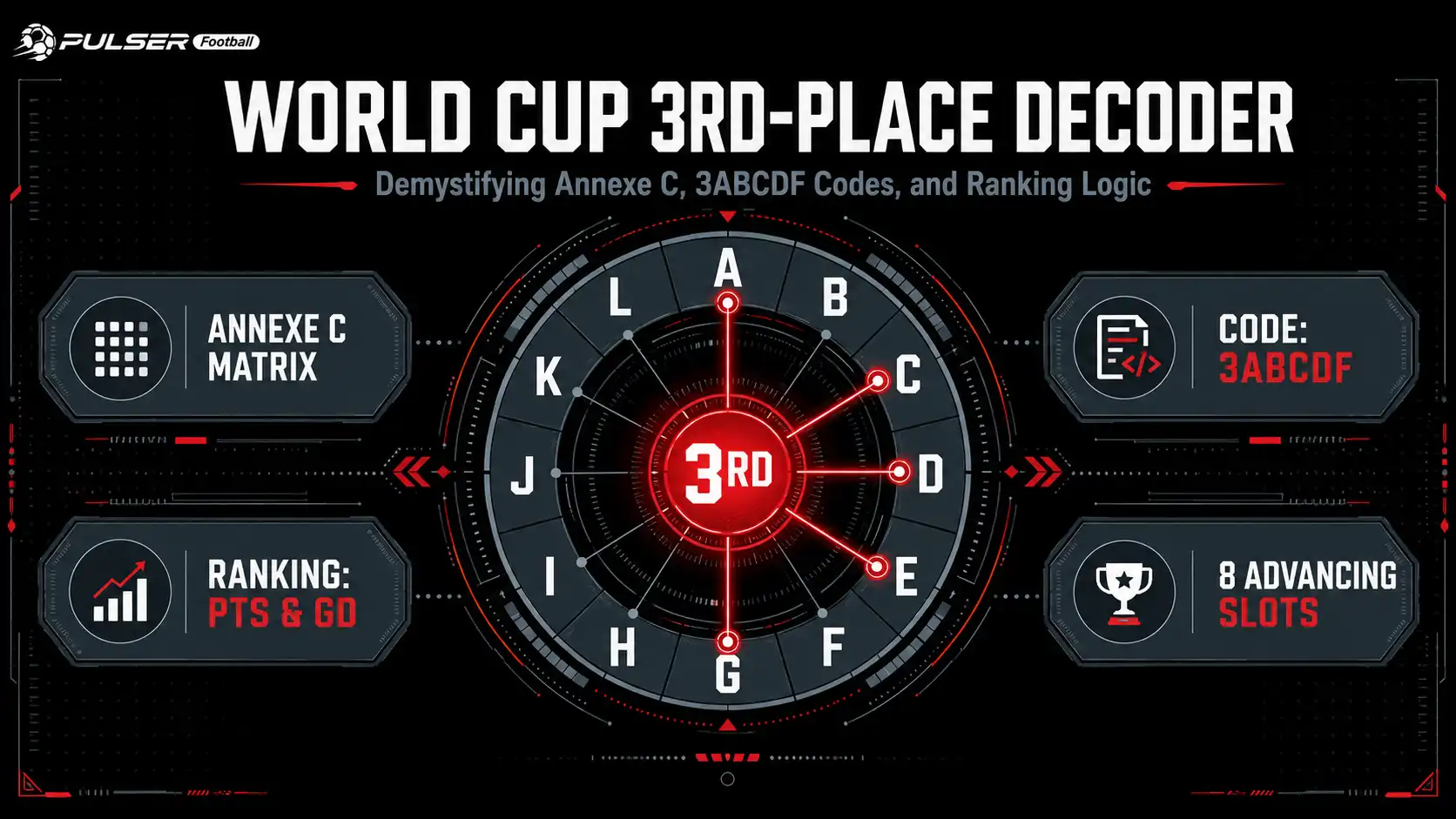
What 3ABCDF Meant in the 2026 World Cup Bracket
The code 3ABCDF identified a single Round-of-32 position reserved for a third-placed group qualifier, with the digit and letters working together to define the potential source groups before final confirmation locked the bracket into place.
The digit “3” specifically denoted that this bracket position awaited a third-placed finisher from the group stage, distinguishing it clearly from group winners marked as “1” or runners-up marked as “2” in the tournament matrix. This numerical classification formed part of a standardized system used across all 12 groups to track qualification pathways into the knockout rounds, reflecting the expanded 48-team format where third-placed finishers could still advance.
The letters “ABCDF” represented the specific pool of five groups from which that third-placed qualifier could legally originate, explicitly excluding Group E and other combinations depending on the specific bracket slot requirements and the mathematical constraints of the Annexe C system. This alphabetical set indicated the permissible source groups allowed by FIFA’s technical regulations for that particular Round-of-32 pairing, ensuring the bracket maintained logical competitive integrity and preventing impossible matchups or same-group rematches before any teams were confirmed.
The notation functioned strictly as a temporary variable rather than a permanent designation, serving as a placeholder that would ultimately resolve to a single national team once all group matches concluded and the Annexe C permutation formula determined the exact allocation. Once the final group stage standings locked into place, the code disappeared entirely from official brackets, replaced by the confirmed country’s name and flag, rendering the placeholder system obsolete for that specific slot.
How the Third-Placed Team Allocation Worked
The allocation mechanism relied on a complex mathematical matrix designed to prevent early rematches while accommodating the tournament’s historic expansion to 12 groups and 48 teams for the first time.
The 2026 World Cup’s expanded format featured 12 groups of four teams each, creating a scenario where only eight of the twelve third-placed teams would advance to the Round of 32, necessitating a dynamic bracket system that could adapt to various qualification permutations without manual reseeding. This structure required careful choreography to ensure that no third-placed team would face a group winner from the same group in the opening knockout round, while also balancing the geographic and competitive distribution across the bracket to maintain fairness for all advancing sides and preserve the integrity of the competition structure.
FIFA’s technical regulations predetermined specific letter combinations for each of the eight third-placed team slots, with codes like 3ABCDF, 3ABCE, or 3ACDF representing distinct possible source pools calculated to maintain balanced knockout pathways. These combinations were not random assortments but mathematically derived sets that ensured no matter which specific teams finished third in the designated groups, the resulting Round-of-32 matchups would avoid same-group reunions and preserve competitive fairness throughout the opening knockout phase.
Once the final whistle blew on all 72 group stage matches, the concrete results fed into the Annexe C formula, which immediately resolved each placeholder code to a specific nation—for instance, transforming 3ABCDF into simply 3D if the third-placed team from Group D earned that particular slot. This resolution locked the opponent for the waiting group winner, finalizing the bracket within hours of the group stage conclusion and allowing teams and fans to prepare for specific opponents rather than multiple possibilities.
Finding the Confirmed Round-of-32 Matchups
All placeholder codes including 3ABCDF have now been permanently replaced by confirmed national teams, with the complete Round-of-32 bracket finalized and published for supporters planning their viewing schedules.
The group stage conclusion eliminated all variables from the bracket matrix, converting every temporary code into concrete team names and eliminating the need for fans to interpret alphabetical placeholders or speculate about potential opponents. Every third-placed qualifier now occupies a fixed position opposite a specific group winner, with the full knockout tree locked into place for the remainder of the tournament and no further permutation calculations required, allowing broadcasters and supporters to finalize their plans with certainty.
Readers seeking the complete confirmed bracket with specific matchups, stadium details, and kickoff times can consult the World Cup 2026 Round of 32 guide for comprehensive coverage of all Round-of-32 fixtures. This resource provides the finalized pairings without requiring fans to decipher technical regulations or placeholder notations, offering instead a clear view of which nations face each other in the opening knockout round.
The full World Cup 2026 schedule in Kenya Time provides comprehensive planning resources for all 104 tournament matches in East Africa Time (EAT, UTC+3), including the complete path from the Round of 32 through to the final. Kenyan supporters can explore this authoritative resource without requiring manual time zone calculations, and can also visit the FIFA hub for additional tournament coverage and team-specific updates as the competition progresses toward the trophy presentation.
FAQ
Did 3ABCDF mean five different teams were playing in one match?
No. The code represented one bracket slot that could be filled by the third-placed team from Group A, B, C, D, or F, depending on the final group stage standings and the Annexe C allocation rules.
Why did some bracket codes show different letters than ABCDF?
Each Round-of-32 slot had a unique letter combination based on FIFA’s technical regulations to ensure balanced knockout pathways and prevent same-group rematches in the early rounds.
Is the code 3ABCDF still visible in the current bracket?
No. Now that the group stage is finalized, all placeholder codes have been replaced by the specific national teams that qualified from the respective groups into each Round-of-32 position.
Reference
- FIFA World Cup 26™ Regulations
- Standings | FIFA World Cup 2026™
- Annexe C — Combinations for Eight Best Third-Placed Teams