
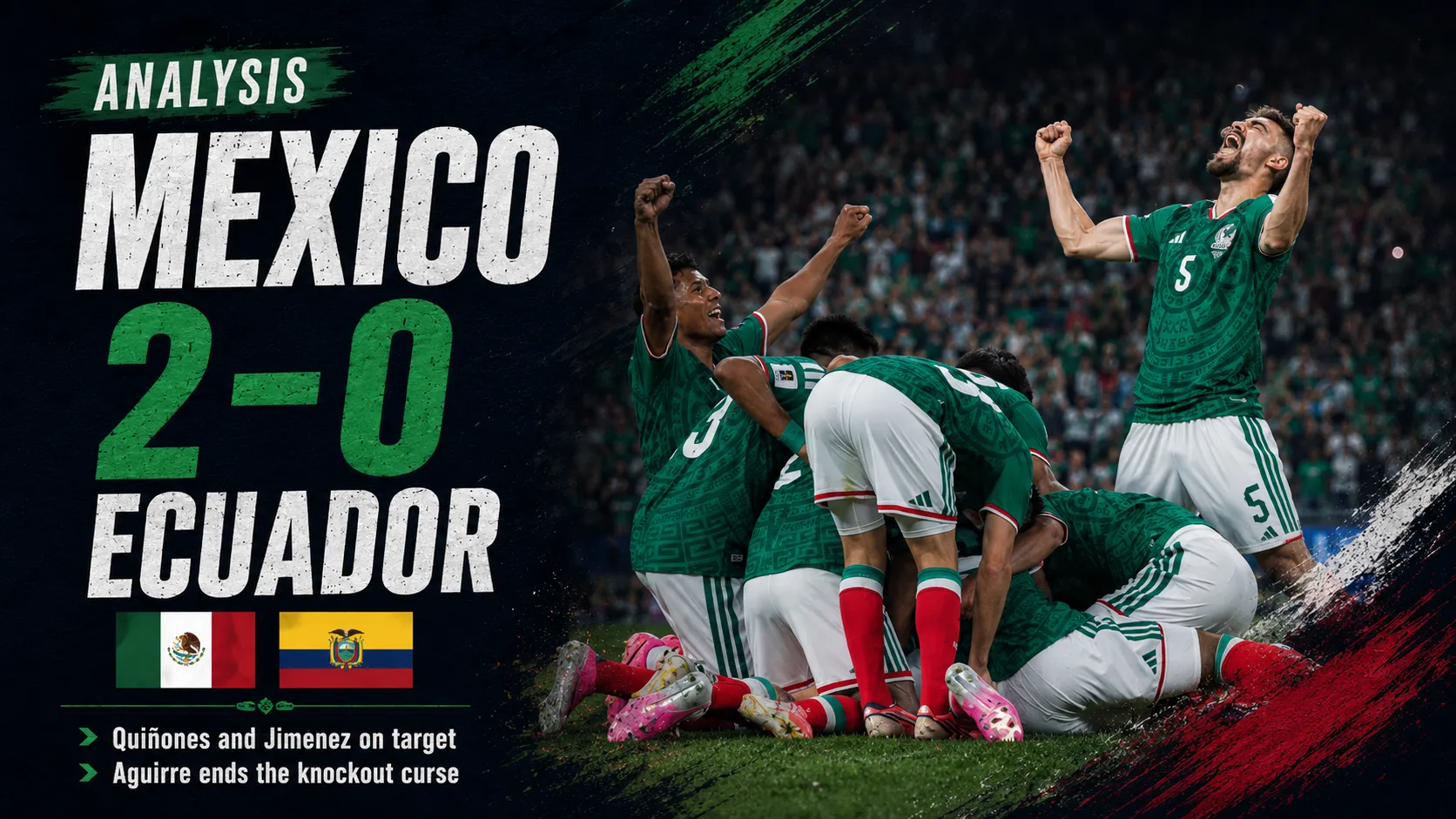
Match Result and Historical Significance: Mexico 2-0 Ecuador
Mexico’s 2-0 victory over Ecuador at the Estadio Azteca on 1 July 2026 ended decades of World Cup knockout-stage heartbreak for the host nation. The fixture, originally scheduled for 11:00 PM EAT according to the World Cup 2026 schedule in Kenya Time, suffered a one-hour postponement when lightning and torrential rain forced players from the pitch during warm-ups. Officials delayed kickoff until midnight EAT, testing the concentration of both squads, yet Mexico emerged from the locker room with renewed intensity that Ecuador struggled to match.
Julián Quiñones and Raúl Jiménez delivered the decisive first-half double that put the contest beyond Ecuador before halftime. Quiñones opened the scoring by capitalizing on defensive hesitancy forced by Mexico’s intense opening tempo, finishing clinically after a defensive error. Jiménez added a second strike that came from a swift transition, catching Ecuador’s disorganized backline and rewarding direct, crowd-fueled attacking play. Both goals exposed Ecuador’s high line, which struggled to reset after losing possession in dangerous areas.
The final whistle confirmed the end of Mexico’s World Cup knockout curse, marking their first progression in single-elimination play in decades. Piero Hincapié’s late dismissal for a reckless challenge encapsulated Ecuador’s mounting frustration as their comeback attempt faded, sealing a result that sends Mexico through while eliminating the South Americans.
Tactical Breakdown: Aguirre’s Game Management vs Ecuador’s Lost Momentum
Javier Aguirre engineered the victory through a clear strategic arc that shifted from high-intensity, crowd-fueled attacks to a disciplined, controlled second-half structure. The manager opened with direct, aggressive pressing designed to harness the Azteca atmosphere, forcing Ecuador into hurried clearances that created the early chances converted by Quiñones and Jiménez. Once the two-goal cushion was established, Aguirre transitioned to a more compact block where Gilberto Mora’s linking play between midfield and attack protected the lead, with Mora dropping deep to collect possession before driving forward to prevent Ecuador from establishing sustained pressure.
Ecuador arrived at the Azteca buoyed by their dramatic 2-1 comeback victory against Germany under Sebastián Beccacece, yet they could not reproduce that momentum once Mexico scored first. The aggressive approach that overwhelmed Germany faltered against Mexico’s compact central spacing after the opening goals, denying Ecuador the room to build the attacking rhythm necessary for a similar recovery. Beccacece’s decision to maintain an aggressive midfield press even while trailing left spaces behind the defensive line that Mexico exploited on the counter.
Observers must assess whether Mexico’s performance demonstrated genuine knockout maturity or if Ecuador’s tactical rigidity made the 2-0 margin appear more comprehensive than the underlying battle warranted. Aguirre’s ability to modulate intensity suggests a team capable of managing pressure, though the true test of this balance will come against opponents who possess the technical quality to exploit any second-half conservatism.
48-Team Format Impact and Round of 16 Pathway
The expanded 48-team tournament structure created this Round of 32 matchup by rewarding Mexico’s dominant Group A final standings performance while offering Ecuador a lifeline through the best third-placed teams route. Mexico topped Group A with a perfect record of nine points and a plus-six goal difference, having defeated South Africa, South Korea, and Czechia during the opening phase. Ecuador, conversely, qualified precariously with four points and a zero goal difference after losing to Ivory Coast, drawing Curaçao, and securing their memorable victory against Germany.
The brutal mathematics of single elimination replaced the recovery possibilities available during group play. Ecuador had no second match to correct their slow start against Mexico, despite proving their resilience in the comeback against Germany, while Mexico’s early efficiency was immediately rewarded with progression. The format’s expansion from 32 teams created additional pathways for qualification but could not protect third-placed qualifiers from the unforgiving nature of knockout football once the tournament reached this phase of the Round of 32 bracket.
Mexico now advance to face the winner of England vs DR Congo in the Round of 16, a fixture that will test whether Aguirre’s tactical flexibility signals genuine capability for deep tournament runs. The balance between attacking intent and defensive control shown against Ecuador suggests a squad growing into the pressures of knockout football, though vulnerabilities may yet emerge against stronger opposition capable of disrupting Mexico’s transitional phases.