
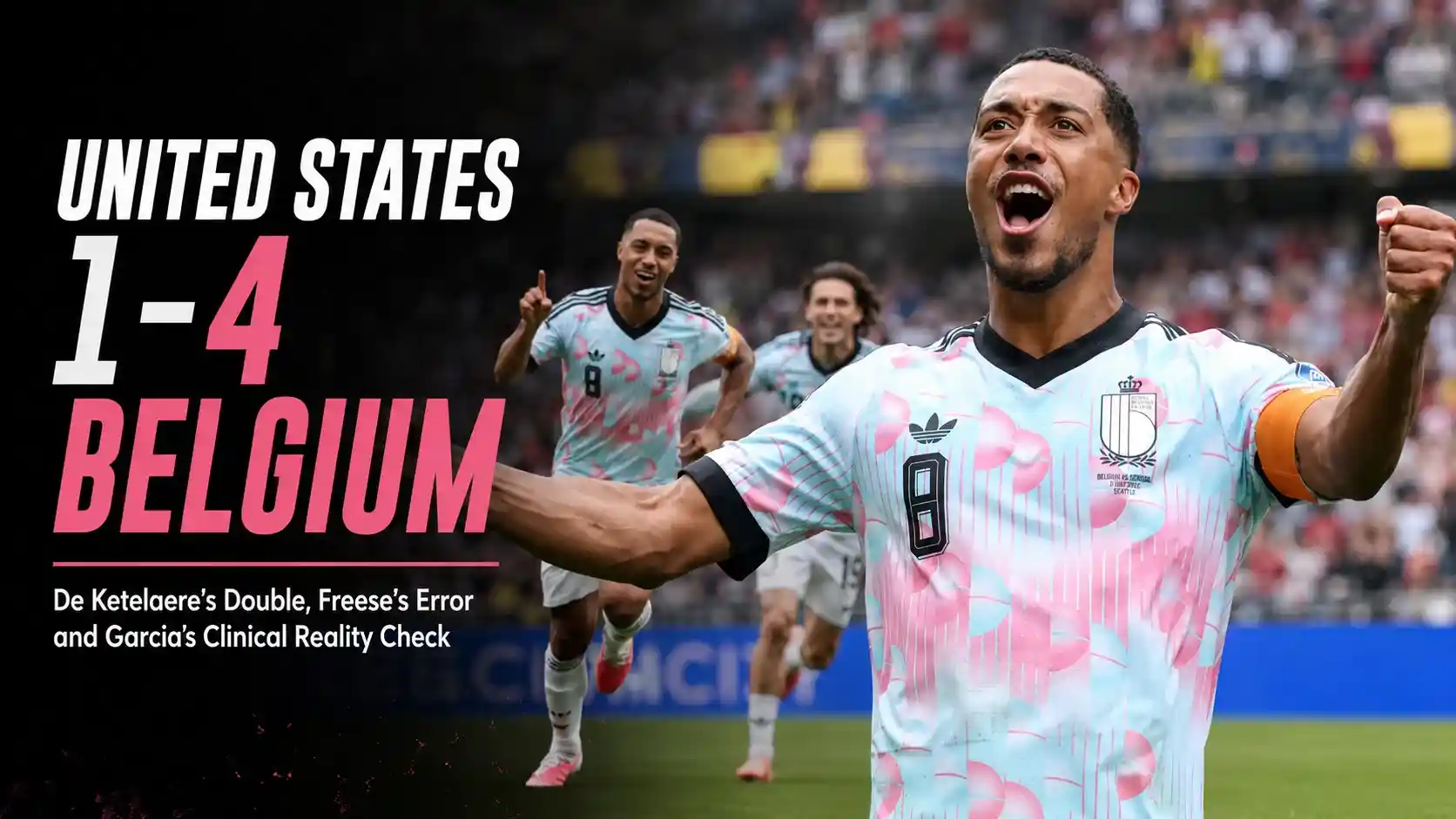
The Seattle Collapse: How Belgium Built a Commanding 4-1 Lead
Charles De Ketelaere’s clinical brace established Belgian dominance inside the first half-hour of this Round-of-16 encounter. The AC Milan forward opened the scoring in the 9th minute by exploiting the gap between Tyler Adams and the American backline, timing his run perfectly to meet a through ball and finish past Matt Freese. De Ketelaere doubled the advantage in the 33rd minute with similar precision around the penalty area, capitalising on the space created by Belgium’s quick interchanges to put the Red Devils 2-0 ahead.
Malik Tillman briefly reignited host-nation hopes with a deflected free-kick in the 31st minute that wrong-footed Belgian goalkeeper Koen Casteels. The Bayern Munich midfielder’s strike offered temporary relief to the Seattle crowd and cancelled out the early deficit, yet Belgium’s experienced squad responded within two minutes to restore the lead before half-time. This rapid re-establishment of control demonstrated the mental resilience that separates tournament veterans from developing sides.
Matt Freese’s costly error in the 57th minute effectively ended American resistance when the goalkeeper’s poor distribution gifted substitute Hans Vanaken an open goal from distance. The Philadelphia Union keeper’s misplaced pass under pressure allowed the Club Brugge midfielder to roll the ball into an empty net, extending the lead to 3-1. Romelu Lukaku added the fourth in stoppage time by capitalising on defensive exhaustion, bundling home from close range to confirm Belgium’s place in the Knockout Stage Guide against Spain.
Tactical Analysis: Garcia’s Compact Transition vs Pochettino’s High Tempo
Rudi Garcia organised Belgium into a compact 4-2-3-1 formation that morphed into a 4-3-3 during defensive phases, designed specifically to absorb American pressure and transition rapidly through the centre. De Ketelaere and substitute Hans Vanaken consistently found pockets of space behind Weston McKennie’s advanced positioning, exploiting the disconnect between the US midfield and defensive lines. This tactical discipline allowed Belgium to weather early storms before punishing the hosts with devastating efficiency on the counter-attack.
Mauricio Pochettino attempted to dictate the tempo through Christian Pulisic, Tyler Adams, and Malik Tillman, instructing his side to press high and maintain possession in the attacking third. The approach created several half-chances but left the backline exposed whenever Belgium broke the press, a vulnerability that the 10-man victory over Bosnia had successfully masked during the group stage. The lack of defensive security became apparent as the match progressed, with the American midfield unable to track Belgium’s late-arriving runners.
Folarin Balogun’s return to the starting lineup after the suspension controversy provided a focal point for American attacks but could not compensate for structural decision-making errors at the back. The Monaco striker held up play effectively and created space for Pulisic, yet the defensive gaps between the lines highlighted the difference between group-stage intensity and the ruthless efficiency required at the quarter-final level. Belgium’s experienced core punished every hesitation, demonstrating that individual attacking talent alone cannot overcome systemic tactical deficiencies in knockout football.
Quarter-Final Consequences and the Reality Check for American Soccer
Belgium’s advancement sets up a formidable quarter-final encounter against Spain in conditions that will test whether Garcia’s ageing but experienced squad can maintain their compact defensive shape against superior technical possession. The Red Devils must recover quickly from their draining 3-2 extra-time survival against Senegal, managing physical fatigue against a Spanish side that progressed with less expenditure. This matchup represents the ultimate examination of Belgium’s counter-attacking model against patient, high-quality buildup play.
Garcia’s squad arrived in Seattle battle-hardened from their gruelling extra-time victory against Senegal, possessing the competitive resilience that trumped the United States’ comfortable Group D progression. The Americans had secured six points and a plus-four goal difference by dominating possession against lesser opponents, yet this Round-of-16 elimination demonstrated that knockout experience proves more valuable than group-stage dominance. Belgium’s five-point Group G campaign required late desperation against Senegal, forging a mental toughness that the host nation lacked when facing adversity.
Pochettino’s defensive structure collapsed under sustained pressure, serving as a painful reminder that elite organisation remains non-negotiable at the quarter-final level regardless of individual attacking talent. Heavy defeats at this stage expose the developmental gap between American potential and tournament-winning requirements, with Christian Pulisic and Folarin Balogun unable to compensate for systemic errors against Belgium’s ruthless efficiency. Kenyan and East African fans following the tournament can observe through the FIFA World Cup Hub that knockout football punishes defensive hesitation mercilessly, particularly when preparing for quarter-final fixtures against elite opposition.