
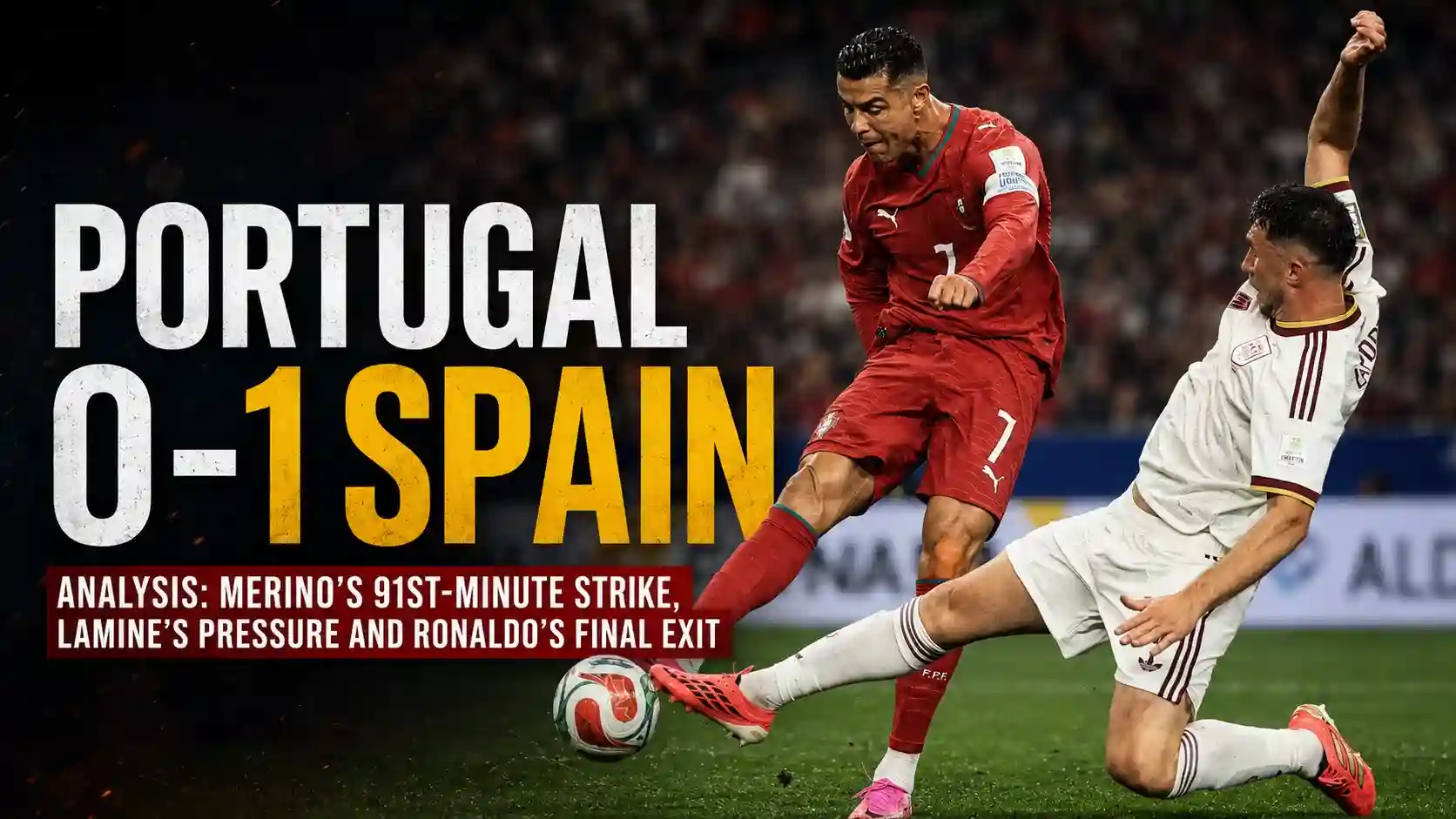
What Happened in Arlington: Spain’s Late Show Ends Portugal’s Campaign
Substitute Mikel Merino broke the deadlock in the 91st minute to send Spain into the quarter-finals and eliminate Portugal from the 2026 FIFA World Cup. The Real Sociedad midfielder entered the pitch in the 85th minute and required only six minutes to settle the tight Iberian derby, slotting home after Ferran Torres created the opening. Late goals have defined Spain’s knockout resilience, but this finish carried particular weight as it came against a Portuguese side that had resisted everything thrown at them for 90 minutes.
Goalkeepers dominated the narrative until Merino’s intervention. Diogo Costa produced a series of crucial stops to deny Lamine Yamal’s cutbacks and Alex Baena’s long-range efforts, positioning himself effectively to frustrate Spain’s intricate buildup play. Unai Simón matched his counterpart at the other end, rushing from his line to smother Cristiano Ronaldo when the Portuguese captain broke through the defensive line in the second half. Bernardo Silva’s stoppage-time chance that flashed across the face of goal represented Portugal’s final opportunity to force extra time, but the narrow miss confirmed Spain’s passage to the next round.
Portugal’s elimination ends their tournament journey following a Group K second-place finish and a 2-1 victory over Croatia in the Round of 32. The defeat confirms the end of Cristiano Ronaldo’s World Cup career, closing the international chapter for the all-time leading scorer without the global trophy that has eluded him. Portugal joins the list of eliminated teams while Spain progresses to face Belgium in the next round.
Tactical Analysis: De la Fuente’s Patience vs Martínez’s Counterattacking Gamble
Luis de la Fuente’s 4-2-3-1 system gradually overwhelmed Roberto Martínez’s reactive approach as Spain’s midfield control and superior bench depth proved decisive. Dani Olmo operated as the central attacking midfielder, drifting between Portugal’s defensive and midfield lines to create passing angles for overlapping full-backs. Pedri dictated tempo from a deeper position, recycling possession efficiently while screening the back four against Portugal’s sporadic counterattacks. Lamine Yamal maintained relentless pressure down the right flank, repeatedly driving at defenders and delivering crosses that forced Costa into action throughout the second half.
Portugal deployed a 4-2-3-1 shape that prioritized caution over control, with João Félix and Pedro Neto starting alongside Cristiano Ronaldo while Rafael Leão remained on the bench. Martínez’s tactical instruction shifted toward counterattacking football after halftime, ceding possession to Spain in exchange for sporadic transition opportunities. The approach generated moments of danger through Bernardo Silva’s movement between lines, but isolated the forward three from midfield support as Spain’s pressing structure recovered the ball quickly in advanced areas. Portugal’s inability to sustain attacks stemmed partly from the decision to start Leão on the bench, removing their primary outlet for relieving pressure.
Substitution patterns revealed the critical difference in squad depth available to each manager. De la Fuente’s decision to introduce Merino from midfield provided the fresh legs and attacking impetus that broke the deadlock, while Portugal’s static approach in the final third raised questions about whether earlier changes might have altered the momentum. Spain’s approach reflected the confidence of a side that won Group H with seven points and a plus-five goal difference before dispatching Austria 3-0 in the Round of 32. The narrow victory demonstrates Spain’s capacity to find solutions through squad rotation, though the reliance on a 91st-minute winner against a reactive opponent suggests potential vulnerabilities against more proactive quarter-final opposition.
Road Ahead: Quarter-Final Consequences and Kenya Viewing Context
Spain will face Belgium in the quarter-finals while Portugal’s elimination closes the chapter on Cristiano Ronaldo’s World Cup career and demands analysis of Martínez’s conservative tactical choices. The Belgium matchup presents a different challenge to the Iberian derby, with Kevin De Bruyne and Romelu Lukaku offering more aggressive pressing and varied attacking threats than Portugal’s withdrawn approach. Spanish defenders will need to maintain the concentration levels shown against Ronaldo when facing Belgium’s intricate passing combinations in the final third. Victory against Belgium would set up a potential semi-final appearance, placing Spain on a trajectory that tests their ability to break down organized defenses without requiring last-minute interventions.
Portugal’s exit stems from tactical decisions that prioritized containment over initiative, particularly the choice to start Leão on the bench and the inability to replicate the intensity shown in their Round-of-32 victory against Croatia. Finishing second in Group K with five points forced Portugal into a tougher bracket path, and the conservative mindset against Spain ultimately failed to protect their goal despite 90 minutes of resistance. Martínez’s tenure will face scrutiny regarding whether Portugal possessed the attacking ambition required to compete for the title, or whether the squad’s generational transition away from Ronaldo’s era requires a more radical tactical reset before the next international tournament cycle.
Kenyan fans can follow the remaining knockout fixtures through Pulser’s FIFA Hub, which provides kick-off times in East Africa Time (UTC+3) and bracket updates as the tournament progresses. Spain’s progression to face Belgium represents the only remaining Iberian presence in the competition, while Portugal’s departure removes one of the pre-tournament favorites from the list of contenders. The quarter-final schedule will test Spain’s ability to maintain their late-game efficiency against opponents who will likely force more open encounters than the stalemate witnessed in Arlington. Fans should consult the knockout bracket to track potential semi-final opponents as the 48-team tournament enters its decisive phase.