
How FIFA Assigned the Eight Third-Placed Teams
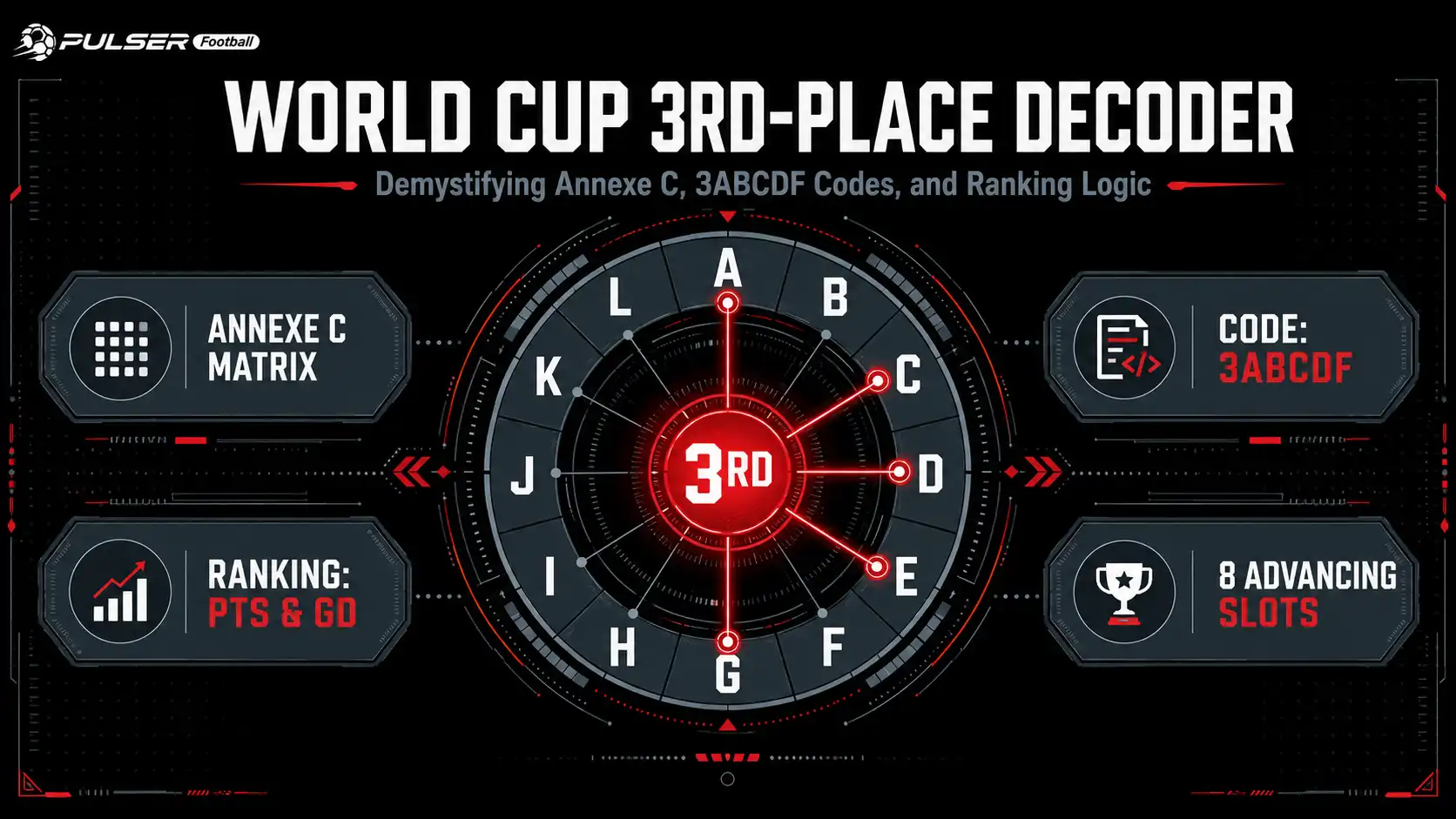
The assignment mechanism relied entirely on Annexe C, a comprehensive allocation table that FIFA published prior to the tournament kickoff. This document contained a complete mapping of every possible permutation where eight third-place finishers could emerge from the twelve total groups. Each potential combination corresponded to a specific row in the matrix, with columns designating exact Round-of-32 fixture slots.
Final group standings triggered the automatic activation of one specific Annexe C pathway. The precise set of eight groups that yielded third-place qualifiers determined which row became operative, instantly locking each qualifying team into a predetermined bracket position. Mathematical certainty replaced manual selection, as the intersection of group letters and final standings dictated assignments without human intervention.
Delegations possessed no authority to influence their knockout destinations. Football associations could not request favorable matchups, lobby for specific kickoff times, or participate in any selection ceremony. The matrix eliminated agency from the process, ensuring that competitive results alone determined every Round-of-32 pairing involving third-place teams.
The Annexe C Matrix and Real-World Allocation
The matrix architecture managed the statistical complexity of 495 theoretical combinations, representing every possible way eight third-place teams could emerge from twelve groups. Rather than requiring a new draw for each scenario, Annexe C compressed these possibilities into a single activated pathway that matched the actual group-stage outcomes. This design preserved bracket integrity while eliminating procedural delays between the final group matches and the knockout announcement.
Specific group origins dictated specific opponent assignments through fixed routing rules. The Annexe C documentation routes a third-placed qualifier from Group D to confront the winner of Group H, while a third-place team emerging from Group K receives an automatic assignment against the runner-up from Group F. These predetermined mappings ensure that no two third-place teams from adjacent groups collide in the opening knockout round, maintaining the structural balance established before the tournament began.
Geographic and seeding distributions followed strict protocols embedded within the matrix. The allocation system scattered third-place teams across opposite halves of the bracket according to fixed algorithms, preventing scenarios where multiple teams from the same confederation or similar competitive tiers cluster in one section. This dispersion mechanism upheld the competitive integrity of the knockout phase while respecting the tournament’s geographic diversity requirements.
Viewing the Completed Bracket and Kenya-Time Schedule
The finalized Annexe C allocation populated the knockout bracket with concrete, non-negotiable matchups. The World Cup 2026 Round of 32 bracket now displays exactly which third-place qualifier faces which group winner or runner-up, transforming the abstract matrix into visible knockout fixtures.
Kenyan supporters can access the full World Cup 2026 schedule in Kenya Time to view all resulting Round-of-32 fixtures. Pulser displays every kickoff in East Africa Time (EAT, UTC+3) without daylight saving adjustments, ensuring accurate local planning for supporters in Nairobi, Mombasa, Kisumu, and across the East Africa region.
The FIFA hub provides broader tournament context and navigation to group-specific pages for readers seeking additional details about the teams occupying these allocated slots. Fans requiring granular match information should consult the dedicated schedule page, which updates automatically as the bracket progresses through the knockout stages.
FAQ
Did the third-placed teams get to choose their Round-of-32 opponents?
No. Opponents were assigned automatically by the Annexe C matrix based on which groups the third-place teams qualified from. No selection process or preference was permitted.
Was there a separate draw for the third-placed teams after the group stage?
No. FIFA did not hold a new knockout draw. The allocation was predetermined by the Annexe C table activated by the final group-stage results.
How many possible bracket combinations existed for the third-placed teams?
While 495 theoretical combinations were possible in the Annexe C matrix, only the single combination that matched the actual group-stage results determined the final bracket assignments.
Reference
- FIFA World Cup 2026™ Knockout Stage Match Schedule and Bracket
- What Is the Format for the FIFA World Cup 2026 Tournament?
- Annexe C — Combinations for Eight Best Third-Placed Teams
- Africa Sends Record 10 Teams into World Cup as 2026 Tournament Begins
- Africa’s Nine World Cup Survivors Learn Round of 32 Opponents