
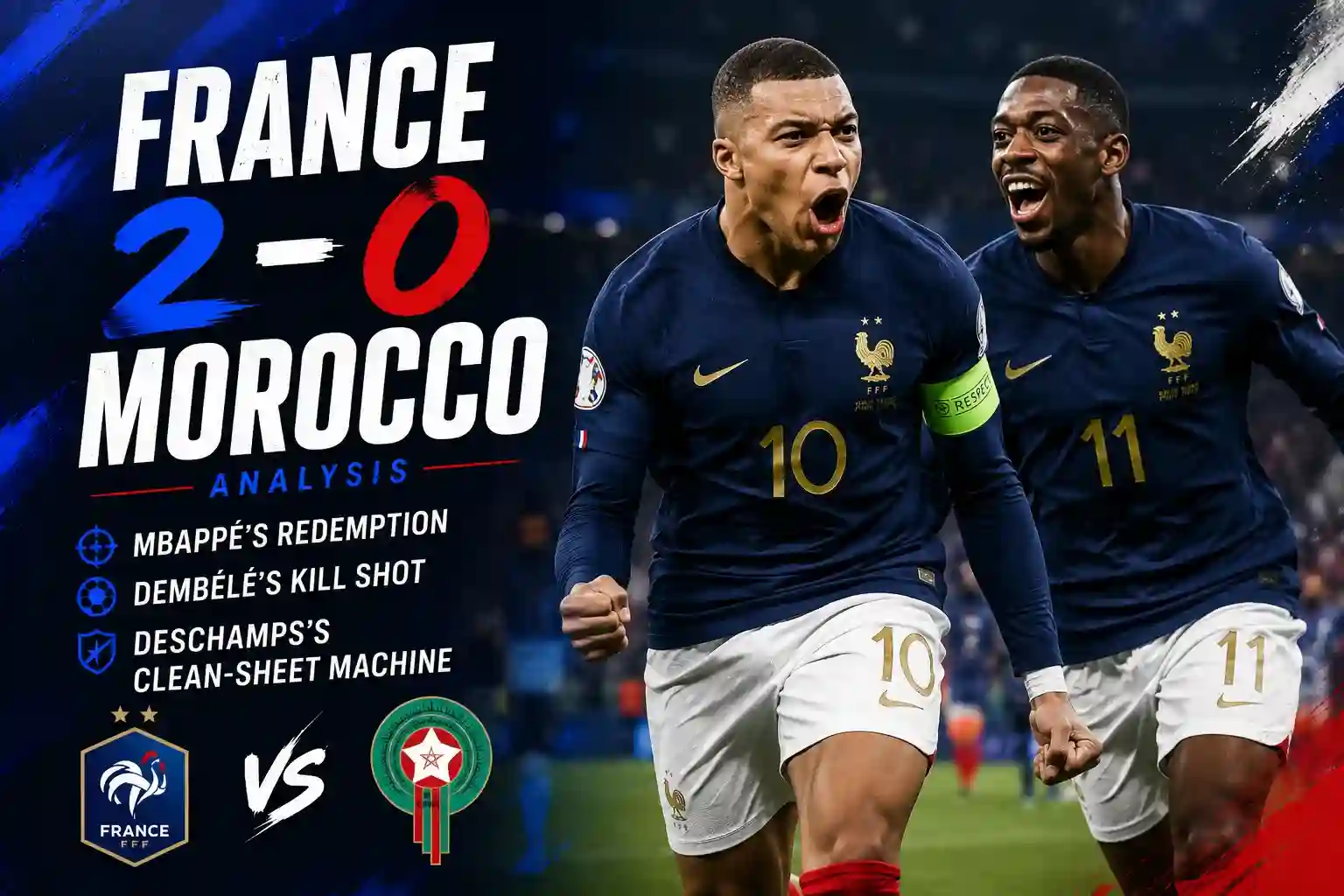
Match Summary: How France Secured a 2-0 Quarter-Final Victory Over Morocco in Foxborough
France overcame a first-half penalty miss and Moroccan resilience at Gillette Stadium by scoring twice in six minutes after the hour mark, with Kylian Mbappé and Ousmane Dembélé delivering the decisive blows that ended Morocco’s tournament and preserved Les Bleus’ perfect knockout record.
Kylian Mbappé’s redemption arc defined the contest after Yassine Bounou denied the French captain from the spot in the 28th minute. The Moroccan goalkeeper’s save briefly threatened to turn the tide, but Mbappé maintained his positional discipline on the left flank and eventually curled a precise finish inside the box in the 60th minute, demonstrating the mental resilience required to break through a stubborn defensive block after the early setback.
Ousmane Dembélé’s 66th-minute strike served as the kill shot that extinguished Moroccan hopes, arriving just six minutes after the opener. The Barcelona winger exploited the defensive space opened by Mbappé’s earlier runs, receiving the ball in a pocket of uncertainty between the Moroccan lines and firing home to make the result mathematically certain before the final quarter of the match.
Didier Deschamps’s clean-sheet machine maintained its tournament-long operation, with the French back four protecting the lead with the same defensive discipline shown during the 1-0 Round of 16 victory over Paraguay. The unit maintained its shape against Morocco’s limited counter-attacks, cutting off passing lanes into the channels and ensuring the opposition failed to register meaningful attempts from open play in the first half, marking another knockout fixture where Les Bleus prevented any breakthrough.
Tactical Breakdown: France’s Hybrid Control vs Morocco’s Compact Block
Deschamps organized France in a hybrid 4-2-3-1 and 4-3-3 shape that utilized Mbappé as a left-sided gravity point to draw defenders, while Mohamed Ouahbi’s Morocco retreated into a compact defensive block designed to neutralize French speed but which ultimately isolated Brahim Díaz as a lone attacking outlet. Readers tracking the evolution from the 48-team group phase can reference the FIFA World Cup 2026 teams and groups page for context on how France and Morocco navigated their respective paths to this quarter-final collision.
France’s midfield structure relied on a double pivot shielding the defense while Michael Olise operated as the primary link between the midfield base and the front line. The Crystal Palace midfielder drifted into half-spaces to combine with Mbappé’s diagonal runs, creating the overloads that eventually stretched Morocco’s back five and generated the scoring opportunities in the second half.
Morocco’s compact defensive strategy under Ouahbi prioritized horizontal density over vertical progression, a logical approach given France’s devastating pace in wide areas. However, the tactical choice left Brahim Díaz stranded as the sole creative presence in advanced positions, with the playmaker forced to drop deep to receive possession and lacking the supporting runners to sustain attacks. The absence of Ismael Saibari’s freshness and invention in progression proved costly, as the midfield lacked the energy to transition quickly from defense to attack when rare turnovers were won.
Bounou’s penalty save served only as a delay rather than a turning point because France’s tactical patience and superior knockout management prevented Morocco from building any first-half momentum. The Atlas Lions registered almost no early shot threat and failed to test the French goalkeeper with meaningful attempts from open play, meaning the psychological boost of the save dissipated as Deschamps’ side maintained possession control and continued probing the defensive block until the decisive breakthrough arrived.
Semi-Final Implications: France vs Spain and Questions for Deschamps
The semi-final clash with Spain will determine whether France’s resilience against Morocco proves they are the tournament’s most complete side, or if their reliance on a brief scoring burst exposes tactical vulnerabilities against technically superior opposition. While the ability to survive a missed penalty and maintain control demonstrates mental fortitude, the narrow window of scoring against a compact block suggests that Deschamps may need alternative solutions if Spain’s midfield dominates possession and limits the transition opportunities that France exploited against Morocco.
The contrast between France’s progression through Paraguay and Morocco versus Spain’s own path highlights a potential stylistic clash in the last four. France has demonstrated efficiency and defensive solidity, but the semi-final opponent will present a fundamentally different challenge that tests whether Deschamps’ pragmatic approach can overcome Spain’s midfield possession dominance without requiring another explosive scoring window.
Morocco’s halted momentum after defeating Canada 3-0 in the Round of 16 illustrates the different pressures of knockout football compared to France’s steady accumulation of control. The African side arrived with continental momentum but discovered that knockout progression against elite opposition requires more than defensive resilience; it demands the clinical execution that France displayed during their decisive six-minute spell.
Kenyan and East African viewers preparing for the France vs Spain semi-final should consult the 2026 FIFA World Cup schedule in Kenya Time to confirm kick-off times in East Africa Time (EAT). The elimination of Morocco leaves no African representation in the final stages, redirecting regional attention toward the tactical nuances of the European heavyweight clash and the question of whether Deschamps can navigate one more hurdle to reach the final.